University groups, multi-campus universities & education trusts in India are outgrowing ERP systems built for a single institution. Admissions data sits in one system, exam records in another. Consolidated financial reporting depends on someone in the group office pulling numbers together by hand every month.
As a trust adds campuses, schools of study or constituent colleges, this fragmentation becomes the real constraint on growth. It's not student numbers or faculty strength, but the absence of one system that can see across all of them at once. A platform that works well for a single college often breaks down the moment a second or third campus joins the group.
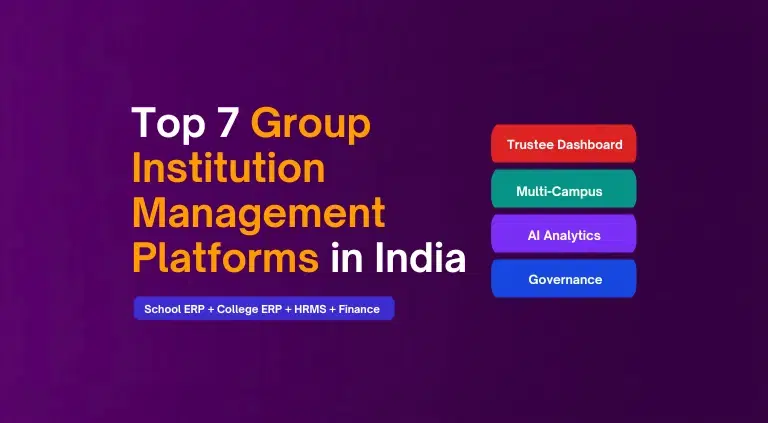
This is why choosing the right ERP for a university group is a fundamentally different decision from choosing one for a standalone institution. To help trustees, chancellors, and academic & finance heads cut through the noise, here are the top 7 ERP platforms evaluated for university groups in India.
TL;DR
Running a university group across multiple campuses means standardising 10 core areas. These are admissions, attendance, examinations, parent communication, finance & trust accounting, approval chains & budget vs actual reporting, trustee dashboards, HR & payroll, NAAC/NBA/UGC compliance, and campus-level governance.
Every additional campus multiplies the admission cycles, exam schedules, fee ledgers, staff records and compliance filings that the group office has to track separately. This keeps happening unless the group moves to one connected system.
The most effective way to manage all 10 areas at once is through a purpose-built group operating system for university groups. edumerge is an integrated platform that connects governance, finance, HR and academics in a single system. Giving trustees & academic heads real-time visibility across every campus instead of monthly manual consolidation.
What is a University Group ERP, and Why it Matters for Multi-Campus Institutions
A university group ERP is a single software platform. It runs the academic, administrative, financial and governance operations of every campus, school or constituent college under one trust, society or holding structure.
A traditional university ERP is built for one campus. A university group ERP is different. It adds a governance layer above the campus level. This includes consolidated financial statements, group wide policy enforcement, and a leadership dashboard that shows every entity at once.
- Academic, financial and administrative data live in separate systems per campus. So leadership sees last month's numbers, not this week's.
- Manual consolidation at month end delays trustee reporting. This increases the risk of errors reaching the board.
- Every additional campus multiplies the number of disconnected tools, spreadsheets and approval chains the group office has to reconcile.
- Compliance and accreditation documentation for NAAC, NBA & UGC returns becomes harder to assemble consistently when each constituent college tracks data differently.
- Group wide policy, such as a common fee structure, HR grade or approval chain, cannot be enforced consistently across campuses without a shared platform.
- A group expanding from 3-10 campuses on disconnected systems adds administrative complexity faster than it adds students.
For a closer look at how growing institutions handle this in practice, read how multi-campus educational institutions scale operations.
Common Mistakes Universities Make While Buying ERP
Most ERP evaluations for groups of institutions go wrong in predictable ways. The table below maps the mistake to what it actually costs the group after go-live.
| Mistake Overlooked | Downstream Impact |
|---|---|
| Buying a single-campus ERP and deploying it separately per campus | The group office ends up managing several separate databases instead of one; consolidation still happens by hand. |
| Evaluating only academic features and treating finance and governance as an afterthought | Trustees are left without Budget vs Actual visibility or a Trustee dashboard after go-live. |
| Choosing a generic corporate system not built for Indian education compliance | NAAC, NBA and UGC-specific workflows require heavy custom development, adding cost and delay. |
| Centralising everything and ignoring campus-level autonomy | Individual campuses resist adoption because day to day academic decisions get routed through the group office. |
| Testing only single-module demos instead of cross-module workflows | Post go-live, data does not flow between admissions, fees and HR, and manual re-entry continues. |
| Underestimating implementation and change management effort across many campuses | Rollout stalls at a handful of campuses while others continue on old systems, defeating the purpose of a group platform. |
| Overlooking trust and society accounting requirements specific to Indian education groups | Fund flows between the trust and its institutions stay outside the system, so consolidated statutory reporting is still manual. |
Mandatory Features Every University Group ERP Must Have
Group-Wide Governance & Campus-Level Autonomy
- Central policy control for fee structures, approval chains & HR grades, set once and applied across every campus.
- Individual campuses retain day to day operational control over admissions, timetables and academic scheduling.
- Role-based access, so a principal sees their campus while a trustee sees the whole group.
Unified Academic Management Across Campuses
- A common admissions, attendance & examination structure that works the same way at every campus in the group.
- A single student information system that follows the student across programmes & institutions within the group.
- Standardised report cards and transcripts regardless of which campus issues them.
Consolidated Finance & Trust Accounting
- Society-to-School (S2S) fund flow tracking between the trust or society and its institutions.
- Budget vs actual reporting available at both campus and group level.
- A defined approval chain for every financial transaction, from purchase order to expense claim.
A Real-Time Trustee and Leadership Dashboard
- Group wide KPIs such as enrolment, fee recovery & staff strength, visible without waiting for a monthly report.
- Drill-down from group level into any individual campus without switching systems.
- A trend view so leadership can compare performance across terms & years, not just the current snapshot.
HR and Staff Management Across Entities
- A single staff record that follows an employee if they move between campuses in the group.
- Payroll & statutory compliance is handled consistently across every entity.
- Group wide workforce data to support hiring and workload planning.
Compliance and Accreditation Readiness
- Structured data capture that supports NAAC, NBA and UGC documentation without a separate manual exercise each cycle.
- Audit trails on financial & academic transactions for internal governance and external scrutiny.
- Consistent data definitions across campuses, so accreditation reports aggregate cleanly at the group level.
Cloud Architecture and Scalability
- No on-premise servers required per campus; new campuses are added to the existing platform rather than a fresh deployment.
- Access from any device, so trustees & academic heads are not tied to a specific campus location.
- A platform that works the same way for a 3-campus group today and a much larger network after years of growth.
Top 7 ERP Platforms for University Groups in India
1. edumergeOS
edumergeOS is a university group ERP built with native multi-campus support. It runs academics, HR, and finance across every institution in a trust or society from one shared platform. So a new campus joins the existing system rather than needing a separate deployment.
It brings School ERP, College ERP, HRMS and Finance & Control together on a single data layer. Giving trustees group-wide governance and real-time visibility while every campus keeps full operational control over its own admissions, timetables, and academic decisions.
- Academic & Operations Fit Across Campuses: Admissions, attendance, examinations and parent communication run on one student information system shared by every campus in the university group, with a common academic data model from day one.
- Financial Governance & Trustee Oversight: S2S workflow, approval chains, budget vs actual, and a trustee dashboard give the university group's central office one place to see spending and approvals across every constituent institution.
- Group-level Visibility (Command Center): A GOI command center gives trustees & university group leadership a single, live view across every institution's academics, HR, and finance.
- Compliance & Indian Regulatory Fit: Built around Indian academic and regulatory structures from the outset.
What to Note: Accreditation automation (NAAC/NBA/NIRF) runs on the same shared academic data model as admissions, attendance and examinations, so it's best evaluated as part of the unified edumergeOS layer rather than as a standalone module.
2. Mastersoft ERP
- Academic & Operations Fit Across Campuses: Deep, mature module coverage for admissions, attendance and examinations, with a long track record at individual universities and colleges, including large public universities.
- Financial Governance & Trustee Oversight: Finance handled as a general accounting add-on rather than a university-group-governance-first design.
- Group-level Visibility (Command Center): No native view across a university group; each constituent institution typically runs its own instance.
- Compliance & Indian Regulatory Fit: Strong, mature compliance and accreditation depth at the individual university or college level.
You may also find this comparison on edumerge vs MasterSoft helpful.
3. Camu
- Academic & Operations Fit Across Campuses: Strong SIS combined with a mature LMS and mobile-first design; supports multiple campuses being deployed on it, though each typically operates as its own instance rather than a unified university group.
- Financial Governance & Trustee Oversight: Financial governance is partial; not designed around trustee-level oversight across a university group's constituent institutions.
- Group-level Visibility (Command Center): No native command layer across a university group.
- Compliance & Indian Regulatory Fit: Partial compliance depth; strength lies more in academic delivery than regulatory reporting.
Explore edumerge vs Camu for a detailed, feature-by-feature look at how the two compare.
4. Digiicampus (CollPoll)
- Academic & Operations Fit Across Campuses: Engagement-led academic and operational workflows, strong on communication across students, faculty, alumni and parents at the individual institution level.
- Financial Governance & Trustee Oversight: Limited financial governance; typically paired with a separate finance system.
- Group-level Visibility (Command Center): No native view across a university group's constituent institutions.
- Compliance & Indian Regulatory Fit: Partial compliance coverage.
5. Contineo
- Academic & Operations Fit Across Campuses: Strong on examinations and admissions, particularly for institutions pursuing academic autonomy; track record concentrated among individual colleges rather than university groups.
- Financial Governance & Trustee Oversight: Limited financial governance capability.
- Group-level Visibility (Command Center): No native view across a university group.
- Compliance & Indian Regulatory Fit: Strong, specialized accreditation and autonomy-readiness capability, with particular depth among VTU-affiliated institutions.
6. Heraizen DHI
- Academic & Operations Fit Across Campuses: Strong for engineering colleges specifically; less proven across arts, commerce, medical or law faculties, or across a mixed-faculty university group.
- Financial Governance & Trustee Oversight: Limited financial governance capability.
- Group-level Visibility (Command Center): No native view across a university group.
- Compliance & Indian Regulatory Fit: Strong, AI-driven accreditation automation.
7. Ellucian (Banner/Colleague)
- Academic & Operations Fit Across Campuses: Enterprise-grade academic and operational modules, proven at scale internationally, but requires heavy configuration to fit Indian academic calendars and workflows.
- Financial Governance & Trustee Oversight: Enterprise-grade financial governance, though built for global corporate structures rather than Indian trust or society norms that govern most Indian university groups.
- Group-level Visibility (Command Center): Multi-entity reporting exists but is not designed around the India-specific university-group or GOI hierarchy.
- Compliance & Indian Regulatory Fit: Not built around UGC, AICTE, NAAC, or CBCS by default; requires a dedicated localization project.
Explore more on this in our comparison between edumerge vs Ellucian Banner.
How to Evaluate the Right ERP for a University Group
Run every platform under consideration through the same checklist, in the same order, so comparisons stay fair across vendors.
- Does the platform run academics, HR & finance on one data layer, or are these separate systems connected by integration?
- Can the group office see consolidated data across all campuses in real time, without a manual reporting cycle?
- Does each campus retain operational autonomy over admissions, timetables and day to day academic decisions?
- Does the finance module support S2S fund flow, an approval chain, budget vs actual reporting and a trustee dashboard?
- Is the platform built around Indian trust and society accounting structures, or does it need custom development to support them?
- Does a single staff record follow an employee if they move between campuses within the group, with payroll and statutory compliance handled consistently across entities?
- Does the vendor have implementation experience specifically with university groups, not only single campuses?
- Can a new campus be added to the existing platform using the group's existing configuration, without a fresh deployment project?
- Does the system support NAAC, NBA and UGC-related documentation without a separate manual data-gathering exercise each cycle?
- What is the vendor's support model once a university group is live across multiple campuses?
- Is pricing structured to scale predictably as the group adds campuses?
University groups looking to widen the comparison further can also explore the 10 best erp for groups of institutions in India.
Conclusion
Choosing an ERP for university groups in India is a governance decision as much as a technology one. The right platform gives trustees consolidated visibility, gives academic heads the tools to run each campus well, and gives the group room to grow without adding a new system for every new campus.
edumerge is trusted by over 800 educational institutions managing more than 500,000 students across India, running School ERP, College ERP, HRMS and Finance & Control together on one platform built for groups from the ground up.
If your institution is evaluating ERP for university groups in India, explore edumergeOS to see how this approach applies to your group.
Frequently Asked Questions (FAQs)
1. What is the difference between a university group ERP and a standard university ERP?
A standard university ERP manages one institution end to end. A university group ERP adds a governance layer that consolidates data, enforces group wide policy, and gives the trust or society office a single view across every campus.
2. What is the Society-to-School (S2S) workflow in an education ERP?
S2S workflow tracks fund flow between the trust or society and the individual institutions it manages, so inter-entity transactions are recorded and reconciled in the system instead of being tracked manually.
3. Is cloud-based ERP suitable for university groups in India?
Yes. Cloud-based ERP removes the need for on-premise servers at every campus, gives leadership access from any device, and lets the group add campuses without provisioning new hardware.
4. Do all campuses in a group need to use the same ERP modules?
Not every feature needs to be identical, but core academic, finance and HR data should sit on the same platform so the group office can consolidate and compare campuses on the same basis.
5. How does a university group ERP support NAAC and NBA accreditation?
By capturing academic, administrative and financial data in a consistent structure across campuses, so the documentation required for NAAC, NBA and UGC returns can be assembled from the system rather than compiled manually each cycle.
6. Can a university group ERP scale from a few campuses to fifty or more?
A platform architected for groups from day one uses the same data model and governance approach whether the group runs 3 campuses or more than 50, so growth does not require a new system per campus.