For years, the report card has followed the same pattern where the subjects are listed down one side, marks are written on the other, and a grade or rank sits at the bottom. If you ask any parent what they remember from their child's report card, their answer is usually a number such as a percentage, a grade or a rank in class.
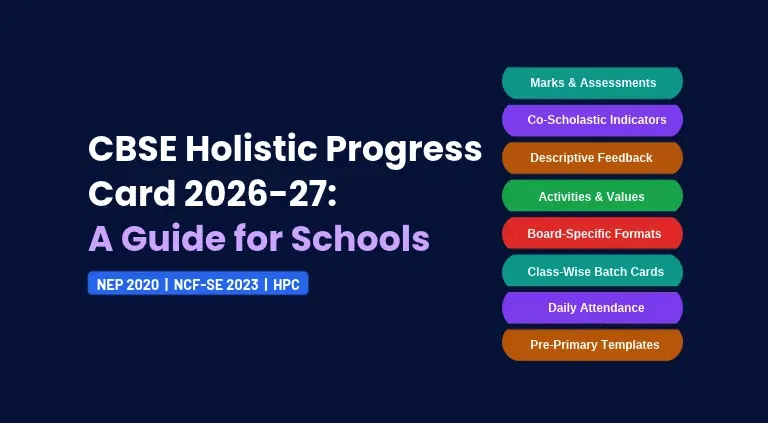
The CBSE holistic progress card (HPC) 2026-27 is designed to change that. Instead of marks alone, it records each student's progress across academics, skills & personal growth, as recommended in paragraph 4.35 of NEP 2020. From the 2026-27 session, CBSE requires schools to implement it as part of the curriculum.
In this blog, you'll learn what the HPC requires in 2026-27, and why every card depends on the records your school keeps each day.
TL;DR
The HPC replaces a marks-only report card with a fuller picture of each student's progress, based on competencies and individual growth.
Its quality depends on the information behind it. Observations, activities and assessments recorded from memory at term-end produce cards that are vague and incomplete.
edumerge School ERP captures marks, co-scholastic indicators, descriptive feedback and activities in one system, so progress cards draw on records kept throughout the year.
What is the CBSE Holistic Progress Card for 2026-27?
The CBSE Holistic Progress Card is the report card CBSE requires schools to use in 2026-27. It records each student's progress across academic and personal development, based on competencies rather than marks alone. It comes from NEP 2020 and is shaped by the National Curriculum Framework for School Education 2023 (NCF-SE 2023).
Also what makes the HPC different is who it is written for. While a traditional report card mainly tells teachers how a student scored, the HPC is designed to give families a clear and detailed understanding of their child's progress.
It plays a major role in explaining how a child is progressing, where they are strong and where they may require extra support.
Alongside the HPC, CBSE has introduced a third language in Class 6 from 2026-27. To see what schools need to put in place this session, read our three language formula 2026-27: CBSE R3 guide for schools.
What Changes for CBSE Schools With the HPC in 2026-27?
For many CBSE schools, the HPC is more than a new report card format. It changes how progress is measured and recorded across the whole school year.
For school leadership, this means looking closely at how assessment information is gathered, well before the cards are due. Here are the key changes schools need to know for the 2026-27 session.
- HPCs become a formal link with families. CBSE's 2026-27 curriculum states that schools are required to implement HPCs as formal communication tools between schools and families.
- The focus moves to individual progress. HPCs should focus on each student's progress and interests, with reporting designed to avoid comparisons with peers.
- CBSE provides prototypes for the early stages. CBSE has published detailed guidelines and prototypes for the foundational and preparatory stages. For its foundational card, CBSE says schools may adopt or adapt the format.
- PARAKH covers every stage. PARAKH, under NCERT, has developed HPCs for all 4 stages, from foundational to secondary.
- Portfolios carry more weight. The Portfolio now makes up 25% of internal assessment and is designed to reflect the HPC's approach to assessment.
The table below shows how the HPC differs from a traditional report card.
| Aspect | Traditional report card | Holistic Progress Card |
|---|---|---|
| What it measures | Marks and grades in each subject | Progress across cognitive, affective, socio-emotional and psychomotor domains |
| How progress is judged | Often against other students, through ranks and averages | Against the student's own progress, avoiding comparisons with peers |
| How it is written | Mostly numbers and grades | Descriptive and competency-based, alongside grades |
| Who contributes | Mainly the teacher | The teacher, with NEP 2020 also calling for self-assessment and peer assessment |
| Its purpose | Reporting results at the end of a term | A formal link between school and family on how to support each child |
For school groups introducing HPC across several campuses, our guide on NEP implementation across multiple schools explains how to set one HPC format centrally.
Why is an HPC Only as Good as the Data Behind It?
An HPC promises a detailed, personal picture of every student. Whether it delivers on that promise depends on one thing: the information teachers have in front of them when they fill it in.
In many schools, 6 common gaps weaken the card before it is even written. Each gap mentioned below has a clear cause, and each one of it affects the card that finally reaches families.
1. Observations are recalled from memory
Why it happens: Teachers rarely have a simple way to note observations during busy school days, so comments are written at term-end.
The effect: The card reflects what the teacher remembers from the last few weeks, not the student's progress across the whole term.
2. Co-scholastic and descriptive sections stay blank or generic
Why it happens: There is no record of a student's activities, attitudes or values to draw from.
The effect: The same phrases appear on card after card, and families learn little about their own child.
3. Activity and project records are scattered
Why it happens: Notes on activities and projects sit on paper, in personal files or with different teachers.
The effect: Achievements go missing from the card, and students who contributed most may receive the least recognition.
4. Assessment results are spread across registers
Why it happens: Each test is recorded separately, often by different teachers in different formats.
The effect: It becomes hard to see whether a student is improving over time, which is exactly what the HPC is meant to show.
5. Attendance is not connected to progress
Why it happens: Attendance is kept in one place and assessment records in another.
The effect: A drop in performance may be judged as a learning problem when the real cause is missed classes, leading to the wrong kind of support.
6. Teachers lose days to compiling cards
Why it happens: Information has to be gathered from many sources just before results are due.
The effect: Teaching time is lost, and the rush leaves little room for the careful, personal comments the HPC depends on.
Compiling cards at the last minute adds to the pressure teachers already face, especially as new subjects like the third language increase their weekly periods.
Our guide on language teacher workload allocation explains how schools can keep teacher workloads fair.
How Daily Records Build a Meaningful Holistic Progress Card
An HPC is only as reliable as the evidence behind each line on it where every comment, grade and observation should reflect something that actually happened during the term.
Without that evidence, even a well-designed card turns into a set of general statements that could describe almost any student. Here is why keeping daily records makes all the difference:
- Every comment should be based on something real. If the card says a student works well in a team, there should be examples of group work to support it. Similarly, if it says a student has grown in confidence, there should be a record of how they changed during the term.
- The information is already available. Schools already gather it every day through attendance, classroom tests, activities and projects.
- Records should be made as things happen. Small moments are easily forgotten, so they need to be noted at the time, not months later.
Furthermore, the table below shows which daily records support each part of the HPC, and why recording them every day makes a difference. It also works as a quick check for school leaders.
If any of these records isn't being kept regularly today, that part of the card is likely to be weak when results are due.
| Daily record | Part of the HPC it supports | Why recording it daily matters |
|---|---|---|
| Attendance | Shows regularity and gives context to a student's progress | Gaps in attendance explain gaps in learning only if they are recorded as they happen |
| Classroom assessments | Track progress on competencies and learning outcomes | Regular results show growth over time, not just a final score |
| Co-scholastic activities | Cover arts, sports, values and other non-academic areas | Activities are easy to forget by term-end unless logged on the day |
| Descriptive observations | Give the teacher's view of each student's strengths and needs | Notes written in the moment are specific; notes written months later are generic |
| Projects and portfolio work | Build the portfolio, which carries 25% of Internal Assessment | Work collected through the year shows real progress, not a last-minute selection |
For groups that want every campus to record and assess learning in the same way, our guide on standardised curriculum across multiple schools explains how to build one common framework.
How edumerge School ERP Brings Progress Card Data Together
Knowing what to record is one step. Making it part of a teacher's normal day is another.
If capturing evidence feels like extra work, it simply won't happen consistently.
edumerge School ERP solves this by building the key records behind a progress card into the tasks teachers already carry out, and keeping them together in one system.
- Every mark comes with context. In CCE & Progress Cards, marks, co-scholastic indicators and descriptive feedback are captured for each student and each subject during marks entry. Teachers add context at the same moment they enter results, not weeks later.
- Progress beyond academics is recorded. Activities, attitudes and values are entered for each student & printed directly on the progress card, so non-academic growth is never left out.
- Every board's format is ready to use. Progress card formats, including pre-primary templates, are configured for each board without additional development. Schools work with the structure they need from day one.
- Cards are ready on result day. Print-ready progress cards are generated for an entire class at once, with co-scholastic and descriptive sections included automatically. No more copying information from one place to another.
- Attendance lives on the same platform. Daily attendance is recorded in attendance management, with summaries available to students, parents and school leaders. Teachers can see it alongside other records when reviewing a student's progress.
The result is simple: information is captured once, at the right time, and is ready whenever progress cards are due. Teachers spend less time compiling cards and more time understanding each student.
To explore everything edumerge School ERP offers beyond progress cards, from admissions & fees to timetables & parent communication, read what is edumerge School ERP.
A Better Progress Card Starts With Better Records
The HPC is one of the most meaningful NEP 2020 assessment reforms. It gives families a clearer picture of their child, and gives teachers a better way to guide each student's growth.
That picture is only as good as the information behind it. Schools that record learning every day can produce HPCs that are specific, accurate and fair, rather than rushed summaries written at term-end.
edumerge School ERP helps make this possible. As a school ERP for CBSE, it brings marks, co-scholastic indicators, descriptive feedback and attendance into one place, so every progress card reflects each student's real progress.
Frequently Asked Questions (FAQs)
1. What is the CBSE holistic progress card 2026-27?
The CBSE holistic progress card 2026-27 is the report card CBSE requires schools to use, recording each student's progress across academic and personal development. Based on NEP 2020, it focuses on competencies and individual growth rather than marks and comparisons with other students.
2. Is the Holistic Progress Card mandatory for CBSE schools in 2026-27?
CBSE's 2026-27 curriculum states that schools are required to implement Holistic Progress Cards as formal communication tools between schools and families. For its foundational card, CBSE says schools may adopt or adapt the format to suit their needs, so cards may look different from school to school.
3. What is included in the CBSE Holistic Progress Card?
The HPC records a student's progress across cognitive, affective, socio-emotional and psychomotor domains. It combines assessment results with co-scholastic achievements and descriptive feedback. NEP 2020 also calls for self-assessment and peer assessment alongside the teacher's assessment, giving a fuller, 360-degree picture of each student.
4. Which classes does the CBSE HPC cover?
CBSE has published its own HPC guidelines & prototypes for the Foundational and Preparatory stages. PARAKH, under NCERT, has developed cards for all 4 stages, from foundational to secondary. Schools should check CBSE's latest instructions for the classes and formats that apply to them this session.
5. How is the portfolio linked to the HPC?
In CBSE's 2026-27 assessment scheme, the portfolio carries 25% of the overall Internal Assessment weightage. CBSE states that it should follow the philosophy of the Holistic Progress Card set out in NCF-SE 2023. So portfolio work becomes part of how each student's progress is understood.
6. How can schools prepare for HPCs without adding to teachers' workload?
The simplest way is to record information as it happens. When marks, co-scholastic achievements, descriptive feedback and attendance are captured during the term, the HPC can draw on them directly. Teachers then review and refine the card rather than rebuilding it from memory at term-end.