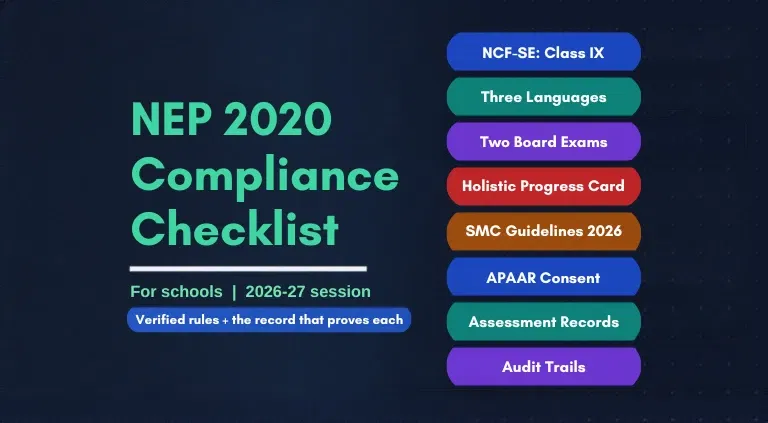
In the 2026-27 session, school leaders face 3 questions they must be ready to answer at any time. Parents want to understand why their Class IX child now studies a third language, trustees want assurance that every campus is ready, and reviews call for documented proof.
This NEP 2020 compliance checklist for schools is designed to help institutions answer all 3 with confidence.
NEP 2020 turned six in July 2026, and its progress is now visible in timetables, assessments and report cards. Launching the SMC Guidelines 2026 on 6 May 2026, Union Education Minister Dharmendra Pradhan said they would help bring the policy into action across nearly 15 lakh schools.
Schools, in turn, have responded well. The Centre told the Supreme Court that nearly 99% of India's 28,819 CBSE schools had already made arrangements for the three-language formula.
A clarification is helpful at the outset. Searches for an NEP 2026 compliance checklist are common, but the policy in force remains NEP 2020. What changes each session is how CBSE and the Ministry of Education implement it.
This guide sets out those requirements for 2026-27, the official source behind each one, and the record that proves your school has met it.
TL;DR
For the 2026-27 session, CBSE schools must follow the NCF-SE scheme in Class IX, the batch-wise rules for three languages and the two-exam system for Class 10. The SMC Guidelines 2026 also apply, but only to government and aided schools.
The Holistic Progress Card is recommended rather than mandatory, while APAAR ID remains voluntary and requires parental consent. In every case, compliance comes down to proof: assessment records, portal entries and documented communication with parents.
edumerge School ERP is the comprehensive solution for keeping that proof in one place, with one record per student, configurable assessments and full audit trails. Trusted by 800+ institutions, it goes live in under 7 hours with basic modules, and within 2 weeks for the complete setup.
Why do Schools Need a School ERP for NEP 2020 Compliance?
Most schools have embraced NEP 2020, and the 2026-27 session reflects meaningful progress. Rules have been refined during the year, tailored to different classes, and supported by clear records at every step, all signs of a system that is steadily maturing.
Fortunately, keeping pace with these changes need not add to the administrative workload. The 6 reasons below explain why schools are moving beyond spreadsheets and paper files, and how a school ERP makes NEP 2020 compliance simpler to manage.
- Rules are updated during the session: CBSE issued the language rules in stages (9 April, 15 May and 10 July 2026), and the Supreme Court added further direction on 28 September.
- Different classes follow different rules: Class IX follows the new NCF-SE scheme, Class X continues with the old one, and Class VI has a court-directed relaxation, all in the same year.
- School-based assessments need clear records: For current batches, the third language (R3) is assessed by the school, so every mark and reassessment must be recorded.
- Records are spread across many places: Language choices sit on the OASIS portal, board registrations in LOC data, and consent forms in physical files.
- Parents need clear and documented communication: CBSE has asked schools to explain the language changes to parents, and APAAR ID needs written consent with an option to decline.
- Trustees need a complete view of every campus: In groups of institutions, compliance is often tracked separately by each principal, making a group-wide view difficult.
For school groups managing several campuses, our guide to NEP implementation across multiple schools explains how to keep every campus aligned.
Must-Have School ERP Features for NEP 2020 Compliance
The record-keeping load this session is significant. CBSE estimated about 26.60 lakh Class 10 students for the first two-exam cycle in 2026, and under 50% of students in CBSE schools had APAAR IDs by 2025-26. To manage this with confidence, a school ERP should offer the following features.
| Feature | Compliance Need It Supports | Positive Outcome |
|---|---|---|
| Student information system | Rules updated during the session | Every student file reflects the latest position after a single update |
| Class-wise academic configuration | Different rules for different classes | Each class follows the correct scheme, subjects and timetable |
| Dated assessment records | School-based assessments such as R3 | Marks and reassessments are ready for any review |
| Configurable reports | Records spread across many places | Required information is available on demand, without manual compilation |
| Logged parent communication | Policy updates and consent | A clear trail of every message and consent document |
| Audit trails and multi-campus dashboards | Group-wide visibility for trustees | Every change is traceable, and every campus is visible in one view |
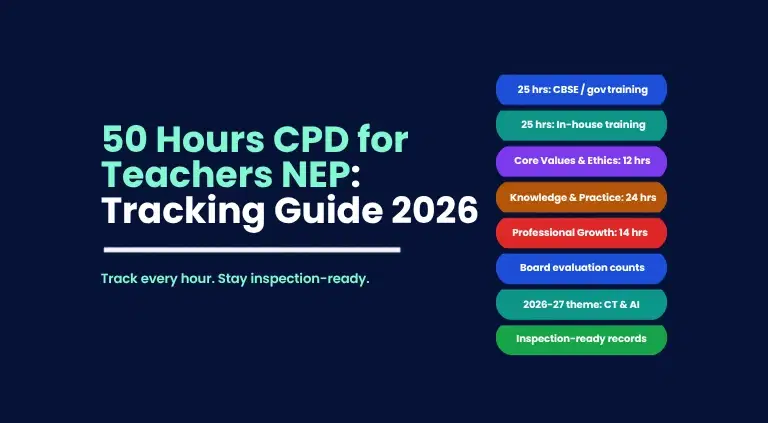
Compliance records extend to teachers as well. Our 50 hours CPD tracking guide for teachers under NEP 2020 shows how schools can document professional development with ease.
NEP 2020 Compliance Checklist for Schools (2026-27): What to Audit
Here is the checklist itself. Treat it as a readiness audit rather than a legal audit; NEP 2020 is a policy framework, so compliance means meeting the board and ministry rules that implement it. Status is as of 13 November 2026.
| Requirement | Status | Official Source | Record That Proves It |
|---|---|---|---|
| 5+3+3+4 stage structure | Framework under NEP 2020 | NEP 2020; CBSE Circular Aff.08/2023 (Foundational Stage) | Stage-wise class mapping and foundational stage plans |
| NCF-SE scheme for Class IX | Mandatory (CBSE) | Circulars Acad-14/2026 and Acad-70/2026 | Adopted scheme of studies and subject allocation |
| Competency-based assessment | Built into the NCF-SE Class IX curriculum | CBSE Curriculum 2026-27 | Assessment records mapped to competencies |
| Three languages (R1, R2, R3) | Mandatory (CBSE), batch-wise; matter pending in court | Circulars Acad-17, Acad-33 and Acad-49 of 2026; Supreme Court order, 28 September 2026 | OASIS R3 entries and internal R3 assessment records |
| Two Class 10 board exams | First exam mandatory, second optional (CBSE) | CBSE Two Board Policy; 2026-27 LOC circular | LOC submission for the February to March 2027 exam |
| Holistic Progress Card | Recommended | NEP 2020 para 4.35; CBSE and PARAKH exemplar cards | Stage-wise progress cards |
| SMC Guidelines 2026 | Mandatory for government and aided schools | Ministry of Education, 6 May 2026 | Committee and sub-committee records |
| APAAR ID | Voluntary, with parental consent | Supreme Court direction, July 2026; CBSE LOC circular, 17 September 2026 | Consent or refusal records |
Reading the Checklist: Quick Notes
- 5+3+3+4 stages: Foundational (three years of pre-school or Balvatika plus Classes 1 and 2), Preparatory (Classes 3 to 5), Middle (Classes 6 to 8) and Secondary (Classes 9 to 12).
- NCF-SE: the Class IX batch of 2026-27 continues on the new scheme into Class X in 2027-28.
- Three languages: students in Class X during 2026-27 continue with two languages. For current Classes VI to IX, R3 is assessed internally by the school, with no Board exam in R3 at Class X. Children with special needs, CBSE schools outside India and foreign students returning to India are exempt.
- SMC Guidelines 2026: one committee now covers Balvatika to Class 12, with School Building and Academic sub-committees.
- APAAR ID: students who opt out must not face any adverse consequences, as directed by the Supreme Court.
How to Evaluate a School ERP for NEP 2020 Compliance: A 5-Point Checklist
If you're comparing systems, these 5 questions separate an ERP that simply stores data from one that proves compliance.
- Can it run different rules for different batches? Your ERP should handle a new scheme for Class IX and the old scheme for Class X in the same year, without workarounds.
- Can assessments and progress cards be configured without custom development? Internal assessments and report card formats change often, and your team should be able to update them without waiting on the vendor.
- Does every record carry an audit trail? Role-based access and change history are what turn everyday data into evidence.
- Can leadership see every campus in one view? For school groups, compliance status should roll up for trustees without waiting for monthly reports from each campus.
- How fast does it go live, and who helps when rules change? Ask for onboarding timelines and named support, not ticket queues, because the next circular may arrive mid-session.
The same principle of building evidence as the work happens applies in higher education too. See how it works for colleges in our guide to NAAC SSR data automation.
How edumerge School ERP Helps Schools with NEP 2020 Compliance
NEP 2020 compliance follows a simple cycle: set up the rules, record the work, keep parents informed and prove it when asked. edumerge School ERP supports every stage of that cycle on one platform, with one codebase and one database, so no information is lost between steps.
- Set up the rules correctly: Each class can be configured with its own subjects & assessment scheme. So Class IX follows NCF-SE while Class X continues with the old scheme. When new language periods are added, automated timetabling and substitution schedule them without clashes.
- Record every assessment: Exams & assessment management captures internal and school-based marks, including R3, with dates attached. CCE and Progress Cards then present them in board-specific report card formats.
- Keep parents informed: Notices, announcements and built-in WhatsApp, SMS, email & in-app messaging carry policy updates to every parent. Each message is logged, and consent documents can be stored in the student's record.
- Prove compliance on request: With one record per student and on-demand MIS reports, the information a review needs is ready in one place. Role-based access and full audit trails show who changed what, and when, while edumergeOS gives trustees a consolidated view across every campus.
Getting started is equally simple. Schools go live in under 7 hours with guided onboarding, historical data is migrated within the same week, and every school is supported by a named account manager.
To see how these capabilities fit into the wider platform, read what is edumerge School ERP? features, pillars and how it works.
Staying NEP 2020 Compliant as the Rules Evolve
An NEP 2020 compliance checklist for schools is only as strong as the records behind it. Every requirement leads back to evidence, and schools that keep that evidence in order can answer parents, trustees and reviewers with confidence.
As the framework continues to evolve, the schools best placed to adapt are those whose records stay current without starting over each time the rules change.
edumerge School ERP is built for exactly this. It brings every student, assessment and communication record into one platform, with full audit trails and a consolidated view for trustees. Book a free demo to see how your school can stay audit-ready all year.
Frequently Asked Questions (FAQs)
1. What is an NEP 2020 compliance checklist for schools?
It is a list of the board and Ministry requirements that implement NEP 2020, each mapped to its status, official source and the record that proves it. For 2026-27 it covers NCF-SE, three languages, board exams, the Holistic Progress Card, SMC Guidelines and APAAR ID.
2. Is there an NEP 2026?
No. NEP 2020 remains the policy in force. "NEP 2026" is an informal label for the 2026 implementation phase, delivered through CBSE circulars, Ministry guidelines and court orders.
3. Is the CBSE three-language policy mandatory in 2026-27?
Yes, for CBSE schools, with batch-wise rules. Students in Class X during 2026-27 continue with two languages, and current Classes VI to IX are assessed internally in R3. The matter is pending before the Supreme Court.
4. Which classes follow the NCF-SE 2023 scheme in 2026-27?
Class IX. CBSE is implementing the NCF-SE scheme of studies in Class IX from 2026-27, and this batch continues on it into Class X in 2027-28. Class X students in 2026-27 stay on the old scheme.
5. Is the Holistic Progress Card compulsory for CBSE schools?
No. NEP 2020 recommends it, and CBSE's exemplar cards state that affiliated schools may adapt or adopt them. It is good practice for showing holistic assessment.
6. Is APAAR ID mandatory for school students?
No. APAAR ID is voluntary and needs parental consent. The Supreme Court has directed an explicit opt-out option and said students who opt out must not face adverse consequences.
7. How do the CBSE two board exams for Class 10 work in 2026-27?
The first exam, held in February to March 2027, is mandatory for all Class 10 students. A second exam later in the year is optional and lets eligible students improve their scores.
8. Do the SMC Guidelines 2026 apply to private schools?
Not to private unaided schools that receive no government funding. The Ministry of Education has clarified this. They apply to government and aided schools from Balvatika to Class 12.
9. What records prove NEP 2020 compliance in a school?
Typical records include OASIS R3 entries, internal assessment records, LOC submissions, progress cards, SMC records for aided and government schools, and parental consent or refusal records for APAAR ID.
10. How does a school ERP help with NEP 2020 compliance?
A school ERP keeps student, assessment and communication records in one place with audit trails. That lets schools run batch-wise rules, record school-based assessments and show compliance quickly.
11. Where can schools check official NEP 2020 updates?
Check the circulars page on cbseacademic.nic.in, notices on cbse.gov.in. Alongside Ministry guidelines on dsel.education.gov.in and the Supreme Court case status for matters under hearing.
12. Can edumerge School ERP manage NEP compliance across multiple campuses?
Yes. edumerge School ERP is configurable per campus, and edumergeOS gives group leadership a consolidated view of every school in the trust or society.