NEP 2020 requires students to study 3 languages, where at least two of them are Indian. On 9th April 2026, CBSE made a third language (R3) compulsory for Class 6 from the 2026-27 session and gave schools 7 days to comply.
For a group of schools, this is where NEP implementation across multiple schools turns from a policy topic into a governance one.
There is a detail that matters to groups. Only the R3 languages a school introduces in Class 6 will be available as options in Classes 9 and 10 for that school. So a language choice made campus by campus this year will shape what each school can offer for years.
Report cards are changing too. PARAKH, under NCERT, has developed the Holistic Progress Card (HPC) for all 4 stages, from the foundational stage to the secondary stage (Classes 9 to 12), and NCERT has asked states to adopt it or adapt it.
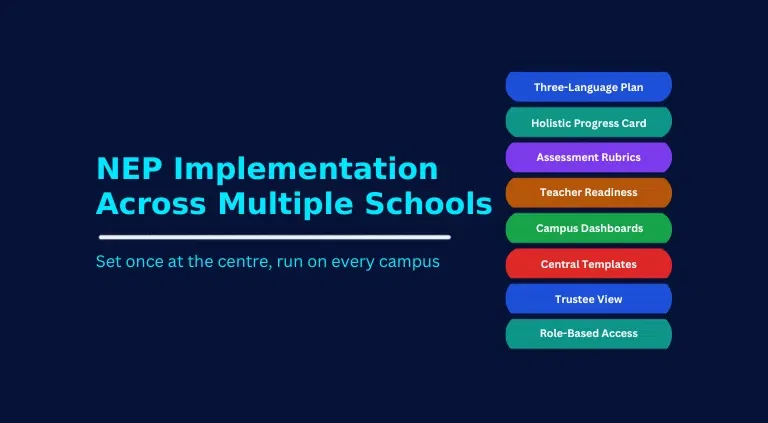
So without one central format, every campus in a group can end up with its own version. This blog explains how school groups can set NEP standards once at the centre, let every campus execute within them and track compliance across all schools.
TL;DR
NEP implementation across multiple schools works best when the group's central office sets the three-language plan, HPC format and assessment framework once. Every campus then delivers within those same standards.
Left to each campus, NEP turns into different language combinations, report cards and rubrics. As a result, the group may lose its comparability, and trustees lose a clear view of compliance.
edumergeOS lets the centre define these standards once and apply them to every campus, with campus-wise progress on one dashboard. This lets schools keep day-to-day autonomy, within guardrails the group sets.
What Does NEP Implementation Across Multiple Schools Mean?
NEP implementation across multiple schools means the group's central office sets one language plan, one Holistic Progress Card format and one assessment framework.
Every campus then executes within them. This replaces campus-by-campus interpretation, where each school reads NEP differently. Without it, the group ends up with standards it cannot compare.
Think of it as a clear division of work. The centre makes the decisions that must stay consistent. These include which R3 languages each campus offers, what the progress card looks like and how competencies are assessed.
Each campus then owns delivery. This covers everything from timetabling language periods to completing HPCs for every child. This way principals stay in charge of their schools, while trustees get one standard across the group.
Why NEP 2020 Rollout Breaks Down in a Group of Schools
In most school groups, NEP rollout does not stall for lack of effort. It stalls because each campus implements it alone. Below are the 6 patterns that show up again and again.
- Each campus chooses its own language combinations. One school picks Sanskrit as R3, another picks a regional language, often based on which teacher is available. As a result, the group has no common language plan.
- R3 decisions made today limit options in Classes 9 and 10. Because only the R3 languages introduced in Class 6 carry forward, a rushed choice this year narrows what students on that campus can study later.
- Report card and HPC formats differ across schools. Some campuses adopt the HPC, some adapt it and some stay with older report cards, so families moving between campuses see different documents.
- Assessment rubrics cannot be compared campus to campus. When each school writes its own rubrics, a "proficient" on one campus may not mean the same thing on another.
- Teacher training and readiness vary by campus. Some teachers are trained on competency-based assessment and the HPC, others are not, and the group rarely has a clear record. (Our guide to 50 hours CPD for teachers under NEP 2020 covers how to track this.)
- Trustees have no single view of compliance. Leadership hears about gaps through calls, emails and spreadsheets, usually after a deadline has passed.
Each of these is manageable in one school. Across 5 or 15 campuses, though, they multiply quickly.
What NEP 2020 Asks School Groups to Change
NEP 2020 touches almost every part of school life, but 4 changes matter most for a group's central office. The table summarises each one and what it means at group level.
| NEP change | What it involves | What it means for a school group |
|---|---|---|
| Three-language plan | Students study three languages, at least two of them Indian. CBSE has made a third language (R3) compulsory in Class 6 from 2026-27. | Approve R1, R2 and R3 combinations for each campus centrally, with Classes 9 and 10 in mind. |
| Holistic Progress Card (HPC) | Developed by PARAKH under NCERT for all 4 stages, from foundational to secondary. It adds self, peer and parent inputs to teacher assessment. | Fix one HPC format, with shared domains and rubrics, for every campus. |
| Competency-based assessment | A shift from rote recall toward assessing competencies through activities, projects, presentations and classroom tasks. | Build shared rubrics so a result means the same on every campus. |
| 5+3+3+4 structure | Foundational (3 years of pre-school plus Classes 1 and 2), preparatory (Classes 3 to 5), middle (Classes 6 to 8) and secondary (Classes 9 to 12). | Map every campus, grade and progress card to the right stage. |
Keep in mind that the R3 requirement is a CBSE rule; state boards set their own language timelines, so groups running mixed boards should apply it board by board.
For the official details, read CBSE Circular No. Acad-17/2026 and the PARAKH HPC page.
Similarly, CBSE later followed up with Circular No. Acad-25/2026 on 4 May 2026. It asked schools to upload their R3 choices on the OASIS portal by 31 May 2026. It also said official R3 textbooks for scheduled languages would be published on the NCERT and CBSE websites before 1 July 2026.
Furthermore, schools not yet teaching two native Indian languages were directed to start from 1 July 2026. For a group, this means every campus's R3 choice is now on record with the board.
Want to understand how the three-language formula works and why it matters for students? Our guide, NEP 2020 language policy explained, covers it in detail.
How to Set NEP Standards Once at the Centre and Execute on Every Campus?
This is where the centre-sets, campus-executes model becomes practical. For each NEP component, the table shows what the central office decides, what each campus owns, how compliance is tracked and what the group gains.
| NEP component | Central office decides | Each campus executes | How compliance is tracked | Positive outcome |
|---|---|---|---|---|
| Three-language plan | Approved R1, R2 and R3 combinations per campus, planned with Classes 9 and 10 in mind | Timetables language periods, assigns teachers and enrols students | Campus-wise language mapping checked against the approved plan | No campus locks itself into an R3 it cannot sustain |
| Holistic Progress Card | One HPC template per stage, with shared domains, rubrics and descriptors | Teachers record observations and self, peer and parent inputs through the term | HPC completion by campus, class and teacher | Parents get the same quality of report on every campus |
| Assessment framework | Common competency rubrics, assessment calendar and grading bands | Runs classroom assessments and enters results on time | Rubric use and result entry tracked against the calendar | Results that can be compared across campuses |
| Teacher readiness | Training plan and minimum expectations for HPC and competency-based assessment | Releases teachers for training and records attendance | Training records per teacher, per campus | Leadership knows which campuses need support |
| Stage mapping (5+3+3+4) | Stage definitions for every grade across the group | Applies the right HPC and assessment format by stage | Stage-wise reporting across campuses | One structure across K-12 |
The principle behind the table is simple: decide once, execute many times. The centre should not run classrooms, and campuses should not rewrite group standards.
Explore our guide on how to manage a group of schools in India that applies the same balance to other functions.
How to Track NEP Compliance Campus by Campus
Setting standards is only half the job. The other half is knowing, at any point in the term, which campuses are on track. Each leadership role needs a different view of the same data.
| Role | What they need to see | Why it matters |
|---|---|---|
| Trustees and Chairperson | Group-wide compliance status by campus, with exceptions flagged | Governance without waiting for monthly reports |
| Academic Director | Language plan adherence, HPC completion and assessment progress across campuses | Spots campuses falling behind before the term ends |
| Principals | Class-wise and teacher-wise progress on their own campus | Acts on gaps within the term, not after it |
| Coordinators and HoDs | Rubric use and pending entries for their subjects | Keeps day-to-day work on schedule |
When these views come from the same records, nobody has to chase anyone. A principal sees a gap the same day the academic director does, and trustees see the summary without asking for it.
Tracking starts with getting the language plan right on every campus. Our three language formula 2026-27: CBSE R3 guide for schools explains what schools need to put in place for R3 this session.
How edumergeOS Brings NEP Compliance Under One Group Command Centre
What school groups want is one NEP standard, delivered consistently on every campus, with no guesswork about where things stand. edumergeOS is built for this, with centralized policies and campus-level autonomy within guardrails the group sets.
- Language plans that stay consistent. Subject and language combinations are configured centrally for each campus, so R3 choices follow the group's plan rather than local improvisation.
- Progress cards in one format. Configurable progress card templates, with co-scholastic and descriptive indicators, let the centre set the group's HPC-aligned format once for every campus.
- Assessment results you can compare. Shared grade scales and exam structures mean results from every campus roll up into the same group view.
- Teacher records from one source. Staff profiles and training records in edumerge HRMS show which teachers are ready for the HPC and competency-based assessment.
- Compliance on one dashboard. Governing body dashboards show campus-wise progress, so trustees, the academic director and principals all work from the same numbers.
Mixed-board groups benefit as well. CBSE, ICSE and state board campuses run on the same platform, each with its own board-specific formats, under one group framework.
Evaluation checklist: five things to verify before you choose a platform for NEP compliance
| Checklist point | What good looks like |
|---|---|
| Central templates pushed to every campus | Language plans, progress card formats and assessment structures are defined once and applied to every campus, with controlled campus-level overrides. |
| Campus-wise compliance dashboard | Leadership sees each campus's progress on language plans, HPCs and assessments in real time, without consolidating spreadsheets. |
| Standardised HPC and assessment rubrics | One set of domains, rubrics and grading bands across campuses, so a result means the same everywhere. |
| Teacher training records from HRMS | Training records and readiness come from the HR system of record, not from lists each campus maintains separately. |
| Role-based access for the centre and campuses | The centre controls standards, campuses control delivery, and every change is logged. |
edumergeOS is built to meet all five, alongside admissions, fees, HR and finance on the same platform.
To understand how edumergeOS works as one operating system for your entire group, beyond NEP compliance, read what is edumergeOS: the operating system for India's groups of educational institutions.
Make NEP a Group-Wide Standard, Not a Campus-by-Campus Effort
NEP 2020 is not a one-time change that schools finish and move on from. It will keep evolving through new circulars, new textbooks and new assessment formats for years to come.
The groups that handle it well will be the ones that treat NEP implementation across multiple schools as a system, not a series of separate campus projects.
That system starts with a simple discipline: Decide once, deliver everywhere, and check progress often. When standards come from the centre, every new board update becomes one decision for the group rather than a scramble on each campus.
Teachers get clarity, parents get consistency, and leadership gets confidence in what is happening on the ground.
edumergeOS gives school groups the foundation for that discipline. It turns NEP compliance into a governed, group-wide standard. So when the next circular arrives, your group can respond as one instead of campus by campus.
Frequently Asked Questions (FAQs)
1. What does NEP implementation across multiple schools involve?
It involves the group's central office setting common NEP standards, including the three-language plan, the Holistic Progress Card format and the assessment framework, and every campus delivering within them. The centre then tracks compliance campus by campus, so the group stays consistent while each school keeps control of day-to-day teaching.
2. How should a school group choose R3 languages across campuses?
Choose R3 languages centrally, campus by campus, before Class 6 timetables are fixed. Under CBSE's rule, only the R3 languages a school introduces in Class 6 will be available in Classes 9 and 10, so check teacher availability, student demand and long-term sustainability for each campus before approving.
3. Can a group of schools use one Holistic Progress Card format?
Yes, in most cases. A group can set one HPC-aligned template per stage, with shared domains and rubrics, and apply it across campuses. Where a state has adapted the HPC for its own board, campuses under that board should follow the state version within the group's wider framework.
4. Does the CBSE three-language rule apply to state board schools in a group?
Not automatically. The R3 requirement for Class 6 from 2026-27 is a CBSE rule. State boards set their own language policies and timelines. So groups running mixed boards should plan language combinations board by board while keeping one group-level process for approving and tracking them.
5. How can Trustees track NEP compliance across campuses?
Trustees can track NEP compliance through a group dashboard that shows each campus's progress on language plans, Holistic Progress Card completion, assessment entries and teacher training. When this view comes from the same data campuses use daily, Trustees see gaps early without waiting for monthly reports or calls.
6. What should a school group decide centrally under NEP?
A school group should decide centrally on the R1, R2 and R3 language combinations for each campus, one HPC format per stage, common competency rubrics, an assessment calendar and teacher training standards. Campuses should then own timetabling, teaching, assessment and record-keeping within those group decisions.