Imagine a school group with 5 campuses. Every campus sends its exam results to the head office, but each one marks papers, sets exams and tracks lessons in its own way. So when the results arrive, there is no fair way to compare them.
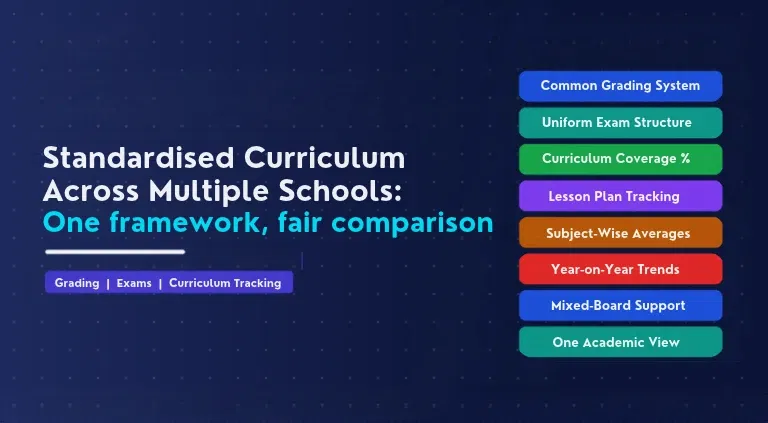
A standardised curriculum across multiple schools fixes this by giving every campus the same grading system, the same exam structure and the same way of tracking the syllabus.
This problem is not limited to school groups. For instance, in July 2024, PARAKH, the assessment body set up by NCERT under NEP 2020, studied more than 30 school boards in India. It found that exam papers were noticeably more difficult in some boards than in others.
To address this, the Ministry of Education asked PARAKH on 6 September 2025 to take charge of making Class 10 and 12 certificates equal across boards. The lesson for school groups is simple: If boards need common standards, campuses within one group need them too.
This blog explains what a standardised academic framework is, how to compare campuses fairly and how school groups can set one up.
TL;DR
A standardised curriculum across multiple schools gives every campus the same grading system, exam structure and curriculum tracking. As a result, a grade means the same thing everywhere.
Without it, each campus measures learning in its own way. Group leaders end up comparing numbers that look similar but cannot be compared.
edumergeOS lets a school group set these standards once for every campus, while campuses keep control of day-to-day teaching. Leadership then sees fair, campus-wise academic analytics in one view.
What is a Standardised Curriculum Across Multiple Schools?
A standardised curriculum across multiple schools means every campus in a group follows the same grading system, exam structure and way of tracking the syllabus.
That way, an A grade or a 75% score means the same thing on every campus. Without it, the group ends up comparing numbers that simply don't line up.
Now, standardising doesn't mean every classroom has to look the same. Teachers still plan their own lessons, and campuses on different boards still follow their board's rules.
But what changes here is how learning is measured and tracked. Once every campus uses the same rules, the group can finally see how each one is really doing.
Looking at the bigger NEP picture, including the three-language plan and the Holistic Progress Card? Our guide on NEP implementation across multiple schools covers it all.
Why Campus Results Can't Be Compared Without a Common Framework
Most school groups collect plenty of academic data. But the real problem arises when data from one campus rarely lines up with the data from another. Below are 6 gaps that most commonly cause this problem.
- Different grading scales on each campus. One campus awards an A for 85% and above, while another sets the bar at 90%. On paper, the grades look alike, but they mean different things.
- Different exam patterns, weightages and pass marks. When one campus weighs internal assessment at 20% and another at 40%, final scores cannot be compared fairly.
- Uneven syllabus coverage. One campus may finish the syllabus a month early, while another is still racing through chapters in the final weeks before exams.
- Question papers set at different difficulty levels. PARAKH found this problem between school boards. Within a group, the same thing happens when each campus sets its own papers.
- Lesson plans tracked differently, or not at all. Some campuses track topics in registers, others in spreadsheets, and some not at all. Leadership has no reliable view of progress.
- Leaders comparing numbers that do not mean the same thing. As a result, decisions about support, training and resources rest on figures that only look comparable.
Language choices are another area where campuses can drift apart. Our three language formula 2026-27: CBSE R3 guide for schools explains what schools need to put in place this session.
Three Pillars of a Standardised Academic Framework
A common academic framework for school groups is built on 3 major pillars. Each pillar addresses a different gap, and together they ensure that results from every campus can be compared fairly.
1. A Common Grading System
All campuses that follow the same board should use the same grading rules, including grade scales, grade bands and pass marks. This way, an A grade on one campus means the same level of achievement as an A grade on any other.
If a group has campuses on different boards, each board keeps its own grading rules, but all campuses under that board follow them in the same way.
2. A Uniform Exam Structure
A uniform exam structure covers the types of exams, how many are held, how they are weighed and when they take place. It can also include a shared blueprint for question papers, following the same thinking as PARAKH's guidelines for balanced question papers. And with one structure, results can be compared term by term.
This pillar also plays a central role in NEP 2020's assessment reforms. NEP 2020 calls for assessment to move away from summative tests based on rote memorisation. Instead, it encourages regular, formative & competency-based assessment that tests higher-order skills, such as analysis, critical thinking and conceptual clarity.
At the same time, the National Curriculum Framework for School Education 2023 still recommends regular summative assessments at logical intervals.
In other words, schools need a balance between ongoing assessment and periodic exams. A shared exam structure helps every campus strike that balance at the same pace. As a result, no campus moves ahead while others remain with rote-based papers.
3. Shared Curriculum and Lesson Plan Tracking
Curriculum coverage tracking shows how much of the syllabus each class has finished so far. When every campus uses the same lesson plan template, and each plan is approved by the HoD, the group can see how far along every campus is. This means any delays are noticed well before exams, rather than after the results come out.
The table below shows how responsibilities divide between the central office and each campus.
| Pillar | Central office sets | Each campus executes | What the group gains |
|---|---|---|---|
| Common grading system | Grade scales, grade bands and pass marks for each board | Applies the same scales during marks entry | A grade means the same thing on every campus |
| Uniform exam structure | Exam types, number of assessments, weightages and the assessment calendar | Conducts exams on schedule and sets papers to an agreed blueprint | Results that can be compared term by term |
| Curriculum and lesson plan tracking | Chapter-wise plan templates and monthly coverage targets | Teachers submit lesson plans, HoDs approve them and topics are marked complete | Syllabus progress visible across every campus |
A shared exam structure works best when every teacher is trained in competency-based assessment. Learn how schools can plan and track this in our guide to 50 hours CPD for teachers under NEP 2020.
How to Compare Education Quality Fairly Between Campuses
Once every campus follows the same framework, school group performance comparison becomes meaningful. The goal, though, is not simply to rank campuses but to find out where each campus needs support. These 5 measures help the group do exactly that.
| Measure | What it shows | What to do when a campus lags |
|---|---|---|
| Curriculum coverage % | How much of the planned syllabus each campus has completed | Review teacher workload and timetable gaps before exams arrive |
| Subject-wise averages | Which subjects are strong or weak on each campus | Share teaching practices from campuses doing well in that subject |
| Pass rates by subject and class | Where students are struggling, down to a single section | Plan remedial classes or extra support for that class |
| Grade distribution | Whether grading is too lenient or too strict on a campus | Check marking consistency and moderate where needed |
| Year-over-year performance | Whether a campus is improving, steady or slipping | Set campus-specific goals rather than one target for all |
This matters even more as NEP 2020 moves the focus from marks to competencies. Without a common framework, a group cannot tell whether a campus is truly building competencies or simply grading differently.
When used together, these measures turn campus-wise academic analytics into action. A campus with low coverage needs a different response from one with low pass rates, and the right data makes that difference clear.
Fair comparison starts with every campus meeting the same NEP requirements. Use our NEP 2020 compliance checklist for schools to check where each campus stands.
How edumergeOS Standardises Academics Across Every Campus
Deciding what to standardise is, naturally, only the first step. The real test lies in applying those standards across every campus without placing an additional burden on teachers.
This is precisely where edumergeOS makes a difference. It brings academic governance together in one central place, while still allowing each campus to manage its own day-to-day teaching.
- One set of exam rules for each board. Exam types, subjects, internal assessment groups, maximum marks, pass marks and grade scales are set up once at the start of each exam cycle. Every step that follows then works to the same rules.
- Grades are calculated the same way everywhere. Weighted totals, grades and pass or fail results are worked out automatically. As a result, no campus applies the rules differently by hand.
- Syllabus progress that is easy to see. Teachers prepare subject-wise and chapter-wise lesson plans, which the HoD then approves. The lesson plan module shows curriculum coverage percentage, topics completed against those planned and each teacher's submission status.
- Results that can be compared fairly. The exams module brings together pass and fail rates by subject and class, subject-wise averages, grade distribution and year-over-year comparison.
- Mixed boards on one platform. CBSE, ICSE, state board and KV campuses can all run on the same system, with each one following its own board-specific formats.
- One academic view for leadership. Trustees and Academic Directors can see every campus in one place, without waiting for each school to send its reports.
To understand how edumergeOS connects academics, finance and HR for groups of institutions on a single platform, read what is edumergeOS? the operating system for India's groups of educational institutions.
One Framework, Every Campus, Fair Comparison
Every school group wants to know which campuses are doing well and which need help. A standardised curriculum across multiple schools makes that question answerable.
With one grading system, one exam structure and one way of tracking the syllabus, results finally mean the same thing on every campus.
The direction nationally is clear. NEP 2020 calls for competency-based assessment, and PARAKH's work on board equivalence shows that consistent assessment matters for fairness. A common framework also makes NEP compliance for school groups easier, because every campus adopts these assessment reforms together and none falls behind.
edumergeOS gives school groups that foundation. Standards are set once, campuses keep their autonomy, and leadership can support the campuses that need it most.
Frequently Asked Questions (FAQs)
1. What is a standardised curriculum across multiple schools?
A standardised curriculum across multiple schools means every campus in a group uses the same grading system, exam structure and curriculum tracking. Results then mean the same thing everywhere. So Trustees and Academic Directors can compare education quality fairly and see which campuses need support.
2. Can a group of schools follow one grading system?
Yes, within each board. Campuses affiliated to the same board can share one grading scale, grade bands and pass marks. In a mixed-board group, each board's prescribed format still applies. So the group standardises within each board while tracking curriculum coverage the same way everywhere.
3. How do you compare academic performance across campuses?
First, put every campus on the same grading system and exam structure. Then compare curriculum coverage, subject-wise averages, pass rates by subject and class, grade distribution and year-over-year trends. The aim is to find where a campus needs support, not only to rank campuses.
4. How can a school group track syllabus completion across campuses?
Use shared lesson plan templates organised by subject and chapter, with HoD approval. As teachers mark topics complete, curriculum coverage percentages update for each class. The group can then see syllabus completion for every campus in one view, well before exams begin.
5. Does a standardised curriculum mean every campus teaches the same way?
No. Standardisation sets common rules for grading, exams and tracking progress. Teachers still plan lessons for their own classrooms, and campuses still adapt to their students. What changes is that every campus measures learning in the same way, which makes results comparable.
6. Is standardising academics part of NEP compliance?
NEP 2020 does not require school groups to standardise across campuses. It did lead to PARAKH, which sets assessment norms and works on equivalence between school boards. A common framework within a group follows the same thinking, supporting consistent, competency-based assessment on every campus.