Every new language group in a school needs a teacher behind it. Someone qualified in that language, with enough periods free to teach it and enough time left to prepare. But finding and organising these teachers has now become one of the main challenges for CBSE schools across India.
Through Circular Acad-17/2026, dated 9 April 2026, CBSE made a third language (R3) compulsory in Class 6 from 2026-27, and the requirement moves up one class every year.
This is where language teacher workload allocation helps. It matches each language group with a teacher qualified to teach it. At the same time, it gives every teacher a clear plan of the sections and weekly periods they are responsible for.
Furthermore, the RTE Act sets clear rules for staffing. In Classes 6 to 8, every school must have at least one teacher for Languages, and at least one teacher for every 35 children. Each teacher must also work at least 45 hours a week, and this includes time spent preparing lessons. So when a school starts teaching three languages, one language teacher is usually not enough.
This blog explains how to calculate how many language teachers your school needs, and how to keep their workloads fair as R3 expands.
TL;DR
Allocating language teacher workloads well means covering every R1, R2 and R3 group while keeping each teacher's weekly load fair. When planned early, it prevents a few teachers from carrying most of the extra periods.
Adding R3 changes more than the timetable. It also affects how many language teachers a school needs, which languages they must be qualified in and how much preparation time they have.
edumerge HRMS brings staff qualifications, teaching workloads, recruitment and training records into one system. School leaders can then plan hiring early and keep workloads balanced.
What is Language Teacher Workload Allocation?
Language teacher workload allocation means giving each language teacher a clear list of the periods and sections they will teach each week. This makes sure every R1, R2 and R3 group has a teacher, and that no teacher is overloaded.
On the other hand, without proper planning, periods are often given to whichever teacher happens to be free. Gradually, the same few teachers end up doing most of the extra work, leaving them with less time to prepare and putting the quality of teaching at risk.
In practice, good workload allocation helps school leaders answer 2 important questions.
- Does the school have enough teachers qualified to teach each language?
- Is the work shared fairly among them?
Once both questions are answered, the next step is to place each teacher into specific periods on the timetable.
When teachers are overloaded, their productivity is the first thing to suffer. To see how the right systems can ease that pressure, read our article on the impact of school ERP on teachers' productivity.
How Adding a Third Language Changes Teacher Workload
Introducing CBSE R3 is a positive step for multilingual learning, but it also changes how much each language teacher teaches, which languages they teach and how their week is planned.
Understanding these changes early helps schools plan their staffing well. Below are 6 key changes worth preparing for.
- More language periods each week. Every new R3 group brings its own weekly periods. As a result, the total teaching time for languages rises.
- New languages that need qualified teachers. When a school offers a language it has not taught before, it may need to appoint a teacher with the right qualification in that language.
- One teacher works across many sections. A teacher qualified in a less common language may need to cover every section that chooses it.
- Uneven loads between language teams. One language may be chosen by most students, while another attracts only a handful. Without attention, the loads can drift apart quickly.
- Less time for lesson preparation. As the number of periods grows, preparation time can shrink unless it is protected in the weekly plan.
- Another class adds R3 every year. As the rollout of the three-language formula 2026-27 extends, staffing needs grow each session, not just once.
For a complete explanation of the rule itself, read our guide, three language formula 2026-27: CBSE R3 guide for schools.
Calculating How Many Language Teachers You Need
Before a school hires any new language teachers, it should first work out how many it actually needs. A simple calculation can show this clearly. And when this is done before the session begins, the school will then have enough time to plan its hiring properly. The calculation can be done in 3 easy steps.
- Count the language groups for each R3 language. List the number of groups each language needs, including any groups combined across sections.
- Multiply by the weekly periods each group needs. Take the period counts from CBSE's Scheme of Studies 2026-27, rather than from estimates found online.
- Divide by a fair weekly teaching load. Use the school's own policy and state rules to decide the maximum number of periods one teacher should take.
The table below applies this teacher workload calculation to a sample school with 4 sections in Class 6.
Also, every figure in this table is an illustrative example, not a CBSE or RTE norm. The example assumes 4 periods per group per week and a maximum load of 28 periods per teacher.
| R3 language (example) | Language groups | Periods per group per week (example) | Weekly periods needed | Share of one teacher's load |
|---|---|---|---|---|
| Language A (chosen by most students) | 4 groups | 4 periods | 16 periods | 0.6 of one teacher's load |
| Language B | 2 groups | 4 periods | 8 periods | 0.3 of one teacher's load |
| Language C (chosen by a few students) | 1 group, combined across sections | 4 periods | 4 periods | 0.1 of one teacher's load |
| Total for Class 6 | 7 groups | 4 periods each | 28 periods | 1 teacher's load, but 3 different languages |
| Next session (Classes 6 and 7) | About 14 groups | 4 periods each | About 56 periods | About 2 teachers' loads, still across 3 languages |
This example reveals an important point which is: based on periods alone, the school needs only one teacher's load for R3 in Class 6.
Each language, though, requires a teacher qualified in it, so the school actually needs 3 teachers who can teach these languages.
When R3 extends to Class 7 the following year, the periods roughly double. Planning hiring a year in advance helps the school avoid a last-minute search.
Once you know how many language teachers you need, the next step is fitting them into the weekly timetable. Our guide, three language formula timetable: R3 without clashes, explains how to schedule R1, R2 and R3 periods without clashes.
How to Keep Language Teacher Workloads Fair
Once the number of teachers is clear, the next step is to make sure the work is shared fairly among them. Hence, good teacher workload management keeps language teachers motivated and prevents any one teacher from being overloaded.
The following practices can help schools achieve this.
- Set minimum and maximum weekly loads. Clear limits ensure that no language teacher is overloaded while others remain under-used.
- Spread R3 sections evenly. Where more than one teacher is qualified in a language, its sections should be divided fairly between them.
- Share teachers across classes or campuses. In a school group, shared teachers across campuses can cover a less common language, so each campus does not need to hire separately.
- Use part-time or visiting teachers where needed. Part-time language teachers can cover languages chosen by only a few students, provided the arrangement meets the school's board and state rules.
- Protect time for preparation and training. Teaching a new language requires preparation, and teachers also need time for professional development.
- Review workloads every term. Student choices and section sizes change during the year, so a load that was fair in April may no longer be fair in October.
A fair workload also leaves room for teachers to grow. To plan and track their professional development, explore our 50 Hours CPD for teachers NEP: tracking guide 2026.
How edumerge HRMS Supports Language Teacher Hiring and Workload
Good staffing decisions start with knowing your teachers well. To plan for R3, a school needs to know which languages each teacher can teach, how many periods they already have and who may need training soon.
In many schools, this information is kept in different files and spreadsheets, which makes it hard to see the full picture. edumerge HRMS keeps all of it in one place, so school leaders can plan language staffing with confidence.
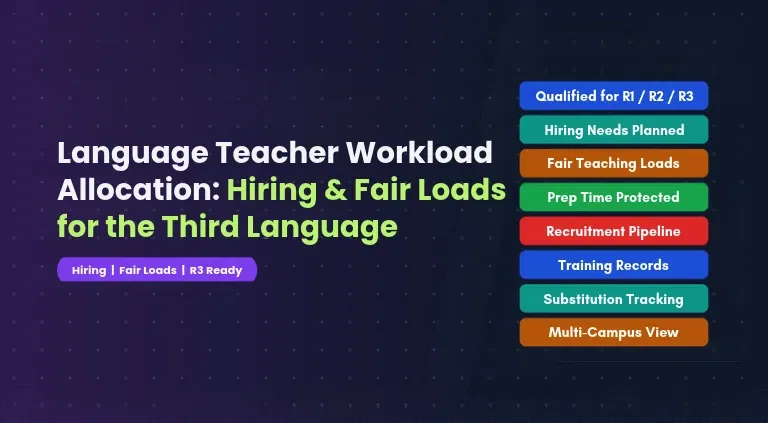
- Know which teacher can teach which language. Each teacher's qualifications & appointments are stored in their staff profile. This allows school leaders to see which teachers are qualified to teach R1, R2 or R3 at a glance.
- See every teacher's workload in one place. Teaching workloads and academic calendars are kept alongside staff records. So it makes it easier to spot uneven loads early and correct them before they become a problem.
- Cover absences fairly. Substitution tracking shows which teacher is covering for whom. As a result, extra periods are not quietly passed to the same few teachers every time.
- Hire new language teachers faster. The entire recruitment process runs through one system, from job posting and the career portal to background verification, offers and onboarding.
- Keep track of training and development. Every training programme a teacher attends is recorded in their profile, so school leaders can plan professional development with confidence.
- View language staff across every campus. For school groups, a combined view of staff across all campuses shows where language teachers are available. This makes it much easier to share teachers between campuses.
With accurate staff information in one place, school leaders can make hiring and workload decisions with clarity rather than guesswork.
To learn how edumerge HRMS supports every stage of a teacher's journey, from hiring to appraisals, read what is edumerge HRMS: talent lifecycle management for educational institutions.
Planning Language Staffing for the Years Ahead
A third language brings real value to students, but its success depends on the teachers who teach it. Therefore, good workload allocation for language teachers makes sure every language group has a teacher, every teacher has a fair amount of work and there is enough time left to prepare lessons.
Schools also need to think about the years ahead, not just the current one. Since R3 moves up to a higher class each year, the number of language teachers needed will keep growing. By working out their teacher needs early, schools can hire calmly instead of rushing to find teachers after the session has started. This kind of planning also helps them stay on track with NEP compliance as the rollout continues.
edumerge HRMS makes this planning easier. It keeps teacher qualifications, workloads, recruitment and training records in one place. As a result, school leaders can plan language staffing with confidence, so the third language improves learning without overloading teachers.
Frequently Asked Questions (FAQs)
1. What is language teacher workload allocation?
It is the process of assigning language teachers their weekly periods and sections, so every R1, R2 and R3 group is covered. It also keeps each teacher's load fair, so no single language teacher ends up carrying most of the extra periods.
2. How many language teachers does a school need for R3?
Count the language groups for each R3 language, multiply by the weekly periods each group needs, then divide by a fair teaching load. Since each language needs a teacher qualified in it, the number of languages offered often matters more than the total periods.
3. What is the workload of a teacher under the RTE Act?
The Schedule to the RTE Act, 2009 sets a minimum of 45 working hours per week for teachers, including preparation hours. For Classes 6 to 8, it also requires 1,000 instructional hours per academic year. Schools set teaching periods within these norms and their state rules.
4. Does the RTE Act require a separate teacher for each language?
No. For Classes 6 to 8, the RTE Act requires at least one teacher each for Science and Mathematics, Social Studies and Languages, plus at least one teacher for every 35 children. Once a school offers three languages, it usually needs teachers qualified in each one.
5. Can part-time teachers teach a third language?
Many schools use part-time or visiting teachers for less common languages, where only a few students choose them. Before appointing them, schools should check that the arrangement meets their board's affiliation norms and state rules on teacher qualifications. A clear record of each teacher's qualifications makes this check much easier.
6. How can an HRMS help with teacher workload management?
An HRMS keeps every teacher's qualifications, teaching workload, substitutions and training in one place. School leaders can see which teachers are qualified for which languages, spot uneven loads early and run recruitment for new language posts from the same system.