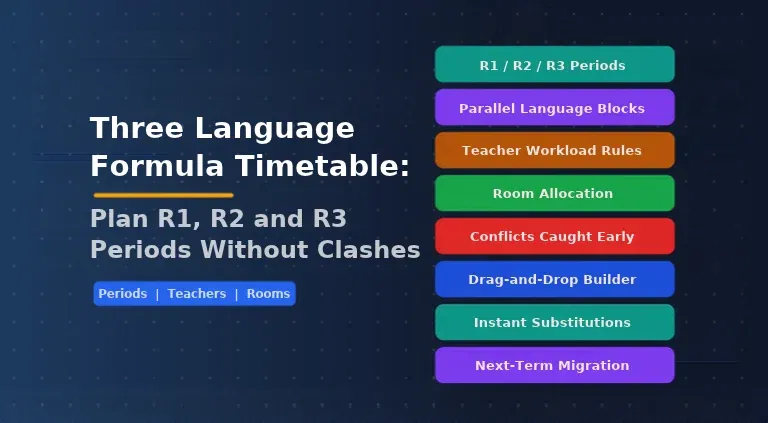
Fitting a third language into an already packed school week is where the three-language rule gets real. And that's exactly what a three language formula timetable is for. It maps R1, R2 and R3 to weekly periods, teachers and rooms for every section, so nothing clashes.
Under CBSE's revised Scheme of Studies for 2026-27, aligned with NEP 2020 and NCF-SE 2023, at least two of every student's three languages must be Indian languages.
The pressure began with Circular Acad-17/2026, dated 9 April 2026, which made R3 compulsory in Class 6. The rollout moves up one class every session, with the first board exams under the scheme expected in 2031. So each new year brings another class that needs R3 periods and R3 teachers.
There's also a long-term catch. Only the R3 languages a school introduces in Class 6 will be available as options in Classes 9 and 10 for that school. That means the timetable and staffing decisions made today will shape a school's language options for years to come.
In this blog, you'll learn how to plan weekly language periods, allocate language teachers fairly and build a timetable that stays clash-free.
TL;DR
A three language formula timetable maps R1, R2 and R3 to weekly periods, teachers and rooms for every section. Planned well, it fits language periods around everything else.
Without a plan, R3 brings split sections, stretched language teachers and room clashes. These problems also grow each year as another class adds R3.
edumerge School ERP helps schools build a clash-free weekly timetable, with teacher workload rules, room allocation and conflicts caught before the timetable is published.
What is a Three Language Formula Timetable?
A three language formula timetable is a weekly timetable that assigns periods, teachers & rooms to R1, R2 and R3 for every section. It is planned before the term begins, so every section knows its language periods from the very first day.
Without this planning, schools end up building the timetable period by period, which often leads to clashes and overworked language teachers.
At its core, R3 timetable planning answers 3 questions for every class:
- When each language is taught
- Who teaches it
- Where the class takes place
To understand the rule itself, including which languages count and how R1, R2 and R3 are defined, read our guide, three language formula 2026-27: CBSE R3 guide for schools. This blog focuses on turning that rule into a timetable that works.
What Schools Need to Plan For When Adding R3
Adding a third language is a positive step towards multilingual learning, and it works best when the timetable is planned around it. At the same time, R3 affects sections, teachers and rooms all at once, so careful planning matters.
With that in mind, here are the 6 key areas schools should plan for.
- Different R3 choices within one section. Students in the same section may choose different languages. So planning for this means arranging two or three language groups in the same period, each with its own teacher.
- Teacher availability for each language. Some languages may have only one qualified teacher. Therefore, knowing this early helps the school plan that teacher's periods across every section.
- Language teachers shared across classes. When one teacher works with several sections, the language blocks need to be arranged so that the teacher is never needed in two places at once.
- Rooms for language groups. A section that divides into three language groups needs three rooms in the same period. Hence reserving these in advance keeps every group settled.
- A balanced weekly schedule. Language periods need to sit comfortably alongside science labs, games, art and other fixed periods.
- Room to grow each year. As the rollout extends to a higher class every session, the timetable needs space for the next class. In addition, some schools are planning R3 for certain Class 9 students this session, following CBSE's 10 July 2026 guidelines.
For school groups introducing R3 across several campuses, our guide on NEP implementation across multiple schools explains how to set one language plan centrally and apply it on every campus.
How to Plan Weekly Language Periods for R1, R2 and R3
At the heart of a clash-free school timetable lies the parallel language block. In a parallel block, every R3 group in a section has its language period at the same time, although each group meets in a different room with a different teacher.
Similarly, students move to their separate language groups for the block and return to their own class once it ends. This ensures that no student misses another subject because of the language they have chosen.
Before any language blocks are placed, schools should first confirm the number of weekly periods required for R1, R2 and R3 in each class. Ideally, these figures should be taken directly from CBSE's official Scheme of Studies 2026-27, rather than from estimates available online.
So when the period counts are confirmed, the table below then outlines the planning steps in the order they should be followed.
| Planning step | What to decide | Why it matters | Clash it prevents |
|---|---|---|---|
| 1. Confirm period counts | Weekly periods for R1, R2 and R3 in each class, taken from CBSE's Scheme of Studies 2026-27 | Every later step depends on these numbers | Too many or too few language periods in the week |
| 2. Fix language combinations | Which R3 languages each section offers and how many students choose each one | This decides how many language groups you need | New groups appearing mid-term |
| 3. Create parallel language blocks | One common slot in which every R3 group of a section studies at the same time | Students split into groups and return together without missing other subjects | Students missing another subject |
| 4. Spread blocks across the week | Which days and periods hold the language blocks | Keeps the load balanced for students and teachers | Clashes with labs, games or other fixed periods |
| 5. Reserve rooms | A room for every language group in each block | Splitting a section needs more rooms than usual | Two groups booked into one room |
| 6. Plan for next session | Free slots and teacher capacity for the next class that adds R3 | The rollout extends to a higher class each year | Rebuilding the timetable from scratch every year |
When these steps are followed in order, CBSE R3 period allocation becomes predictable. It will also leave room for the next class that adds R3, so the timetable grows each year rather than being rebuilt.
The three-language timetable is one part of a school's wider NEP readiness. To review the rest, explore our NEP 2020 compliance checklist for schools (2026-27).
How to Allocate Language Teachers Without Clashes
Once the periods are planned, the next task is language teacher allocation. Following these 5 steps help schools assign teachers fairly and avoid clashes.
- Step 1: Map each teacher to the languages and sections they can teach. Start with a simple list of every language teacher, the languages they are qualified to teach and the classes they can take.
- Step 2: Set minimum and maximum weekly teaching loads. Teacher workload balancing prevents one language teacher from carrying most of the R3 periods while others are under-used.
- Step 3: Group students across sections for less common R3 languages. If only a few students in each section choose a language, combining them into one group across sections saves teacher time. And this only works if those sections share the same language block.
- Step 4: Assign rooms for every language group. Room allocation for language groups must be done alongside teacher allocation, since a group without a room is still a clash.
- Step 5: Check for teacher, room and section clashes before publishing. Timetable conflict detection at this stage means problems are fixed by the coordinator and not discovered by students on the first day.
Teacher readiness matters too, especially for new R3 languages. Our guide to 50 hours CPD for teachers under NEP 2020 explains how schools can plan and track teacher training alongside the timetable.
How edumerge School ERP Builds Clash-Free Language Timetables
Planning a three language formula timetable on paper is only half the task. The greater challenge is keeping it clash-free as sections, teachers and rooms change throughout the year.
This is where edumerge School ERP makes a real difference, through its timetable & substitution management module:
- Every section, teacher and room is in one visual grid. Coordinators build the timetable by dragging subjects and teachers into time slots. As a result, even complex language blocks across several sections are easy to view and adjust.
- Fair workloads for every teacher. Minimum and maximum teaching loads are set as workload rules. The builder then applies these rules while scheduling, which prevents any teacher from being overloaded or under-used.
- No room booked twice. Each room is registered with its type and capacity. The system then ensures that two language groups are never placed in the same room at the same time.
- Clashes resolved before students see them. Scheduling policies and workload rules flag double-bookings, over-assignment and policy breaches while the timetable is still being built. Every issue can therefore be fixed before the timetable is published.
- Quick cover for absent language teachers. When a teacher is absent, the substitution is recorded and immediately reflected in the timetable views for students and staff.
- No full rebuild each term. At the end of a term, the timetable carries forward its structure, subject assignments and room allocations. Only the changes need attention.
To see how timetabling fits alongside admissions, attendance, exams and fees on one platform, read what is edumerge School ERP? features, pillars and how it works.
Turning the Three-Language Rule Into a Timetable That Works
The three-language rule is set by the board, but making it work happens in the timetable. A well-planned three language formula timetable gives every section its language periods, every teacher a fair load and every group a room.
The task will not stay the same size. As R3 extends to a higher class each session, the timetable needs to grow without being rebuilt each year.
edumerge School ERP helps schools meet that challenge. With workload rules, room checks and clashes caught before publishing, the timetable becomes something the school can rely on, rather than a puzzle it solves again every term.
Book a Product Walkthrough Today
Frequently Asked Questions (FAQs)
1. What is a three language formula timetable?
A three language formula timetable is a school timetable that maps R1, R2 and R3 to weekly periods, teachers and rooms for every section. It is planned in advance, so language periods fit around other subjects without clashes or overloaded language teachers.
2. How do schools schedule R3 when students choose different languages?
Most schools use parallel language blocks. All R3 groups in a section study at the same time, each with its own teacher and room. Students separate for the block and return together afterwards, so nobody misses another subject because of their language choice.
3. How many language teachers does a school need for R3?
It depends on the R3 languages offered, the number of language groups and the weekly periods each group needs. Multiply groups by periods, then compare the total with each teacher's maximum weekly load. Plan for more groups as R3 extends to higher classes each year.
4. How many periods per week does R3 get under CBSE?
Schools should take R3 period counts from CBSE's official Scheme of Studies 2026-27 rather than estimates found online. Once the periods are confirmed for each class, the timetable can be built around them, with language blocks placed before other flexible subjects.
5. Does the three-language rule apply to state board schools?
The R3 requirement described here is a CBSE rule under its revised Scheme of Studies for 2026-27. State boards set their own language policies, so state board schools should follow their board's guidelines when planning language periods in the timetable.
6. How can school timetable software prevent language clashes?
School timetable software applies workload rules and scheduling policies while the timetable is being built. It flags teacher double-bookings, room clashes and over-assignment before the timetable is published, so problems are fixed by the coordinator instead of being discovered by students.