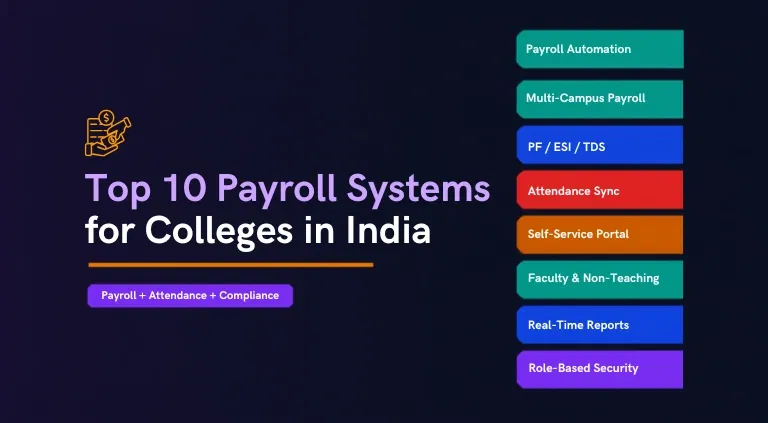
A payroll management system for colleges in India is expected to handle multiple pay structures for both teaching and non-teaching staff. This includes applying statutory deductions correctly every cycle. Hence giving finance & HR leaders a single, accurate view of workforce costs across every campus.
Today's colleges are not single-department institutions. Faculty pay structures include research allowances, examination duties & honorariums. While non-teaching staff follow entirely different pay scales.
Adding multi-campus operations, changing PF, ESI, TDS & Professional Tax rules, and a basic salary processing tool quickly runs out of depth. This guide walks through what goes wrong when colleges choose the wrong system, features worth evaluating, and how leading options in the Indian market compare.
TL;DR
Indian colleges need payroll systems built for real complexity. Multi-campus operations, separate pay structures for teaching versus non-teaching staff. It also constantly shifts PF, ESI, TDS & Professional Tax rules. Choosing the wrong system creates fragmented data, manual errors, compliance delays, communication gaps, and scalability problems.
The best systems offer automation, centralized data, real-time reporting, built-in compliance, employee self-service, cross-department collaboration, integrations, scalability, and security.
Comparing the market, edumerge HRMS stands apart as the only platform built specifically for Indian education. Running payroll, attendance, academics, and finance on one shared system. With one-click multi-campus payroll and native faculty pay structures.
The other 9 options fall into broader enterprise-grade categories, most needing manual configuration for education-specific needs.
The Cost of Choosing the Wrong Payroll System for Colleges
Selecting the wrong payroll system does not just slow down HR. It creates recurring risk across compliance, staff trust, and institutional reporting. The sections below break down each common issue and the effect it has once it plays out inside a real payroll cycle.
1. Fragmented Employee and Salary Data
The Challenge: Staff records, biometric attendance, leave balances, and salary structures for teaching & non-teaching employees often live in separate spreadsheets and disconnected HR tools. No single system holds the complete picture for any one employee. So HR has to pull data from 3-4 places before a payroll run can even begin.
The Effect: Every payroll run becomes a manual reconciliation exercise. HR teams spend days matching biometric attendance to leave records and salary structures by hand. Similarly, a single missed entry, a leave marked in one system but not updated in another, results in a wrong disbursal. This results in getting corrected the following month, along with the awkward conversation that comes with it.
Read about how errors in salary calculation lead to teacher turnover in Indian schools.
2. Manual Payroll Processes
The Challenge: Arrears, loss of pay adjustments, and full & final settlement calculations are still done manually in many colleges. It sits in spreadsheets and is maintained by a single accounts officer who also handles other financial responsibilities. There is no system enforcing consistency between how one employee's arrears are calculated versus another's.
The Effect: Manual computation is time-consuming and error-prone. Every manual step is a point where a calculation mistake can reach an employee's payslip. When that happens, correcting it after disbursal is not just an administrative fix; it damages staff trust in the institution's payroll process and adds a recurring cycle of rework for HR.
3. Delays in Statutory Compliance and Reporting
The Challenge: PF, ESI, Professional Tax, and TDS rules change periodically. Also, a payroll system without built-in compliance logic depends entirely on someone in the finance team remembering and manually applying the current rates for every filing cycle.
The Effect: A missed PF deadline carries a financial penalty. An incorrect TDS projection carries over into a year-end recovery from the employee's salary. Both create avoidable audit exposure for the institution. Both are also the direct result of compliance logic that lives in someone's memory rather than in the system itself.
You might also like to read about managing college finances effectively? We've crafted this guide for finance heads & admins.
4. Communication Gaps Between HR, Finance, and Department Heads
The Challenge: When HR, Finance, and department heads work off different versions of payroll data, there is no shared, real-time record of pending approvals for increments, arrears, or new hires. Each team has to follow up separately to confirm whether a change has actually gone through.
The Effect: Approvals for increments, arrears, or new hires get delayed. This makes the department heads find out about a payroll change only after it has already affected a colleague's salary. This erodes confidence in the payroll process itself. And over time it pushes department heads to keep their own shadow records just to stay informed.
5. Limited Scalability Across Campuses
The Challenge: A payroll system designed for a single campus is typically built around one set of pay policies, one attendance source, and one approval chain. It has no natural way to represent a second campus with its own staff categories, pay scales, or local compliance requirements.
The Effect: What worked for one location becomes a bottleneck the moment an institution adds a new campus, a new employee category, or a new pay structure. HR is forced to build manual workarounds, duplicate spreadsheets, and parallel approval processes. This paves the way for reintroducing the very errors and delays that automation which was meant to be removed in the first place.
See our guide on automating payroll for schools & colleges in India for a step-by-step approach.
Must-Have Features of the Best Payroll Management System for Colleges
The table below outlines the core capabilities a college should evaluate before choosing a payroll management system, and why each one matters in practice.
| Feature | How It Helps |
|---|---|
| Automation of salary processing | Calculates salaries, arrears, and full & final settlement automatically, removing manual computation and the errors that come with it. |
| Centralised employee data | Brings attendance, leave, and compensation data for teaching and non-teaching staff into one system. This ends the reconciliation between disconnected tools. |
| Real-time reporting | Gives trustees & finance heads live dashboards on payroll cost, headcount, and compliance status, without waiting for month-end reports. |
| Built-in statutory compliance | Applies PF, ESI, Professional Tax, and TDS rules automatically and generates audit-ready filings, so compliance does not depend on manual tracking. |
| Employee self-service | Lets staff view payslips, apply for leave, and submit reimbursement claims directly, reducing routine queries to the HR desk. |
| Cross-department collaboration | Keeps HR, Finance, and department heads aligned on approvals and payroll changes with a clear, shared audit trail. |
| Integrations | Connects payroll with attendance, leave, finance & accounting systems so data moves automatically instead of being re-entered. |
| Scalability across campuses | Supports consolidated, single-click payroll runs across multiple campuses as the institution or group grows. |
| Security and access control | Protects sensitive salary and personal data with role-based access, so only authorised staff can view or edit payroll records. |
Comparing the Top Payroll Management Systems for Colleges in India
1. edumerge HRMS
edumerge HRMS is the only payroll platform on this list built specifically for Indian education. Where payroll, attendance, academics, and finance run on one shared system instead of being stitched together separately.
Key strengths:
- One-click payroll across teaching, non-teaching, and contractual staff, with staff attendance & leave management feeding directly into salary calculation
- Full statutory compliance built in: PF, ESI, Professional Tax & TDS auto-calculated, with PF ECR, ESIC challans, Form 16, and Form 24Q generated at a click
- True multi-campus payroll from a single dashboard, with each campus retaining its own staff records and pay policies
- Faculty-specific pay structures (research allowances, examination duty pay) handled natively alongside non-teaching and contractual pay
- One shared database across payroll, attendance, academics & finance, so nothing needs manual bridging between departments
- Real-time dashboards give trustees & finance heads live visibility into payroll cost and compliance across every campus
What to note: Best suited to institutions that want payroll unified with attendance, academics, and finance on one platform. Especially multi-campus colleges and groups of institutions.
2. Keka HR
A modern, employee-centric HR and payroll platform built for Indian SMBs and mid-market companies, known for its polished interface.
Key strengths:
- Comprehensive gross-to-net payroll covering earnings, arrears, retro adjustments, and statutory deductions
- Automated PF, ESI, Professional Tax, and TDS compliance built specifically for Indian regulations
- GPS-based & biometric attendance tracking, useful for institutions with distributed campuses
- Strong performance management with OKRs, 360 feedback, and 9-box grids
- Clean, modern interface that speeds up HR adoption and reduces training time
What to note:
- Built for general corporate HR use rather than education specifically.
- So faculty pay structures, academic-calendar-linked leave policies, and multi-entity campus governance typically need manual configuration.
- Pricing can feel steep for smaller single-campus colleges.
You might also like our comparison on edumerge HRMS vs Keka HR.
3. greytHR
A long-established, payroll-first Indian HRMS, known for reliable statutory compliance.
Key strengths:
- Rock-solid PF, ESI, Professional Tax, and TDS automation with a strong compliance track record across Indian states
- Reliable payslip, Form 16, and tax computation with minimal manual error
- Biometric device integration for attendance tracking
- Established support network with responsive helpdesk teams, frequently praised by long-term users
- Simple, non-technical interface that HR teams without a tech background can pick up quickly
What to note:
- Interface is often described as dated compared to newer platforms. It functions as a standalone payroll and compliance engine.
- Institutions usually need to integrate it separately with attendance, academic, or student ERP systems. It is also positioned mainly for single-entity organisations under 250 employees rather than multi-campus groups.
Also worth a look: our comparison edumerge HRMS vs greytHR.
4. Darwinbox
An enterprise HCM suite covering the full employee lifecycle, used by large organisations including some large education groups.
Key strengths:
- Full hire-to-retire coverage: recruitment, onboarding, payroll, attendance, performance, and learning in one suite
- Strong workforce analytics and no-code workflow configuration for complex approval chains
- Multi-language support, useful for institutions with diverse regional staff
- Serves large, multi-entity organisations at scale, including enterprises with 1,500+ employees
- Mobile-first design across all HR functions
What to note:
- Positioned and priced for large enterprises, so implementation effort and cost can be significant for a mid-size college or a single group of institutions.
- Better suited to very large university systems than smaller colleges.
Explore more: edumerge HRMS vs Darwinbox, a side-by-side look at how the two platforms compare.
5. Zoho Payroll
A cloud payroll product within the Zoho suite, aimed at SMEs needing straightforward salary processing and compliance.
Key strengths:
- Affordable and quick to set up compared to enterprise-grade platforms
- Native integration with other Zoho products (Zoho People, Zoho Books) for combined HR and finance workflows
- Core statutory compliance handled automatically for Indian payroll
- Employee self-service portal for payslips and tax declarations
- Straightforward pricing that scales reasonably for small teams
What to note:
- Lacks education-specific workflows such as faculty allowance structures, examination duty pay, or biometric attendance linked to academic calendars.
- Works best for smaller, single-campus institutions with simple, largely uniform pay structures.
6. Saral PayPack
A veteran, deeply compliance-focused Indian payroll software from Relyon Softech, built around statutory processing rather than a broader HR or employee-experience layer.
Key strengths:
- Long-standing, dedicated payroll engine with government tax slabs and formulas built in and updated regularly, rather than compliance layered on top
- Detailed statutory reports for PF, ESI, PT, and TDS, plus e-filing support and Form 16 generation
- Standing instructions, arrears calculation, and customisable salary rules suited to organisations with varied and complex pay components
- Available on both cloud and on-premise deployments, with a choice of database backends, giving institutions with strict IT policies more control
- Strong audit trail module that tracks every change made within payroll processing, useful for internal audits and finance reviews
What to note:
- The interface and workflow lean traditional and processing-heavy rather than employee-experience-led, and it functions primarily as a payroll and compliance engine rather than a unified HR platform.
- Faculty-specific pay categories, academic-calendar-linked leave, and multi-campus consolidation aren't native, so colleges would still need to build those workflows around it separately.
7. HROne
A cloud HCM platform positioned as a connected hire-to-retire system for mid-size to large Indian organisations.
Key strengths:
- Configurable payroll rules and multi-level approval workflows
- Pre-built workflow templates that reduce setup time for common HR processes
- Built-in ROI dashboard giving visibility into HR and payroll cost efficiency
- Mobile app for employee self-service, payslips, and leave requests
What to note:
- It's a general-purpose HCM platform, so colleges would need custom configuration for faculty pay components, non-teaching staff categories, and academic-term-linked leave policies, none of which come pre-built for education.
For a closer look at faculty evaluation, see our guide on faculty appraisal systems for educational institutions.
8. Pocket HRMS
An AI-assisted HRMS & payroll platform aimed at automating routine HR and payroll tasks for Indian businesses.
Key strengths:
- AI-based chatbot that handles routine employee payroll and leave queries, reducing HR workload
- Automated statutory compliance updates as PF, ESI, and TDS rules change
- Reasonably priced compared to enterprise-grade HCM suites
- Employee self-service for payslips and reimbursement claims
- Straightforward implementation for small to mid-size organisations
What to note:
- Education-sector workflows such as faculty categories, examination duty allowances, or academic-term-linked policies are not native.
- It would need to be built through customisation, which adds implementation time and cost.
9. MCB HR Plus
A payroll and staff management platform designed around the specific needs of academic institutions, from schools through universities.
Key strengths:
- Flexible salary structures covering teaching, non-teaching, outsourced, and contractual staff in one system
- Biometric attendance synced directly into payroll with automatic loss-of-pay computation
- Audit-ready statutory reports (TDS, EPF, Professional Tax) generated at a click
- Purpose-built staff management module (Staff Wall) that centralises employee records
- Add-on modules for performance management and continuous professional development, extending beyond pure payroll
What to note:
- Positioned primarily around staff management and payroll rather than a full institutional ERP.
- Institutions should check its depth in finance, student data, and academic ERP integration of a single unified platform across departments is the goal.
10. Bharat Payroll
A payroll and HR services provider offering education-specific payroll, often delivered as a managed service rather than pure software.
Key strengths:
- Education-centric compliance handling tailored to academic institution regulations
- Teacher self-service portal for payslips and leave management
- Managed payroll option that offloads processing and statutory filing to their team
- Handles complex faculty scheduling alongside payroll, which generic tools often miss
- Reduces internal administrative workload since a large share of execution sits with their team rather than in-house HR
What to note:
- The managed-service model suits institutions that want to outsource payroll execution rather than run it in-house.
- It's less suited to institutions that want full internal control, real-time system access, or ownership of their payroll data pipeline.
For a closer look at how other HRMS platforms stack up for higher education, see our guide on the 10 best HRMS for colleges in India.
Why edumerge is the Best Payroll Management System for Colleges in India
Most payroll tools ask colleges to adapt their staff structure to fit the software. edumerge HRMS does the opposite. It was designed around how Indian colleges actually run. So it makes faculty allowances, examination duty pay, and non-teaching pay scales sit inside the system from day one, not bolted on as custom fields.
That same design extends to how the institution sees itself. Because payroll shares one data layer with attendance, academics, and finance, a trustee or finance head gets a live, consolidated view of workforce cost and compliance status across every campus. This makes them not to wait on a report stitched together after the fact.
For HR heads, this means fewer end-of-month fire drills and more time spent on people decisions, not payroll corrections.
The result shows up where it matters most: on the payslip. Salaries land accurately and on time, every cycle, because the system removes the manual steps where errors usually creep in.
For staff, that consistency builds trust in the institution. For the institution, it turns payroll from a monthly risk into one less thing to worry about, freeing HR and Finance to focus on the work that actually needs their judgment.
Conclusion
Choosing the right payroll management system for colleges in India comes down to how well it handles multi-campus operations, faculty & non-teaching pay structures, and statutory compliance without manual intervention. edumerge HRMS was built to meet exactly this need for Indian colleges and groups of institutions.
Frequently Asked Questions
1. What is a payroll management system for colleges?
It is software that automates salary calculation, statutory compliance, and payslip generation for teaching and non-teaching college staff, often across multiple campuses.
2. Does edumerge HRMS support multi-campus colleges?
Yes. edumerge HRMS runs a consolidated payroll across all campuses in a single click, while each campus retains its own staff records and pay policies.
3. Can the system handle different pay structures for faculty and non-teaching staff?
Yes. edumerge HRMS supports separate pay structures, allowances, and deduction rules for teaching, non-teaching, and contractual staff on the same platform.
4. How does payroll stay compliant with PF, ESI, and TDS rules?
Statutory rules are built into the payroll engine, so PF, ESI, Professional Tax, and TDS are calculated automatically and updated as regulations change.
5. Does the system integrate with attendance and leave management?
Yes. Attendance and leave data flow directly into payroll, so loss of pay and arrears are calculated automatically instead of being reconciled manually.
6. Can staff access their own payslips and apply for leave?
Yes. Employee self-service lets staff view payslips, apply for leave, and submit reimbursement claims without routing every request through HR.
7. How long does it take to implement a payroll system for a college?
Implementation timelines vary by institution size and campus count, but a purpose-built system like edumerge HRMS is designed for fast, guided onboarding.
8. What reports can trustees and finance heads access?
Real-time dashboards cover payroll cost, headcount, attrition, leave trends, and statutory compliance status across every campus.
9. How does the system protect sensitive salary data?
Role-based access control ensures only authorised HR and finance staff can view or edit payroll and personal data, keeping records secure and audit-ready.
10. How is edumerge HRMS different from generic corporate payroll software?
Generic payroll tools are adapted for education after the fact. While edumerge HRMS is built natively for faculty and non-teaching pay structures, academic calendars, and multi-campus college groups.
11. Should a college choose a standalone payroll tool or a unified HRMS?
Colleges with multiple campuses or complex staff categories benefit most from a unified HRMS. Where payroll shares data with attendance, academics, and finance, avoiding manual reconciliation between separate systems.