Every NAAC cycle starts the same way: Circulars to every department, reminders in WhatsApp groups and an IQAC team waiting on replies.
Under NAAC's Revised Accreditation Framework (RAF), in use since 2017, assessment is organised into 7 criteria, each broken into key indicators and metrics. That makes NAAC criteria data collection less about one big report and more about many small figures held by different people.
Those figures add up fast. An affiliated college reports on 32 key indicators and 56 metrics, while an autonomous college reports on 34 key indicators and 85 metrics. Each metric sits with a different office, cell or department, and each one needs a follow-up when no one clearly owns it.
The framework is changing, but this problem is not going away. NAAC announced the binary accreditation and MBGL reforms on 10 February 2025. Under the published reform documents, the familiar 7 criteria remain the broad structure, so knowing who owns which metric will matter just as much.
This blog shows Principals, IQAC coordinators, criterion coordinators & HoDs which department owns each criterion, and how one system can end the chase between departments for good.
TL;DR
NAAC criteria data collection works when every metric has one named owner. Without that, the IQAC spends months chasing departments for the same figures.
Clear owners and a single source of data let the IQAC review figures instead of chasing them. Departments know what they own, and deadlines stop being a scramble.
edumerge College ERP assigns every NAAC criterion and sub-criterion to an owning team. Data is entered once at the source, and the IQAC tracks each owner's tasks on one dashboard.
What is NAAC Criteria Data Collection?
NAAC criteria data collection means gathering the data and evidence NAAC asks for under each of its 7 criteria. It runs smoothly when every metric has one department that owns it and records it as the work happens. Without that, the IQAC ends up chasing every department for every figure.
Here is why ownership matters so much. No single criterion comes from one office.
- Criterion 2, for example, needs results from the exam cell and faculty details from HR.
- Criterion 5 needs placement records from the placement and scholarship data from the scholarship desk.
So the real question for a principal or IQAC coordinator is not just what NAAC wants. It is who in the college is responsible for every part of it.
To discover the wider administrative pressures colleges face alongside NAAC preparation, explore our article on challenges faced by college administration in India.
Why NAAC Data Collection Turns Into a Department-by-Department Chase
Many colleges handle NAAC data through WhatsApp groups, shared folders and circulars sent to every department. It works, but only through constant follow-up. Below are 6 problems that keep the chase going.
- The IQAC becomes a messenger. Instead of reviewing quality, IQAC members spend their time forwarding requests between departments and collecting replies.
- No named owner for each metric. When a metric belongs to everyone, it belongs to no one. As a result, requests bounce between offices.
- The same data is requested again and again. Student strength or faculty count is asked for separately for the NAAC SSR, AQAR and other reports.
- Formats change from one department to the next. Each department sends data in its own layout, so someone has to clean and merge it before it can be used.
- Evidence is missing dates or signatures. Certificates, reports & photos are collected without dates, signatures or reference numbers. So they have to be traced and redone before submission.
- Follow-ups pile up before every deadline. Collection starts late, reminders multiply, and teaching time goes into chasing files.
Each of these comes down to the same cause: data lives in separate files, not in one system.
Look into how much time manual processes quietly consume in our article on the hidden cost of spreadsheet administration.
NAAC Criteria Data Collection: Department Ownership Matrix
This matrix gives a criterion-by-criterion overview of which department owns each set of NAAC metrics, where the data comes from and how often it should be collected. So you can adapt it to your own NAAC manual.
| Criterion | Key metrics | Owning department | Source record | Collected |
|---|---|---|---|---|
| 1. Curricular Aspects | Value-added and certificate courses, students in field projects and internships, structured stakeholder feedback | HoDs, academic coordinator, IQAC | Course registrations, internship records, feedback surveys | Every semester |
| 2. Teaching-Learning and Evaluation | Enrolment and reserved seats filled, student-teacher ratio, full-time and PhD faculty, pass percentage, student satisfaction | Admissions office, HR, exam cell, HoDs | Admission records, staff records, marks entry and results | Every admission cycle and semester |
| 3. Research, Innovations and Extension | Research grants, publications and books, seminars and workshops, extension activities, collaborations | Research cell, faculty, extension coordinators | Grant letters, publication records, event reports, MoUs | As each activity happens |
| 4. Infrastructure and Learning Resources | Infrastructure spend excluding salary, library resources and usage, IT facilities, maintenance spend | Finance, librarian, administration and IT | Budget and expenditure records, library records | Library monthly, spend annually |
| 5. Student Support and Progression | Scholarships, career guidance, grievance redressal, placements, higher studies, awards, alumni engagement | Scholarship desk, placement cell, student welfare, sports and cultural committees | Scholarship records, offer letters, progression lists, certificates | Every semester |
| 6. Governance, Leadership and Management | E-governance, support for teachers, faculty development, audits, IQAC quality initiatives | Principal, registrar, HR, finance, IQAC | Approval records, training records, audit reports, IQAC minutes | Annually, training as it happens |
| 7. Institutional Values and Best Practices | Gender equity, energy and waste management, inclusion, best practices, distinctiveness | IQAC and college committees | Event reports, dated photos, green and energy audit reports | As each activity happens |
Notice that almost every source record already exists in daily college work. The task is not to create new data. It is to give each record a clear owner and a single home.
For affiliated colleges adapting this matrix, our guide on how to manage affiliated college operations covers the wider picture.
Criterion-Wise Breakdown: What Each Department Must Collect
Knowing who owns a criterion is only the first step. The next is knowing exactly what to keep ready.
Below is a walk-through of all 7 criteria, one at a time, with the key metrics each department is responsible for and the evidence that backs them up. Use it as a checklist, and the IQAC won't have to come asking.
Criterion 1: Curricular Aspects
- Value-added and certificate courses: Course outlines, enrolment lists & completion certificates.
- Field projects and internships: Student-wise lists, organisation letters & completion certificates.
- Stakeholder feedback: Filled feedback forms, analysis reports and an action-taken report.
Criterion 2: Teaching-Learning and Evaluation
- Enrolment and reserved seats: Sanctioned intake letters, admission lists and category-wise data.
- Faculty profile: Appointment letters, sanctioned post details & degree certificates, including PhDs.
- Results: Programme-wise result sheets and pass percentage reports.
- Student satisfaction: An up-to-date student list with valid contact details for the survey.
Criterion 3: Research, Innovations and Extension
- Research grants: Sanction letters and project completion or progress reports.
- Publications and books: Copies of first pages, journal links and ISBN or ISSN details.
- Extension activities: Event reports, participant lists and dated, geo-tagged photos.
- Collaborations: Signed MoUs and reports of activities carried out under them.
Criterion 4: Infrastructure and Learning Resources
- Infrastructure spend: Audited statements showing expenditure excluding salary.
- Library: E-subscription receipts, library management records and usage logs.
- IT facilities and maintenance: Purchase records, stock registers and maintenance expenditure statements.
Criterion 5: Student Support and Progression
- Scholarships: Sanction orders and student-wise disbursement lists.
- Placements and higher studies: Offer letters and proof of admission to higher studies.
- Guidance and grievance: Session reports, attendance sheets and grievance logs with resolutions.
- Awards: Certificates of medals and awards, with event details and dates.
Criterion 6: Governance, Leadership and Management
- E-governance: Proof of digital systems in use, such as screenshots and purchase or subscription records.
- Faculty development: Training certificates and records of financial support given to teachers.
- Audits: Internal and external audit reports.
- Quality initiatives: IQAC meeting minutes and action-taken reports.
Criterion 7: Institutional Values and Best Practices
- Gender equity: Programme reports, attendance sheets and an annual gender sensitisation plan.
- Environment: Energy, water, green and environment audit reports, with dated photos.
- Best practices and distinctiveness: Write-ups in NAAC's format, backed by dated evidence through the year.
Discover how structured appraisal systems make faculty development evidence for Criterion 6 easier to maintain in our guide to faculty appraisal systems for educational institutions.
Where Shared Metrics Break Down Between Departments
Most mismatches in NAAC data begin with metrics that more than one department handles. Each office counts the same thing in a slightly different way, which leaves the IQAC to work out which number is correct.
| Shared metric | Departments involved | Why it breaks | How to fix it |
|---|---|---|---|
| Student strength | Admissions, exam cell, scholarship desk | Each office counts students on a different date and for a different purpose | Admissions owns the number; everyone else reads it |
| Faculty count | HR, HoDs, timetable | Visiting, guest and newly joined teachers are counted differently | HR owns the staff record; departments do not keep their own lists |
| Scholarships | Scholarship desk, Finance, student welfare | Sanctioned, disbursed and pending amounts are mixed up | One office owns scholarship records end to end |
| Placements | Placement Cell, HoDs | Departments count offers, the cell counts students placed | Placement cell owns it, with offers linked to named students |
The fix is always the same. Give each shared metric one owner, and let every other office read from that record. That is easy to agree on in a meeting, but hard to keep up with spreadsheets.
To explore how a single student record resolves mismatched student counts, read our guide to the best student information system for universities.
How One System Removes the Department-by-Department Chase
A single system changes how the work flows. Each department enters data once, as part of its normal work. The admissions office records students at admission, the exam cell enters marks and the placement cell logs offers as they arrive.
That same data then feeds the right NAAC criterion. So instead of sending requests, the IQAC opens a governing dashboard and sees which metrics are complete, which are pending & which need evidence. Follow-ups become targeted, and most of them are no longer needed.
A Step-by-Step Process for Criterion-Wise NAAC Data Collection
Whether or not you use software, this 5-step process brings order to NAAC criteria data collection.
| Step | What to do |
|---|---|
| 1. Assign a named owner to every metric | Map every metric in your NAAC manual to one department and one person. Shared metrics get one owner, not several. |
| 2. Set a collection calendar | Fix when each metric is updated: at admission, every semester, monthly or as activities happen. |
| 3. Standardise formats | Use NAAC's data templates as the base, so every department records data the same way. |
| 4. Review monthly | The IQAC checks criterion-wise status each month and flags gaps while there is still time to close them. |
| 5. Roll it up into the AQAR | At year end, the AQAR draws on data that is already collected, checked and owned. |
For groups of institutions that run schools alongside colleges, explore how a similar step-by-step approach applies to schools in our NEP 2020 compliance checklist for schools (2026-27).
How edumerge College ERP Assigns Every Criterion to Its Owner
The outcome colleges want is simple: every criterion owned, every figure traceable, and no one chasing anyone. edumerge College ERP gets there by collecting NAAC data from the work departments already do.
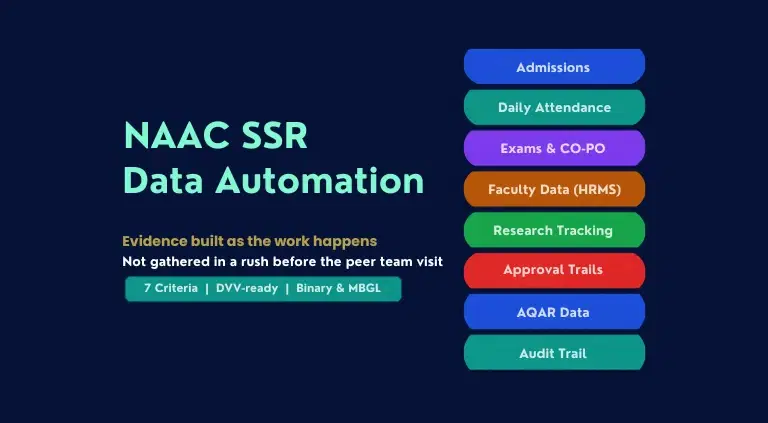
- Admissions feed Criterion 2 and 5. Enrolment, category-wise intake and scholarship data are captured once, at admission.
- Attendance and examinations feed teaching-learning metrics. Results and CO-PO attainment come straight from marks entry.
- Research and library records stay current. Publications and library usage are recorded as they happen.
- Placements are linked to named students. Offers and progression data are always ready for Criterion 5.
- Faculty records come from one source. Staff profiles and training records from edumerge HRMS feed faculty metrics.
- Approvals leave a trail. Governance decisions are recorded with dates & owners for Criterion 6.
Each criteria owner sees only their own data entry and evidence tasks, while the IQAC follows completion and gaps across all 7 criteria.
Evaluation checklist: 5 things to verify in any NAAC data collection system
| Checklist point | What good looks like |
|---|---|
| Criterion and sub-criterion ownership | Every criterion and sub-criterion is assigned to a responsible team or person, so nobody has to ask who is responsible. |
| One-time data entry at the source | Data entered in daily work, such as admissions, attendance or marks, counts towards NAAC without being typed again. |
| Criterion-wise status dashboard for the IQAC | The IQAC sees which metrics are complete, pending or missing evidence, criterion by criterion. |
| Faculty data from HRMS | Faculty counts, qualifications and training come from the HR system of record, not from department lists. |
| Role-based access for every department | Each department updates only its own metrics, while the IQAC and leadership see everything, with every change logged. |
edumerge College ERP is built to meet all 5; alongside OBE, examinations and placement records on one platform.
To explore how a college ERP brings admissions, examinations, faculty records and accreditation onto one platform, read what is College ERP software? - a complete guide for HEIs.
From Chasing Departments to Owning the Data
Every NAAC metric already has a natural home somewhere in the college. NAAC criteria data collection becomes easier the moment that home is made official, with one owner, one source and one place to see it.
When ownership is clear, the IQAC stops acting as a messenger and starts acting as a reviewer. Departments know what they are responsible for, and leadership can see readiness without calling meetings to find out.
edumerge College ERP brings that clarity into everyday work, so each criterion has an owner and each record has a source. The result is NAAC preparation that runs steadily through the year, driven by ownership rather than follow-ups.
Frequently Asked Questions (FAQs)
1. What is NAAC criteria data collection?
NAAC criteria data collection is the process of gathering data and evidence for every metric across NAAC's 7 criteria. It works best when each metric has a named department owner and data is recorded at the source, instead of the IQAC chasing every department for figures before each deadline.
2. Who is responsible for NAAC data in a college?
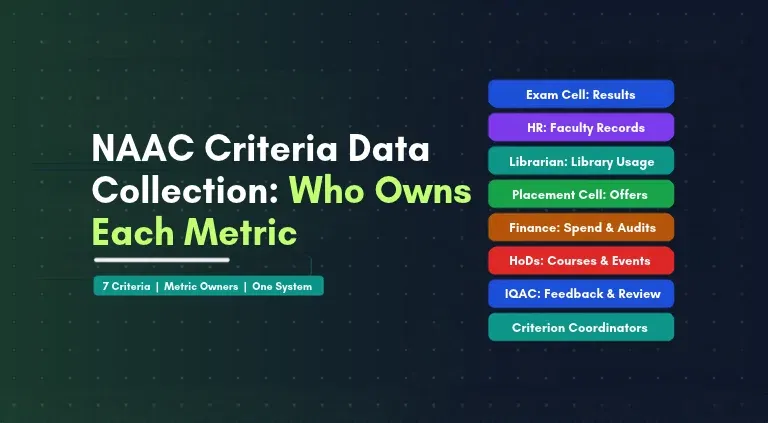
Each department is responsible for the data it creates. The Exam Cell owns results, HR owns faculty records, the Librarian owns library data and the Placement Cell owns placements. The IQAC coordinates the process, criterion coordinators check their criterion, and the Principal oversees overall readiness.
3. Which department handles Criterion 5 in NAAC?
Criterion 5 covers student support and progression, so it is shared. The scholarship desk handles scholarships, the Placement Cell handles placements and higher studies, student welfare handles grievance and guidance, and sports and cultural committees record awards. A criterion coordinator brings these together for the IQAC.
4. What does a NAAC criterion coordinator do?
A NAAC criterion coordinator acts as the nodal person for one criterion. They coordinate with departments and HoDs, check that data is complete and verifiable, report gaps to the IQAC and make sure every metric under their criterion has supporting evidence ready for the SSR and AQAR.
5. How often should colleges collect NAAC data?
Colleges should collect NAAC data continuously, not once before submission. Admissions data is captured each cycle, results each semester and library data monthly, while events, research and extension activities are recorded as they happen. The IQAC can then review status monthly and compile the AQAR every year.
6. How can a college ERP help with NAAC data collection?
A college ERP lets each department record data once in daily work, such as admissions, attendance, examinations and placements. Accreditation modules draw on those same records, so the IQAC sees criterion-wise status on one dashboard instead of collecting spreadsheets from every department.