A parent asks for a small discount at the fee counter, and the office agrees. It seems harmless, until the same thing happens on every campus, every term, with no record of who said yes or why.
This is exactly what a fee concession approval process is designed to prevent. It sets out clear steps that every concession must follow before it reaches a student's fee: A defined category, an approval limit, the right approver and a recorded reason.
At the same time, concessions also affect the trust's finances. Under the Income-tax Act, 2025, a school trust registered as a non-profit must apply, or formally accumulate, at least 85% of its regular income each tax year. So when concessions are not approved or recorded, the trust loses income without knowing exactly how much.
This blog explains how to set up a concession approval process that keeps every concession fair, approved and fully recorded across all your campuses.
TL;DR
Clear approvals are especially important because school fees are regulated. Under Chapter 7 of CBSE's Affiliation Bye-laws, 2018, schools may charge fees only as per the regulations of the appropriate government. And only under the fee heads prescribed by the state or UT Department of Education.
In addition, Clause 2.4.9 requires every affiliated school to publish the fees it charges on its website. As a result, each concession is a departure from a regulated, published fee.
A clear approval process for concessions makes sure every concession has a category, a limit, the right approver and a recorded reason before it is applied.
Without one, concessions are granted verbally, rules differ by campus and nobody can see the total. Over time, this becomes a steady and largely invisible loss of income.
edumerge Finance & Control brings control and visibility to concessions across campuses. Its approval controls, complete audit trail and Trustee dashboard show leadership exactly how much income is given up and why, while School ERP applies rule-based concessions automatically.
What is a Fee Concession Approval Process?
A fee concession approval process is a clear set of steps that every concession must follow before it reaches a student's fee.
In this process,
- each request is checked against agreed limits,
- approved by the right person, and
- recorded with a reason.
It simply replaces the quick yes at the counter, over the phone or in an email with an informed decision that can be traced efficiently.
Furthermore, a strong process covers every kind of fee reduction a school offers. That typically includes a fee discount approval for siblings, as well as a fee waiver approval for a family going through a difficult time.
At their core, concessions are an important way for schools to support families, staff and deserving students. The goal isn't to give fewer of them, but to make sure each one is fair, stays within agreed limits and has a clear record behind it.
Since concessions directly reduce a trust's income, it helps to see how they fit into the trust's overall accounts. Our guide on how to manage educational trust accounts in India explains this wider picture.
Why Fee Concessions Become a Leakage Point Across Campuses
Most fee leakage in schools comes from everyday decisions rather than fraud. In most cases, concessions are easy to grant but hard to track. And this becomes especially true when each campus follows its own approach.
Since CBSE requires schools to charge only approved fees and publish them, every concession is a departure from a regulated fee. And when these departures aren't recorded, the trust cannot see how much income it is giving up.
Across several campuses, the following patterns are the most common causes.
- Concessions are granted verbally or by email. A quick yes from a principal or office head leaves no formal record, so the concession cannot be checked later.
- There are no clear limits on who can approve how much. When anyone can approve any amount, large concessions can pass without senior review.
- Each campus follows its own rules. One campus may give a 25% sibling concession while another gives 10%, so families and staff see the group as inconsistent.
- Supporting documents go missing. Sibling details, staff IDs or income proof are often not collected, which makes concessions hard to verify during an audit.
- Concessions continue after the reason ends. A staff ward concession may carry on after the staff member leaves, simply because nobody reviews it.
- Nobody sees the total. Without a single view across the group, trustees cannot tell how much income is given up through concessions each year.
Each gap may seem small on its own. Together, though, they create steady revenue leakage that only shows up when the year's accounts are closed.
Our guide on fee collection management for groups of institutions looks at the wider fee picture across campuses.
How to Set Up a Fee Concession Approval Process, Step by Step
Setting up a fair concession process doesn't have to be complicated. In fact, the best ones are simple enough for every campus to follow.
These 6 steps which are mentioned below give all your campuses the same rules, while still keeping approvals quick for routine requests.
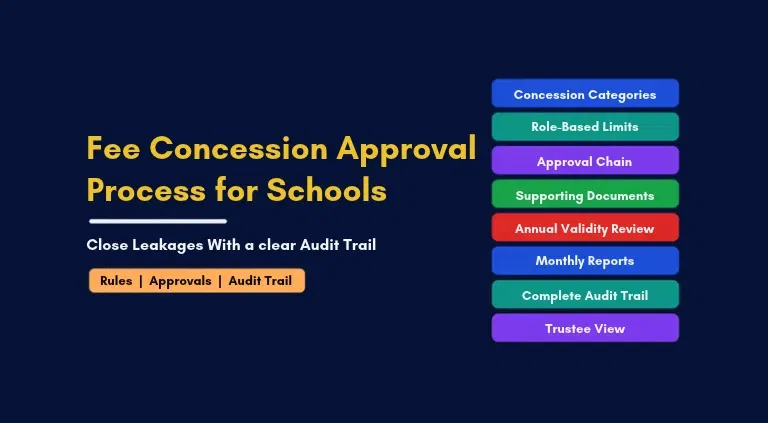
- Define concession categories. List the types of concession the group offers, such as sibling, staff ward, scholarship, merit and financial hardship. Also write a short fee concession policy for each, stating who is eligible and the standard amount.
- Set approval limits by role and amount. Decide who can approve each category and up to what value. The reason is that routine concessions may need only one approver, while larger or discretionary ones should go to a senior approver.
- Route every request through an approval chain. No concession should be applied until it has been approved through the agreed chain, with each step recorded.
- Require supporting documents. Ask for the right proof for each category, such as a sibling's admission number or a staff ID, and store it with the request.
- Set a validity period. Give every concession an end date, usually the end of the academic year, so it is reviewed again before it continues.
- Review concession reports every month. Compare totals by campus and category each month, and look closely at any unusual increase.
For a deeper look at how two-person approvals strengthen this process, explore our article on maker-checker control for procurement, fees and academics, which explains how maker-checker approvals work in practice.
How an Audit Trail Closes the Concession Leakage Gap
An approval is only as strong as the record behind it. While an audit trail for fee concessions captures the full story of every concession, from the first request to the final decision.
With that record in place, any concession can be reviewed in minutes, explained clearly to trustees and defended with confidence during a fee audit. The table below sets out the essential details every concession record must capture, and why each one matters.
| What to record | Why it matters |
|---|---|
| Who requested it | Shows where each concession began, so patterns by campus or staff member can be spotted |
| Who approved it | Confirms the concession was approved by someone with the right authority for that amount |
| Amount and fee head | Shows exactly how much income was given up, and under which fee head |
| Concession category | Allows concessions to be totalled and compared by type, such as sibling or staff ward |
| Reason | Explains the decision, which matters most for discretionary concessions such as financial hardship |
| Supporting document | Provides proof of eligibility, such as a sibling's admission number or a staff ID |
| Date and validity period | Shows when the concession started and when it must be reviewed again |
With complete records in place, finance teams no longer have to piece together the history of a concession from emails and memory.
Concessions also become easier to plan for, since their total value can be compared against the budget each month. Our guide to budget vs actual for school trust finances explains how to track this across campuses.
How edumerge Finance & Control Brings Control and Visibility to Fee Concessions
In most school groups, a fee concession starts as a conversation and ends as a figure nobody can fully explain. The approval was verbal, the reason was never written down and the total only surfaces when the accounts close.
edumerge Finance & Control changes that story by giving the group's finance team and trustees control over what happens once a concession enters the system.
- Clear authority for every financial decision. Finance & Control brings discipline to the group's finances through defined approval chains and role-based approval limits. Every approval is traceable to the person who gave it, so there is never any doubt about who decided what.
- A complete record in the accounts. Through fee-finance integration, every fee posting, reversal and refund from the campus flows to Finance with a complete audit trail and role-based access. Nothing changes in the books without a record of how it got there.
- One view of every campus for Trustees. The trustee dashboard brings figures from all campuses together, so leadership can review the group as a whole rather than one campus at a time.
- Concessions that start with rules. Finance & Control works hand in hand with school ERP's fee management, where concessions for categories such as scholarship, staff ward and sibling are set up as rules. They apply automatically when a student meets the conditions, rather than when a parent negotiates at the counter.
It also works alongside the trust's existing books, not as a replacement for them. The result is simple: every financial approval has an owner, every rupee has a record and every campus is visible on one screen.
To explore how Finance & Control supports finance, operations and governance across your entire group, read what is edumerge Finance & Control: finance, operations & governance for educational institutions.
Every Concession Approved, Every Rupee Accounted For
Concessions are one of the most valuable ways a school supports its families, staff and deserving students. The aim is not to give fewer of them. It is to make sure every concession is fair, approved by the right person and backed by a clear record.
When concession categories, approval limits and records are the same on every campus, fee leakage becomes much harder to hide. Trustees can then see exactly how much income the group gives up through concessions, and why, instead of discovering the total only when the accounts close.
edumerge Finance & Control gives school groups the control to make this happen. With defined approval chains, a complete audit trail through fee-finance integration and a trustee dashboard covering every campus, every financial decision has an owner and every rupee has a record.
As a result, concessions stop being a quiet source of leakage and become a well-governed part of how the group supports its community.
Frequently Asked Questions (FAQs)
1. What is a fee concession approval process?
It is a defined set of steps every concession must pass through before it is applied. Each request falls into a set category, stays within role-based limits, is approved by the right person and is recorded with a reason and supporting document.
2. Who should approve fee concessions in a school?
Approval should depend on the type and size of the concession. Rule-based concessions, such as sibling or staff ward, can follow set rules. Discretionary concessions, such as financial hardship, should go to a senior approver, with larger amounts escalated to the Principal or group finance head.
3. What documents are needed for a fee concession?
The documents depend on the category. A sibling concession usually needs the sibling's admission details, a staff ward concession needs the staff member's ID, and a financial hardship concession needs income proof or a written request. Every document should be stored with the concession record.
4. How can schools prevent fee leakage from concessions?
Schools can prevent this by setting clear concession categories, fixing approval limits by role and requiring a recorded reason and document for every concession. Monthly concession reports and an annual review of every concession then help catch anything granted without proper approval.
5. How often should fee concessions be reviewed?
Each concession should carry a validity period and be reviewed at least once a year. So it ends when the reason for it no longer applies. Group finance teams should also review consolidated concession reports every month, comparing totals across campuses and categories.
6. Can fee concessions be applied automatically?
Yes, for set categories. Rule-based concessions, such as sibling, staff ward or scholarship, can be applied automatically when a student meets the defined conditions. One-off or discretionary concessions should still go to a named approver, with a recorded reason and supporting document.