For a group of institutions, fee collection is rarely one process. Each campus runs its own counters, payment links & concession decisions, and the trustee board sees the combined figure only after someone compiles it.
Fee collection management for a group of institutions is about closing that gap.
The cost of the gap is real. As edumerge's research on school management ROI shows, late fees, missed installments and manual concessions can quietly drain 2 to 4% of a school's annual fee income. Across several campuses, those small leaks add up quickly.
Speed matters too. edumerge's case study on Clarence High School shows daily fee reconciliation moving from a manual, multi-hour exercise across payment modes to a fully automated, real-time process. Repeat that across every campus, and the case for one governed system becomes clear.
TL;DR
Most groups of institutions see their fee position only after a month-end compilation. So trustees decide on figures that are already out of date.
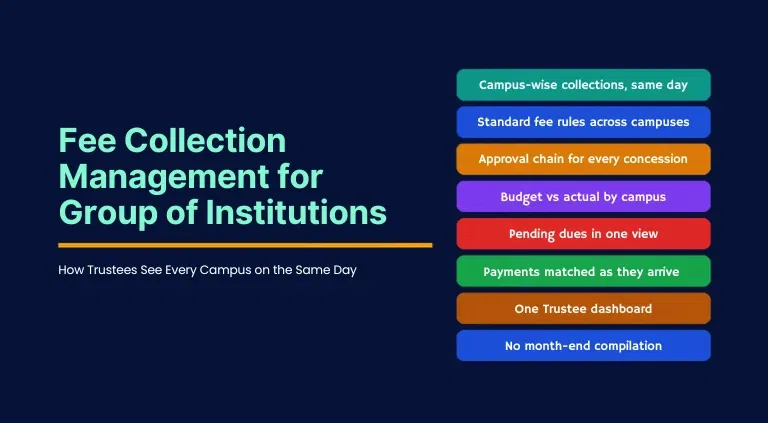
The fix is centralised fee collection: standard fee rules, online payment at every campus, instant matching and an approval chain for every concession.
edumerge Finance & Control gives trustees campus-wise collections, pending dues and budget vs actual on the same day through the trustee dashboard.
What is Fee Collection Management for a Group of Institutions?
Fee collection management for a group of institutions means collecting, matching & reporting fees across every campus in one governed system. The group gets a single, current collection figure instead of separate campus totals compiled at month-end.
For a single school, fee management is mostly about collecting on time. For a group, it is also about consistency and visibility.
In practice, it covers 5 areas:
- Standard fee structures: Fee heads, instalment plans and due dates are set once & applied across every campus.
- Online collection: Parents pay through UPI, cards and net banking at any campus, with less cash handled at the counter.
- Payment matching: Each payment is linked to the right student as it arrives, so reconciliation happens daily.
- Controlled concessions: Every discount follows a common policy and carries a recorded approver and reason.
- Group-level reporting: Campus-wise collections and pending dues roll up into one view for leadership.
As a result, every campus follows the same rules, and the board can see where each one stands without waiting for a report.
Choosing the right system starts with knowing what to look for. Read our guide on how to choose the best fee management software for your school.
Why Campus-Wise Fee Collection is Hard to See Across a Group
Most groups grow one campus at a time, and their fee processes grow the same way. These are the problems that come up most often:
- Different fee structures and tools: Each campus sets up fees in its own way, so the figures cannot be compared on a like-for-like basis.
- Different reporting formats: One campus sends a spreadsheet, another a printed summary, and someone has to make them match.
- Payments matched by hand: Bank credits are checked against student records manually at each campus, which takes hours and invites errors.
- Manual compilation at month-end: The group figure exists only after the accounts team spends days putting it together.
- Inconsistent concession approvals: Discounts are granted case by case, with no common rule or record of who approved them.
- No single view of pending dues: Each campus tracks its own defaulters, so the group cannot see total outstanding fees in one place.
- Late warning on shortfalls: A campus falling behind is spotted only after the board meeting, when it is too late to act.
The result is a fee position that is always a few weeks old, and a trustee board that decides on last month's figures. We explore this further in our blog on multi-campus fee collection for school groups.
How to Manage Fee Collection Across Every Campus in One System
Multi-campus fee management works when the group sets the rules once and every campus collects within them. Five steps get you there:
- Standardise fee structures and concession rules at group level, so every campus uses the same fee heads, instalment plans and discount policy.
- Collect fees online at every campus, giving parents UPI, card & net banking options, and reducing cash at the counter.
- Match each payment to the student as it arrives, so collections are reconciled daily, not at month-end.
- Route every concession through an approval chain, so each discount carries a recorded reason and approver.
- Roll collections up into one group view, where campus-wise figures and the group total update together.
The first two steps happen at campus level through online fee collection for schools. The last 3 turn separate campus figures into one governed group picture.
What the Trustee Dashboard Shows on Any Given Day
The real test of fee collection management for a group of institutions is what a trustee can see without asking anyone for a report:
| What the trustee sees | Without a dashboard | With the trustee dashboard |
|---|---|---|
| Campus-wise collections | A compiled report, often a week or more after month-end | Current collections for every campus on one screen, so shortfalls show up the same week |
| Pending dues | Separate lists kept by each campus office | Group-wide and campus-wise dues together, so follow-up starts before the deadline |
| Concessions approved | Known only to the campus that granted them | Every concession with its approver and reason, so leakage is visible and controlled |
| Budget vs actual | Reviewed after the year closes | Collections tracked against budget campus by campus, so the board can act mid-year |
The goal is not more reports. It is the same current figures for everyone, as we covered in our blog on multi-campus dashboards.
How edumerge Finance & Control Supports Group-Wide Fee Collection
edumerge Finance & Control is built for groups of institutions that need one clear view of fees across campuses.
With fee-to-finance integration, collections from every campus flow into the group's finance records automatically, with no re-entry or compilation.
Every concession moves through a defined approval chain, so each discount has a recorded approver and reason. Budget vs actual shows how each campus is tracking against its plan during the year.
The trustee dashboard brings campus-wise collections, pending dues and budget positions onto one screen for trustees, chairpersons and CFOs.
When you evaluate any system for group-wide fee collection, check these 5 points:
| Checklist point | What to check | Why it matters |
|---|---|---|
| Campus-wise collection visibility | Each campus and the group total on one screen | Trustees see the fee position without waiting for a report |
| Standard fee and concession rules | Fee heads and discount policies set once at group level | Figures are comparable and fair across every campus |
| Approval chain for every concession | A recorded approver and reason for each discount | Leakage is controlled and every concession is auditable |
| Budget vs actual by campus | Collections tracked against budget during the year | Shortfalls are caught mid-year, not at year-end |
| A same-day trustee dashboard | Current figures available on any given day | Decisions rest on today's position, not last month's |
For a closer look at how centralised collection works across many schools, read our guide on multi-campus fee collection software.
One Current Fee Position for the Whole Group
Fee collection across a group of institutions is not just an accounting task. It is a governance decision. When every campus collects and reports in its own way, the trustee board is always looking back at last month instead of acting on this one.
edumerge Finance & Control brings every campus into one governed system. Fee rules are set once, every concession passes through an approval chain, and Budget vs Actual is tracked as the year unfolds, not after it ends.
The result is a trustee dashboard that shows today's figures, campus by campus. Shortfalls surface early, decisions rest on the current picture, and the board leads the group instead of waiting on a report.
Frequently Asked Questions (FAQs)
1. What is fee collection management for a group of institutions?
It is the process of collecting, matching and reporting fees across every campus in one governed system. Instead of separate campus totals compiled at month-end, the group has a single, current collection figure, with standard fee rules and controlled concessions applied consistently across all its schools or colleges.
2. How can trustees track fees across campuses?
Through a trustee dashboard that shows campus-wise collections, pending dues and Budget vs actual on one screen. When every campus collects and records fees in the same system, the figures update together, so trustees see the current position without waiting for a compiled report.
3. How do groups standardise fee structures across campuses?
By setting fee heads, instalment plans and concession policies once at group level, then applying them to every campus. Local variations can still be allowed within those rules, but the structure stays consistent, so collections can be compared fairly across all campuses.
4. How are fee concessions controlled across campuses?
By routing every discount through an approval chain. Each concession carries a recorded reason and approver. So the group can see who approved what, at which campus and why. This closes a common source of fee leakage and gives auditors a clear trail.
5. What is budget vs actual in fee management for school groups?
It compares the fee income each campus planned to collect with what it has actually collected so far. Tracked during the year, it shows trustees and CFOs which campuses are falling behind early enough to act, instead of after the year closes.
6. Why does manual reconciliation slow down group fee reporting?
Each campus has to match payments to students by hand before its figures can be combined. That takes hours every day and delays the group report until every campus finishes. Matching payments as they arrive removes the delay and keeps the group figure current.