Imagine the accounts have closed for the year, and only then does the trust find out that one campus went over budget months earlier.
Budget vs actual for school trust finances prevents this by comparing each campus's planned income and spending with actual figures, month by month. As a result, overruns come to light while there is still time to act.
This matters even more since 1 April 2026. Under the Income-tax Act, 2025, a school trust registered as a non-profit must apply, or formally accumulate, at least 85% of its regular income each tax year, or the shortfall becomes taxable. So both overspending and underspending carry risk.
Similarly, raising fees is not an easy fix either. In Delhi, a School-Level Fee Regulation Committee must approve fees for 3 academic years. And in 2026-27, schools have continued at 2025-26 rates under interim High Court orders.
In this blog, you'll learn how school trusts can track budget vs actual campus by campus and act on overruns while there's still time.
TL;DR
Budget vs actual for a school trust compares what each campus planned to collect and spend with what actually happened. Its value lies in timing: monthly or live, not once a year.
Most trusts consolidate campus accounts only at year-end, approve spending without a budget check and notice fee shortfalls late. By then, overruns are history, not decisions.
edumerge Finance & Control gives trustees real-time financial reporting for every campus as spending is approved and fees are collected. It works alongside the trust's existing books, giving trustees control without replacing them.
What is Budget vs Actual for a School Trust?
Budget vs actual for a school trust is a live comparison of what each campus planned to earn and spend against what actually happened. It is reviewed throughout the year.
Furthermore, this replaces the year-end consolidation, which reveals overruns only after the money is spent. By then, the only option left is to explain them.
In practice, budget vs actual for schools works at two levels: Budget head and month.
- Every campus has a budget split by head, such as salaries, utilities, maintenance or events.
- That budget is then spread across the year.
So when fees come in, approved spending is matched against each budget line and the gap between the two is called the variance.
The purpose of school budget variance analysis is simple: Notice that gap early, then decide what to do about it.
Tracking budget vs actual begins with a well-built budget. And our guide on how to prepare a budget for schools & colleges in India explains how to create one, step by step.
Why School Trusts Discover Overruns Only at Year-End
Most school trusts prepare a budget at the start of the year, but the real problem begins only after that. Once the year is under way, the trust often has no clear view of how much each campus is actually spending compared with its plan.
Below are 6 common reasons why overspending stays hidden until the year-end accounts are closed:
- Campus accounts come together only at year-end. Each school keeps its own books. As a result, the trust gets a consolidated financial view at the same time as the auditor, which is far too late to act.
- Spending gets approved without a budget check. Without budget control in procurement, approvers ask whether a purchase makes sense. They rarely ask whether the budget head can still afford it.
- Fee shortfalls go unnoticed for months. When there's no fee collection tracking for school groups, a campus can fall behind its collection target while spending continues as planned. Meanwhile, the gap quietly grows.
- Trustees depend on manual reports. These reports arrive late, in different formats from each school. By the time they're read, the numbers are often out of date.
- Every campus defines a budget head its own way. One school books repairs under maintenance, while another books them under infrastructure. So comparing campuses becomes guesswork.
- There's no early warning system. Without alerts, nobody knows a campus is nearing its limit. The first sign of an overrun is usually the overrun itself.
At the heart of all 6 is one simple problem: money moves faster than the reports that track it. Good school trust financial management fixes this by giving the right people up-to-date numbers. So they can step in before small gaps turn into big ones.
To understand how trust-level accounts are structured, from separate campus books to consolidated reporting & audit requirements, explore our detailed guide on how to manage educational trust accounts in India.
How to Track Budget vs Actual Campus by Campus, Month by Month
Managing budgets across several campuses does not have to be complicated. The key is to focus on a few important figures and review them regularly, rather than trying to track everything.
The table below explains what each campus should monitor, when a difference between budget & actual needs attention and what action should be taken. The limits shown are for guidance, and each trust may adjust them to suit its own requirements.
| What to track | Why it matters | Review trigger (example) | Action it should prompt |
|---|---|---|---|
| Fee collection vs target | Fees fund most of a school's spending, so a shortfall shows up everywhere else later | Collection below the monthly target for 2 months in a row | Start a campus-level fee follow-up and review upcoming discretionary spend |
| Spend by budget head | Salaries, utilities, maintenance and events each behave differently | A head reaches its limit before the period it was planned for | Pause new spend requests on that head until finance reviews them |
| Monthly budget utilisation | Spending is seasonal, so yearly totals hide monthly drift | Utilisation well ahead of the monthly plan, not just the annual one | Ask the campus to explain the gap and re-phase the remaining months |
| Variance by campus | One campus overspending can be masked by another underspending | A campus moves outside the variance band the trust has agreed | Trustee review of that campus, with transaction-level detail |
| Pending spend requests | Approved requests are commitments even before they are paid | Pending requests that would push a head past its budget | Hold or re-prioritise requests in the approval chain |
| Underspend against plan | Unspent income that is not formally accumulated can leave the trust below the 85% mark | Planned spend lagging well behind by mid-year | Bring forward planned spend or record the reason for the gap |
Together, these measures form a practical budget vs actual report for trusts. Also they lay the foundation for a more effective budget control across a group of schools.
Of all the items, fee collection needs the closest attention, since it funds nearly every other line in the budget.
To learn how groups keep fee collection on target across all their campuses, explore our article on multi-campus fee collection software.
What to Look for in a Budget vs Actual Software for School Trusts
Spreadsheets work well for writing a budget. But trouble starts when spending happens across several campuses at once, and the sheet simply can't keep up.
That's where dedicated software makes a difference. But what's important to note is that not every tool is built for school trust financial management. So before you choose one, check it against these 5 points.
| Checklist point | What good looks like |
|---|---|
| Campus-wise budget heads under one trust structure | Every campus uses the same budget heads, so variances can be compared and rolled up to trust level. |
| Actuals updated as spending is approved and fees are collected | Real-time financial reporting for schools reflects today's position, not last month's closing, without anyone compiling a report. |
| Budget checks built into the approval chain | Approvers see the remaining budget before they approve a spend request, not after the money is gone. |
| Variance alerts before a campus crosses its limit | Heads approaching their limit are flagged early, while there is still time to act. |
| A Trustee dashboard with a consolidated, cross-campus view | Trustees see which campuses are on track, approaching limit or over budget, in one place. |
The third point matters more than it first appears. Because a budget check inside the spend approval workflow turns budget control from a report into a habit.
Since fee collection drives every line of the budget, the right system should track it alongside spending. Explore our guide on fee collection management for group institutions to see how this works across campuses.
How edumerge Finance & Control Flags Overruns Mid-Year
Knowing why overruns stay hidden is only the first step. Preventing them requires a system that tracks spending as it happens, and edumerge Finance & Control is designed to do exactly that.
Trustees should not have to wait for the auditor to learn which campus has overspent and that's why our platform brings budget vs actual into the moment a spending decision is made.
Every rupee is approved within budget, and every campus is visible on one screen.
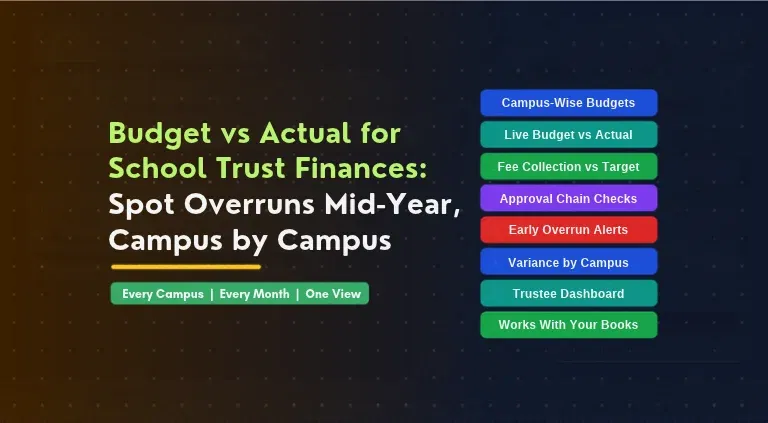
- No spending takes place outside the budget. Each spend request is raised at campus level and routed through a defined approval chain. Also, approvers can view the remaining budget before approving, which prevents overspending at the source.
- Variance is tracked live, not monthly. Budget vs actual is updated as soon as spending is posted. This makes finance heads and principals review their position at any time without requesting a report.
- Alerts are raised before an overrun occurs. The budget dashboard shows each department and campus as on track, approaching its limit or over budget. Early alerts flag potential overspending while there is still time to respond.
- Every variance is supported by detail. Summary variance shows the gap by department and budget head. While detail variance lists the transactions behind it, ready for trustee review.
- Monthly plans reflect actual spending patterns. The annual budget is distributed across the months in line with seasonal spending, rather than divided evenly by 12.
- Trustees can view every campus at once. For trustees, the group dashboard provides a consolidated financial view of all campuses, with a complete record behind every approval.
The system operates alongside the trust's existing books rather than replacing them. Finance teams retain their current accounting process, while trustees gain real-time control over spending.
From Year-End Surprises to Mid-Year Control
A budget is only as useful as the moment someone acts on it. When budget vs actual for school trust finances is reviewed once a year, it becomes a record of what went wrong. Reviewed month by month, campus by campus, it becomes a tool for keeping things right.
The timing has never mattered more. Fees are harder to adjust mid-year, and the 85% rule means both overspending and underspending carry consequences. Trustees need trust-level financial visibility while there are still months left to respond.
edumerge Finance & Control gives them that view. Every spend request passes a budget check, every campus is tracked live, and every overrun is flagged early enough to act on, so the year-end accounts confirm decisions already made rather than revealing surprises.
Frequently Asked Questions (FAQs)
1. What is the budget vs actual for a school trust?
Budget vs actual for a school trust is a comparison of what each campus planned to earn and spend against what it actually collected and spent. Reviewed monthly or live, it helps trustees spot overruns and shortfalls during the year, while there is still time to correct them.
2. How often should a school trust review budget vs actual?
A school trust should review budget vs actual at least monthly, with live tracking where possible. Monthly reviews catch drift early, while quarterly Trustee meetings can focus on campuses outside the agreed variance band. Waiting until year-end leaves no room to correct an overrun.
3. What is a budget variance for a school?
A budget variance is the gap between the amount a school budgeted for a head. Such as salaries or maintenance, and the amount it actually spent or collected. School budget variance analysis treats lower spending or higher income as favourable, and the opposite as unfavourable.
4. Why should a school trust track underspending too?
Under the Income-tax Act, 2025, a registered non-profit organisation must apply or accumulate at least 85% of its regular income to its purposes in the tax year, or the shortfall becomes taxable. Tracking underspend mid-year helps a trust bring planned spend forward instead of discovering the gap at year-end.
5. How can a trust track budget vs actual across multiple campuses?
Multi-campus budget tracking starts with the same budget heads on every campus and annual budgets split into monthly plans. Actuals are recorded as spending is approved and fees are collected. A Trustee dashboard then shows each campus as on track, approaching limit or over budget.
6. Does budget vs actual software replace a trust's accounting system?
Not necessarily. edumerge Finance & Control is built to work alongside a trust's existing books. It adds approval chains, budget vs actual tracking and a Trustee dashboard, so trustees gain control and visibility over spending without changing how the accounts themselves are kept.