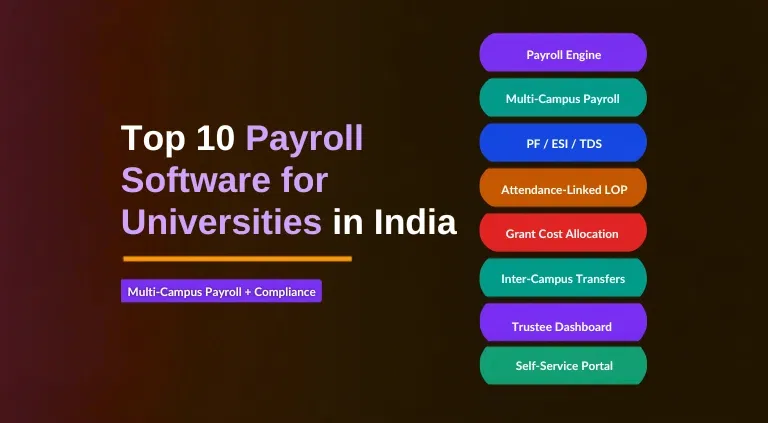
University payroll is not a simple monthly salary run. It has to account for teaching & non-teaching pay scales, grant-funded posts, exam duty pay, hostel & lab allowances, and staff spread across multiple campuses under one trust.
Most institutions still run this on generic HR software. The ones built for corporate offices, not education campuses. Every academic-calendar event becomes a manual workaround. Every faculty pay structure needs a workaround too. So does every inter-campus transfer.
The gaps do not stay hidden. They show up every month. In manual corrections, delayed payslips, and reconciliation work that falls on HR and finance teams already stretched thin.
This guide walks through the top 10 payroll software for universities in India. Explaining why generic tools fall short & exactly where, and how academic complexity meets statutory compliance. All while laying out what to check before you sign a vendor contract.
TL;DR
Generic payroll software is built for corporate offices, not campuses. Universities need academic-calendar aware cycles, grant-based cost allocation, and multi-campus payroll consolidation that most mainstream HR tools cannot handle natively.
This guide ranks the top 10 payroll software for universities in India. From education-native platforms like edumerge HRMS to enterprise HCM suites like Darwinbox, SAP SuccessFactors, and Workday. Weighing each against real university needs rather than generic feature checklists.
The right choice depends on whether payroll needs to understand teaching versus non-teaching pay, grant funding, and inter-campus staff movement. Or whether a standard HR platform is enough. edumerge HRMS is built specifically for the former.
Why Generic Payroll Software Falls Short for Universities in India
Corporate payroll platforms are built around a single pay cycle, single pay structure, and a single legal entity. A university rarely matches any of those three assumptions, and that mismatch is exactly why dedicated payroll software for universities exists.
- Academic Calendar Blindness: Generic payroll runs on a fixed monthly cycle with no concept of semesters, exam duty periods, or vacation-linked pay for teaching staff. Every academic-calendar event turns into a manual override.
- No Grant-Based Cost Allocation: Universities often pay faculty & research staff from multiple funding sources within the same department. A generic payroll engine has no field for this, so finance teams end up allocating costs in a separate spreadsheet after every pay run.
- One Pay Structure for All Staff Types: Teaching faculty, non-teaching staff, part-time visiting professors, and contractual employees each need distinct salary components. Forcing all of them through one generic pay structure creates errors that surface only at the audit stage.
- No Inter-Campus Staff Mobility: When a university or a group of institutions transfers staff between campuses, generic software treats it as an exit and a fresh hire. Payroll history, leave balances, and tax declarations do not carry forward automatically.
- Compliance Treated as an Afterthought: PF, ESI, Professional Tax, and TDS slabs change frequently and vary by state. Generic platforms built for a single industry vertical are often slower to update these rules for the specific exemptions that apply to educational trusts and societies.
You might also like exploring the best payroll systems for colleges in India.
The Challenge Without the Right Payroll Software for Universities
Here is what actually happens on the ground when a university runs payroll on a system that was not built for education.
| Challenge | How It Affects the University |
|---|---|
| Manual exam duty and overtime calculation | Accounts teams spend days reconciling allowances before every pay run, delaying salary disbursement |
| No grant-wise cost tracking | Finance cannot report accurately to grant bodies or auditors on how funded positions were paid |
| Fragmented staff records across campuses | Trustees wait for consolidated reports instead of seeing group payroll cost in real time |
| Manual Loss of Pay calculation | Payslip errors and disputes rise, increasing HR desk queries every month |
| Delayed statutory updates | Institutions risk late or incorrect PF, ESI, and TDS filings and the penalties that follow |
| Disconnected payroll and finance systems | Payroll journal entries are re-keyed manually into the accounting system, adding reconciliation risk |
| No self-service for staff | HR teams field repetitive payslip and leave balance queries instead of higher-value work |
Curious about automating payroll end to end? Take a look at our guide on automating payroll for schools & colleges in India.
Top 10 Payroll Software for Universities in India
1. edumerge HRMS Suite
Education-native payroll designed for institutions, with payroll & workforce management, student administration and finance built on one shared data architecture rather than three separate systems stitched together.
Key strengths:
- Attendance, leave & workload data flow directly into payroll with no manual handoff. So PF, ESI, Professional Tax & TDS are calculated automatically from verified time records rather than reconciled after the fact.
- The full salary run, including LOP deductions, arrears, and statutory contributions, executes in a single action and produces payslips and bank disbursement files together. Removing the multi-step process that most generic HR tools require.
- Payroll sits connected with the ERP and Finance & Control modules. So staff cost data, budget actuals, and trustee-level reporting stay connected instead of living in separate systems that need manual bridging.
- Purpose-built for the education sector's specific payroll shapes: academic-year cycles, teaching versus non-teaching pay structures, semester-based contractual staff, and multi-campus consolidation under one GOI.
- Statutory compliance (PF, ESI, PT, TDS, Form 16, full and final settlement) is maintained centrally and kept current with regulatory changes, rather than requiring each campus to track updates independently.
- Because it is built for institutions rather than adapted from generic corporate HRMS, onboarding a university group does not require reconfiguring the product around education-specific realities.
Book a Free Demo Today Explore edumerge HRMS Payroll
2. Darwinbox
Enterprise-grade cloud HCM suite with a strong India payroll engine. Widely adopted by large organisations including big education groups needing global-standard HR at scale.
Key strengths:
- Handles global statutory compliance, useful for institutions with cross-border staff or campuses.
- Broad HCM coverage beyond payroll, including talent and performance management, for institutions wanting one enterprise HR system.
What to note:
- Built as a general enterprise HCM suite, not for academic-year cycles or teaching staff pay structures
- Education-specific workflows need custom configuration.
- Enterprise scope and pricing are typically sized for large multi-entity organisations, which can be heavier than a university group needs for payroll alone.
Take a look into our comparison between edumerge HRMS vs Darwinbox which dives deep into the HR operations, features and functionality.
3. SAP SuccessFactors
Global HCM platform from SAP offering payroll as part of a broader autonomous, AI-assisted human capital management suite.
Key strengths:
- Deep integration with SAP's broader ERP ecosystem, useful for institutions already on SAP for finance or operations.
- Strong global compliance and reporting framework suited to institutions with multi-country presence.
What to note:
- Designed for large multinational enterprises first, so India-specific and education-specific payroll nuances often require significant configuration or third-party add-ons.
- Implementation and licensing costs are typically higher, and timelines longer than education-focused alternatives.
You might also find this comparison helpful on edumerge HRMS vs. SAP SuccessFactors HCM.
4. Workday
Cloud-based HCM and finance platform used by large global enterprises, with payroll as one module within a wider people-management suite.
Key strengths:
- Unified data model across HR, payroll, and finance, reducing reconciliation across systems for large organisations.
- Strong analytics and workforce planning capabilities alongside payroll processing.
What to note:
- Not built for Indian statutory payroll specifics or academic institution structures out of the box; both typically need partner-led customisation.
- Positioned and priced for large multinational enterprises, which can make it disproportionate for a single university group's payroll needs.
Explore the edumerge HRMS vs Workday comparison to evaluate key features and HR capabilities.
5. Keka
Employee-centric HRMS with a payroll module built around one-click processing, popular with mid-market Indian organisations for its usability.
Key strengths:
- One-click payroll flow with built-in PF, ESI, PT, and TDS handling designed to be operable by HR teams without finance dependency.
- Native architecture connects payroll with attendance, leave, performance, and recruitment under one employee record.
What to note:
- Built for general mid-market businesses, not education institutions
- Academic-year cycles, teaching staff structures, and student-employee payroll are not native concepts
- Multi-campus, trustee-level, or GOI-wide consolidated reporting is not a built-in capability and would need workarounds
See how edumerge HRMS compares with Keka across key HR, payroll, attendance, and employee management features.
6. greytHR
Widely used Indian payroll and compliance platform, especially common among SMBs and mid-sized organisations for its compliance-first approach.
Key strengths:
- Strong track record on Indian statutory compliance breadth and update cadence when tax slabs or rules change.
- Straightforward setup, making it accessible for institutions without large in-house IT or HR-tech teams.
What to note:
- General-purpose SMB-oriented tool, not designed around academic calendars, teaching versus non-teaching pay structures, or multi-campus GOI reporting.
- Broader HR and finance functionality is limited compared with unified education ERP suites, so it typically sits alongside other systems rather than replacing them.
Discover how edumerge HRMS and greytHR differ in their approach to payroll, workforce management, attendance, and HR automation.
7. Oracle Human Capital Management (HCM)
Enterprise cloud HCM suite from Oracle, offering payroll within a large, globally deployed human capital management product line.
Key strengths:
- Extensive global payroll and compliance coverage across many countries, suited to institutions with international operations.
- Deep integration potential with Oracle Fusion Cloud Finance and Procurement for organisations already on the Oracle stack.
What to note:
- Implementation is typically long and resource-intensive, and education-specific payroll structures require substantial custom configuration.
- Total cost of ownership and technical overhead are generally sized for large enterprises, not education-focused mid-size institutions.
Discover how edumerge HRMS differs from Oracle HCM across payroll, finance, HR automation, attendance tracking, and employee management.
8. ADP Workforce Now / ADP India
Established payroll and workforce management suite used by large organisations, including some university systems, for tax and compliance predictability at scale.
Key strengths:
- Broad integration ecosystem with finance and HR systems.
- Support infrastructure built for large, multi-location organisations.
What to note:
- Not built around academic institution needs; semester-based pay, teaching staff categories, and student-employee payroll require custom setup.
- Positioned primarily for large corporate workforces, so pricing and configuration can be heavier than what a single GOI's payroll function needs.
9. PeopleStrong
Indian enterprise HCM platform commonly chosen by large domestic organisations for unified HR and payroll operations.
Key strengths:
- Combines payroll with talent, attendance, and workforce analytics in one suite.
- Localised support and implementation experience within the Indian market.
What to note:
- General enterprise HR product, not built for academic-year cycles or education-specific staff categories.
- Configuration effort is needed for university use cases.
- Multi-campus, trustee-facing, or GOI-level consolidated reporting is not a native feature.
You might like this guide on how multi-campus institutions scale operations.
10. Zoho Payroll
Cloud payroll solution from the Zoho ecosystem, commonly used by smaller institutions or those already using Zoho Books and Zoho People.
Key strengths:
- Straightforward integration with Zoho Books and Zoho People for organisations already in the Zoho ecosystem.
- Handles core Indian statutory payroll requirements (PF, ESI, PT, TDS) reliably for standard use cases.
What to note:
- Designed for small teams and standard business payroll, not multi-campus GOIs, teaching staff structures, or academic-year specific pay cycles.
- Limited depth for complex, high-volume institutional payroll compared with education-focused or enterprise-grade suites.
If you're looking for employee management and HR automation capabilities, take a look at how edumerge HRMS compares with Zoho People.
How to Choose the Best Payroll Software for Your University
Once the gaps are clear, the next step is evaluating vendors against features that actually matter for a university, not a generic HR feature checklist. Here are the must-have capabilities to look for right now.
1. Academic-Calendar Aware Payroll Cycles
The system should run payroll around semesters, exam periods, and vacation pay without manual date overrides. For the Principal or Academic Head, this means payroll never conflicts with the teaching calendar.
2. Grant and Fund-Wise Cost Allocation
Payroll costs for grant-funded and departmentally funded posts should be tagged and reported separately by default. This gives the Finance Head audit-ready reports without a parallel spreadsheet.
3. Faculty, Non-Teaching, and Contractual Pay Structures
Look for configurable salary templates for every staff category in one system. HR Heads get accurate, error-free payroll across every staff type without maintaining separate processes.
4. Attendance-Linked Loss of Pay Automation
Leave and attendance data should flow into payroll automatically, with LOP calculated and shown as a named line item on the payslip. This gives staff full transparency and cuts payroll disputes for the HR desk.
5. Built-In Statutory Compliance
PF, ESI, Professional Tax, and TDS should be calculated automatically and filings such as PF ECR, ESIC challans, Form 16, and Form 24Q generated by the system. This keeps the Trustee or Chairperson audit-ready at any time.
6. Employee Self-Service Portal
Staff should be able to view payslips, apply for leave, and update personal details without visiting the HR desk. IT Heads see fewer support tickets and a single platform to secure with role-based access.
7. Real-Time Trustee and Director Dashboards
Payroll cost should be visible by campus and by department in real time, not at month-end. Trustees get consolidated group health without waiting for reports from each campus.
Conclusion
Choosing the best payroll software for universities in India comes down to one question: does the system understand academic calendars, grant funding, and multi-campus staff movement, or does it treat a university like any other office?
edumerge HRMS is built specifically for this context, connecting payroll to attendance, leave, and finance on one platform so trustees, HR heads, and finance teams work from the same real-time data.
Institutions ready to move off generic payroll can start with a demo of edumerge HRMS and see how a group-wide payroll run looks on a single, education-native system.
Frequently Asked Questions (FAQs)
1. Does payroll software for universities support multiple campuses?
Purpose-built education payroll platforms support group-wide payroll runs, campus-wise cost reporting, and inter-campus staff transfers with payroll history carried over automatically. Generic tools often require a separate account or workaround per location.
2. How does payroll software calculate Loss of Pay (LOP) for university staff?
LOP is calculated by linking unpaid leave and unauthorised absences from the attendance & leave module directly to the payroll engine. So the deduction appears automatically on the payslip without manual computation.
3. What statutory compliances should university payroll software cover?
University payroll software should automate Provident Fund (PF), Employee State Insurance (ESI), Professional Tax (state-wise slabs), and Tax Deducted at Source (TDS), and generate filings such as PF ECR, ESIC challans, Form 16, and Form 24Q.
4. Is payroll software for universities different from payroll software for corporates?
Yes. University payroll must account for academic-year salary cycles, teaching and non-teaching pay scales, grant-funded posts, and semester-linked exam duty pay. None of which a corporate payroll engine is designed to handle natively.
5. How long does it take to implement payroll software for a university?
Generic payroll platforms typically take 3-6 weeks for data migration, salary structure mapping, and attendance integration. Education-native platforms with pre-built academic salary structures can go live in a single guided onboarding session.
6. Does edumerge HRMS handle multi-campus payroll for groups of institutions?
Yes. edumerge HRMS runs group-wide payroll across all campuses with consolidated cost reporting for the trustee dashboard, and inter-campus staff transfers carry payroll records automatically to the new campus.
7. What questions should a university ask before signing a payroll vendor contract?
A university should ask about data ownership, exit & migration terms, statutory update turnaround time, support response SLAs, pricing at scale, and whether the platform is education-native or a generic tool configured for education.
8. Can payroll software integrate with a university's finance and accounting system?
A well-integrated platform posts payroll, PF, ESI, and TDS journal entries directly to the finance ledger without manual re-entry, which reduces reconciliation errors between HR and finance teams.