Every academic year, groups of institutions across India commit lakhs of rupees to vendors before a formal approval trail even exists. Public finance research shows education budgets are routinely trimmed by 9-16% before funds are released. So the runway institutions plan against is already shorter than the number on paper.
For a school or college still running purchase orders (POs) on paper or email, that leaves almost no room for a missed approval or an untraceable invoice. Survey data backs this up.
In a recent review of India's school education spending, 20.3% of respondents named misallocation of resources as a top concern. And 31.1% said infrastructure and facilities took the biggest hit when spending controls failed.
A purchase order management software exists to close exactly this gap, between what gets budgeted and what gets responsibly spent. This guide walks education leadership & operations heads through the challenges institutions face without it. Along with the features that separate a genuine buying decision from a checkbox purchase, and a checklist to evaluate vendors with confidence.
TL;DR
Manual procurement in Indian schools and colleges causes budget overruns, year-end "March rush" spending, and weak audit trails. Purchase order management software fixes this by connecting requisitions, approvals, and budgets in one workflow.
The evaluation should be on role-based approval chains, real-time budget vs actual tracking, multi-campus visibility, and a Trustee-level dashboard. At a time when cloud-based systems suit multi-campus groups better than on-premise software.
The 6-point evaluation checklist covers workflow flexibility, budget control depth, multi-campus support, vendor management, integrations, and implementation support. To help you make a sound decision before shortlisting any vendor.
Highlighting the strengths of edumerge's procurement management module under its Finance & Control suite.
Why Schools and Colleges Need Purchase Order Management Software?
Institutions typically run on tight budgets pulled from multiple sources. Without a system that ties every purchase to an approved budget line, spending decisions end up made in isolation. By whoever happens to hold the register or the email thread that day.
Manual approval workflows make this worse:
- Staff spend time chasing signatures instead of running day-to-day operations.
- Delayed approvals push departments toward emergency purchases at premium prices.
- Slow procedures tempt staff to skip approval altogether, creating compliance risk.
A good purchase order management software fixes this by creating one traceable path: from requisition, to approval, to vendor commitment. Along the way:
- Trustees get group-wide visibility instead of waiting on periodic reports.
- Finance heads get a live budget picture instead of reconciling at month-end.
- Principals and department heads get purchases moving without chasing signatures.
The case is even stronger for groups of institutions running multiple campuses. A shared finance platform means every campus:
- follows the same approval chain, instead of improvising its own process.
- buys at the same vendor rates, so no single site quietly overpays.
- meets the same audit standard, so no site becomes the weak link at review time.
As AI takes on a bigger role in financial decision-making, the same audit-trail discipline that governs every purchase order also applies to AI-assisted approvals. Read why AI needs an audit trail in regulated education to see why traceability cannot be optional in regulated institutions.
On-Premise vs Cloud-Based Purchase Order Software: What's Right for Your Institution
Many Indian institutions still run older, on-premise accounting systems inherited from a single-campus era. As groups of Institutions expand to multiple cities, the choice between on-premise & cloud-based PO software becomes a governance decision.
| Factor | On-Premise Software | Cloud-Based Software |
|---|---|---|
| Upfront cost | Higher, with server and licence costs paid at once | Lower, subscription-based with predictable annual cost |
| Multi-campus access | Limited; usually needs a local server per campus | Native; all campuses access the same live system |
| Maintenance and updates | Managed by institution's own IT staff | Handled by the vendor, with regular updates |
| Access during travel or outages | Restricted to the campus network | Available from any location with an internet connection |
| IT staffing needed | Dedicated server administration required | Minimal; institution IT focuses on users, not infrastructure |
| Best suited for | A single, self-contained campus with in-house IT | groups of institutions with multiple campuses or locations |
Real-time budget vs actual tracking only works if the budget itself is built well. See how to prepare budget for schools & colleges in India for a step-by-step approach before the next procurement cycle.
Key Features to Look for in Purchase Order Management Software for Schools and Colleges in India
Not every finance tool built for a general business fits an education institution's approval culture and multi-campus structure. These 10 capabilities separate software genuinely built for schools & colleges from a generic accounting add-on.
- Requisition-to-PO workflow that converts an approved request directly into a purchase order (PO) without re-entry.
- Role-based approval chains that route requests to the right approver by department, category, or amount.
- Real-time budget vs actual tracking so committed spend is visible before, not after, an invoice arrives.
- Multi-campus and multi-entity support for groups of institutions managing several schools or colleges under one trust.
- Trustee-level dashboard giving governance visibility across every campus without waiting for monthly reports.
- Vendor master and rate-contract management to keep pricing and vendor terms consistent across departments.
- Mobile-friendly approvals so principals and trustees can approve or query a purchase order while travelling.
- Audit trail with document attachments on every purchase order (PO), supporting statutory and internal audits.
- Threshold and budget-breach alerts that flag a purchase before it exceeds an approved budget line.
- Integration with existing finance & accounting systems so purchase data flows directly into the general ledger.
Purchase order (PO) data does not stop at approval. It flows straight into monthly closing, which is why getting reconciliation right matters just as much.
See how to do bank reconciliation for schools in India for the step that follows a settled purchase order.
Top 9 Purchase Order Management Software for Schools and Colleges in India
1. edumerge Finance & Control
Purpose-built purchase order management inside a full Finance & Control platform for schools, colleges, and groups of institutions. Every workflow, process and function is made to accommodate the typical operations of the Indian education & procurement landscape. That too, without any extra customization or external dependencies.
Key strengths:
- GST-inclusive PO line items capturing item, quantity, unit price, and GST percentage for compliant, audit-ready purchase orders.
- Vendor price verification checks PO rates against the vendor's catalog price before approval, flagging any mismatch between negotiated and entered rate.
- Full parent linkage; every PO traces back to its originating PR and RFQ, giving a complete chain for audit and governance review.
- Auto-PO creation on RFQ award, pulling in the winning vendor's item-wise prices without manual re-entry.
- PO auto-closes on full receipt via GRN, blocking further GRNs or invoices once all line items are received.
- Dedicated PO Status Report showing every order by status, vendor, and delivery completion, with pending GRN quantities visible.
- Budget validated at the purchase requisition stage, before a PO can even be raised, with escalation triggers on threshold breach.
- Connected to GRN, Service Entry Sheet, asset creation, and inventory posting, so a PO's downstream receipt and payment stay in one audit trail.
- Two-layer, amount-based approval workflow and cost-centre budget controls that scale from a single campus to a multi-institution group.
- Asset management integration auto-registers PO items marked as assets on GRN, giving them a unique code and moving them into the tracked lifecycle, from allocation and maintenance to disposal, without manual re-entry.
- AI finance insights adds AI-assisted expense categorisation for cost centre accuracy, along with predictive analytics that flag budget risk and vendor concentration before period end. A voice assistant also gives trustees, HODs, and principals direct access to spend status without touching the full module.
- Sits alongside vendor management within the same procurement management module, so every PO connects to a governed vendor record rather than a standalone entry.
2. Zycus Procure-to-Pay (Merlin AI)
Indian-origin, AI-driven procurement platform used mainly by large enterprises, occasionally by well-funded institutions.
Key strengths:
- Guided Procurement System standardises how POs are raised, reducing off-catalogue or maverick purchases.
- Merlin AI automates invoice-to-PO matching and vendor query handling.
What to note:
- Built for enterprise sectors like manufacturing and BFSI, so academic budget cycles and trustee-level PO reporting need custom mapping.
- Pricing and implementation are enterprise-grade, heavier than most schools or mid-size groups of institutions need.
Explore more about edumerge's zero hidden cost policy.
3. GEP SMART
Cloud-based, AI-powered procurement suite built on Microsoft Azure, aimed at large organisations.
Key strengths:
- PO issuance sits within a single platform covering requisition through supplier performance, with no separate bolt-on module.
- Optional managed-services layer for institutions that want day-to-day PO processing run externally.
What to note:
- Positioned for large corporations; education-sector PO reference cases in India are limited.
- Full value depends on adopting the wider spend-management stack, not just the PO function alone.
4. SAP Business One (SAP B1)
SAP's SME-tier ERP with a purchase order module, occasionally deployed by larger private universities.
Key strengths:
- Purchase orders tie directly into SAP's finance and inventory ledgers within one ERP backbone.
- Familiar to institutions already running SAP for other functions.
What to note:
- Built as a general SME ERP, not for education, so PO-to-department-budget mapping is absent by default.
- Customisation and licensing costs can run high relative to a single school or college's PO volume.
You might also like our comparison on edumerge Finance & Control vs SAP Business One.
5. Oracle Fusion Cloud Procurement
Enterprise cloud procurement module from Oracle's Fusion suite, used by a small number of large Indian university systems.
Key strengths:
- Strong PO approval hierarchies that handle complex, multi-entity structures at scale.
- Solid audit trail and compliance controls on every order, out of the box.
What to note:
- Complexity and cost typically exceed what a standalone school, college, or mid-size group needs.
- Long implementation cycles, usually requiring dedicated Oracle-certified partners.
Also give a read on how edumerge compares with Oracle ERP.
6. Zoho ERP (Zoho Books / Zoho Creator)
Low-cost, configurable business suite smaller institutions use to build a lightweight PO and approval flow.
Key strengths:
- Zoho Creator lets institutions build a custom PO-approval app without heavy development.
- Connects to Zoho's broader finance and inventory apps for basic PO tracking.
What to note:
- PO-specific workflows like RFQ comparison, GRN matching, and budget validation must be custom-built rather than configured out of the box.
- Multi-campus, trustee-level PO consolidation is not a native feature and needs additional development.
Take a deeper look at how edumerge Finance & Control compares with Zoho Books over features.
7. GeM (Government e-Marketplace)
Government of India's national public procurement portal, mandatory for the government and many aided institutions buying notified categories of goods and services.
Key strengths:
- Mandatory PO route for government and autonomous institutions under GFR Rule 149.
- Built-in e-bidding and reverse e-auction tools before a PO is issued, aiding competitive pricing.
What to note:
- Relevant mainly to government and government-aided institutions
- Private schools and colleges have no compliance obligation to use it.
- It is a marketplace, not an internal workflow tool. It doesn't manage internal indents, PO approval chains, or budget validation on its own.
8. Academia ERP (Serosoft)
Full-scale campus management platform with a purchase and inventory management module, used by schools, colleges, and universities.
Key strengths:
- The PO and store module sits alongside admissions, examinations, and student records in one suite.
- Migration support for institutions moving off legacy or spreadsheet-based PO tracking.
What to note:
- PO-specific depth such as RFQ bidding, GRN quality checks, and invoice ageing is not the module's primary design focus.
- Implementation timelines can extend for larger groups given the breadth of modules configured together.
9. MasterSoft ERP (Store and Purchase module)
Store management module within MasterSoft's broader education ERP, used by institutions in India.
Key strengths:
- Covers PO issuance, receipt of goods, stock book entries, bill passing, and store reports in one flow.
- Automates receipt of goods and material issuance tied to each purchase order.
What to note:
- PO-specific depth (RFQ bidding, invoice ageing, budget escalation) may not be the platform's primary design focus.
- Institutions evaluating it purely for PO management may end up paying for the broader ERP suite even if only the store module is needed.
Also take a look at our comparison between edumerge vs MasterSoft Education ERP
Vendor master and rate-contract management is only as strong as the vendor management approach behind it. Compare options in top vendor management tools for institutions in India.
Choosing the Right Purchase Order Management Software: A 6-Point Evaluation Checklist
Once a shortlist is ready, evaluate every vendor against these 6 points. This helps keep the comparison objective and closes the buying decision faster.
- Approval workflow flexibility: Can the workflow be configured to match your existing approval hierarchy, rather than forcing your institution to adapt to the software?
- budget control depth: Does the system show budget vs actual in real time, or only after month-end reconciliation?
- Multi-campus and group consolidation: Can a Trustee view spend across every campus from a single dashboard?
- Vendor and rate-contract management: Does the system prevent duplicate vendor entries and inconsistent pricing?
- Integration with existing finance, ERP, or HRMS systems: Will purchase data sync with your general ledger without manual re-entry?
- Implementation timeline and support in India: Does the vendor have a track record of onboarding Indian institutions within a realistic timeframe, with local support?
A Trustee dashboard is only as useful as the confidence leadership has in what it shows. Read what leadership actually needs from AI: verified Answers for a closer look at building that trust into AI-generated financial data.
Conclusion
Choosing the right purchase order management software for schools and colleges in India comes down to real-time budget visibility, role-based approvals, and a view that spans every campus a group operates.
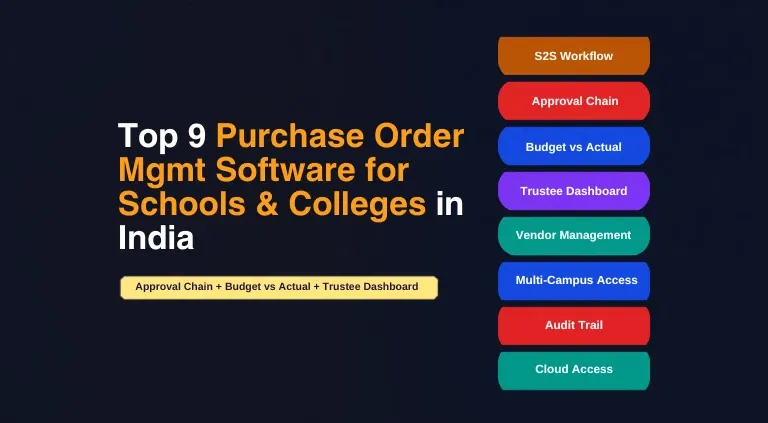
edumerge's Finance & Control suite was built around exactly this context. With an S2S workflow, approval chain, budget vs actual tracking, and a Trustee dashboard designed for Indian Groups of Institutions.
For institutions ready to move past manual procurement, edumerge offers a purchase order management approach built for the realities of Indian education finance, not adapted from a generic business tool.
Frequently Asked Questions (FAQs)
1. What is purchase order management software for schools?
It is a system that connects purchase requisitions, approvals, budgets, and vendor records. Built for a school, college, or group of institutions, to replace manual, paper-based procurement.
2. Why do colleges in India need a formal PO approval workflow?
A formal workflow ensures every purchase is checked against an approved budget before commitment. Thereby, reducing overspending and improving audit readiness.
3. Is cloud-based purchase order software better for multi-campus groups?
Yes, cloud-based software gives every campus access to the same live data. While on-premise systems typically need a separate server per location.
4. Does purchase order software help with budget overruns?
Yes. Real-time budget vs actual tracking flags spending against a budget line before an invoice is raised, rather than after the fact.
5. Can purchase order software integrate with existing accounting systems?
Most modern platforms, including edumerge Finance & Control, are built to sync purchase data directly with existing finance and accounting systems.
6. How long does it take to implement purchase order software in an institution?
Implementation timelines vary by vendor and institution size. So ask for a realistic timeline and local support track record during evaluation. Explore more about edumerge's implementation methods.
7. What causes the year-end procurement rush in Indian schools?
Budgets that are not spent earlier in the year must often be used within a short period to avoid lapsing, leading to rushed, lower-priority purchases.
8. Does purchase order software replace an institution's full accounting system?
No. It manages the requisition-to-approval-to-vendor commitment process and feeds that data into the institution's existing accounting and finance systems.
9. Is purchase order management software only for large institution groups?
No. Single-campus schools and colleges also benefit from structured approvals and budget visibility. Though the case is strongest for multi-campus Groups of Institutions.