In a group of colleges, each college prepares for NAAC at its own pace. Some are well prepared, while others may have weak areas that nobody has noticed yet. Group leadership often finds out about these gaps only a few weeks before the peer team visit.
NAAC preparation for multiple colleges solves this by tracking SSR and AQAR readiness for every college in one place. So leadership can spot problems early and act in time.
The reporting load is also significant here. Each NAAC-accredited college submits an AQAR for the previous academic year by 31 December, and 4 AQARs in every 5-year cycle. Also since 2016, regular AQARs have been made mandatory for the second and later cycles.
On top of this, the volume of data adds to the challenge as well. The major reason behind this is NAAC looks at colleges across 7 criteria, with 56 metrics for an affiliated college and 85 for an autonomous one. So when a few colleges are put together, the group is suddenly tracking hundreds of metrics.
In this blog, you'll learn how to build one clear view of accreditation readiness across your group, so weak criteria are fixed months ahead.
TL;DR
Group-wide NAAC preparation means tracking SSR and AQAR readiness for every college together, so leadership can spot gaps early and act on them.
When each college prepares on its own, cycles and deadlines overlap, progress is reported by phone or spreadsheet, and gaps often surface only before the visit.
edumergeOS brings every college onto one platform, with accreditation management for each institution and real-time visibility for group leadership.
What Does NAAC Preparation for Multiple Colleges Involve?
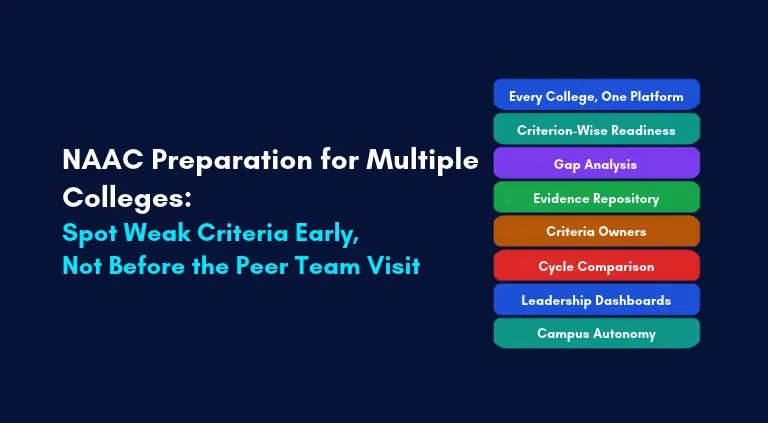
NAAC preparation for multiple colleges means tracking SSR and AQAR readiness for every college in a group from one place. It should help leadership get a clear view on each college's progress and act on gaps early before they turn into costly mistakes.
It is without this view, each college prepares everything separately, and gaps often surface only shortly before the peer team visits.
Since each college still owns its own NAAC preparation, its IQAC collects data, gathers evidence and prepares the AQAR and SSR when required.
What actually makes the change is that group leadership can see the whole picture, compare progress across colleges and step in where support is needed, rather than waiting for issues to be reported.
Groups that include autonomous colleges face extra responsibilities, from running their own examinations to managing their own curriculum.
To see how these colleges can be run smoothly alongside NAAC preparation, explore our guide on how to manage autonomous college operations.
Why NAAC Readiness is Hard to Track Across a Group of Colleges
Preparing one college for NAAC already takes a lot of work. But when a group has several colleges, the challenge becomes even more bigger.
Each college may be doing its own work well, but the group has no easy way to compare progress or check where things stand. Below are the key reasons on why this happens:
- No common format. Each college records its NAAC data in its own templates and systems. So when leadership tries to compare colleges, the figures simply don't line up.
- Overlapping timelines. Every college has its own accreditation cycle, yet all AQARs are due by the same date, 31st December. As a result, the group ends up juggling several cycles while facing one shared year-end rush.
- No like-for-like comparison. Without a shared way of measuring progress on each criterion, leadership cannot tell whether one college's "80% ready" means the same as another's.
- Mock reviews become the only checkpoint. Many groups rely on a mock NAAC review to assess readiness. By then, there is little time left to fix what it reveals.
- Reports lag behind reality. Updates reach the group office through calls, emails and spreadsheets, so leadership is always looking at last month's position.
- Lessons stay local. When one college finds a better way to handle a criterion, the rest of the group rarely benefits from it.
Many of these issues start with how NAAC data is owned within each college. Our guide on NAAC criteria data collection explains which department typically owns which metric.
How to Build a Group-Level View of SSR and AQAR Readiness
Having a group-level view of accreditation does not mean every college must prepare in the same way. Each college can still follow its own process.
What matters is that the same important information from every college is available in one place. The 5 steps below explain how a group can set this up:
- Map every college's accreditation cycle. List each college's current grade, its validity and when its next SSR is due.
- Track each college's AQAR status every year. Check that each AQAR is on track well before the 31 December AQAR deadline.
- Monitor criterion-wise readiness for each college. Review how complete the data and evidence are for each of NAAC's 7 criteria.
- Flag weak criteria early and assign owners. Give each one a named owner and a clear action plan.
- Set a group-wide review calendar. Agree when IQACs report progress and when leadership reviews the group as a whole.
The table below shows what to track for each college, how often to review it and the early warning signs to watch for.
| What to track | What it covers for each college | How often to review | Early warning sign |
|---|---|---|---|
| Accreditation cycle | When the current grade ends and when the next SSR is due | Every quarter | A cycle ending soon with no SSR plan in place |
| AQAR status | Whether the latest AQAR is submitted and this year's evidence is on track | Monthly from September | Evidence gaps in the autumn, or an AQAR at risk of missing 31 December |
| Criterion-wise readiness | Data and evidence completion for each of the 7 criteria | Monthly | One criterion falling well behind the others |
| Criteria needing attention | Criteria with gaps, along with an owner and an action plan | Monthly | The same criterion weak in several colleges |
| Leadership review | A short group-wide summary for trustees and directors | Every quarter | Repeated delays at the same college |
For the detailed steps each college should follow for its annual report, read our guide on how to prepare AQAR.
What to Look for in a NAAC Readiness Platform for a Group of Colleges
Spreadsheets are often where NAAC tracking begins, and for a single college they can work reasonably well. Once a group adds more colleges, the sheets multiply, versions clash and no one is sure which figures are current.
That's usually the point where groups start looking for dedicated NAAC accreditation software. Before choosing one, it helps to check how well it meets the criteria below.
| Checklist point | What good looks like |
|---|---|
| Criterion-wise readiness and gap analysis for each college | Each college can see how complete every criterion is, and where the gaps are, at any time. |
| A consolidated view for group leadership | Trustees and directors can see every college's progress in one place, without waiting for reports. |
| Evidence repository & criteria owners for every institution | Each criterion has a named owner, and evidence is stored against the criterion it supports. |
| Comparison across accreditation cycles | Colleges can compare current readiness with earlier cycles to spot trends and recurring gaps. |
| Role-based access for IQACs, principals & group leadership | Each person sees the information they need, while group leadership keeps a view across all colleges. |
A platform that meets these points turns accreditation from a cycle of last-minute effort into steady, visible progress.
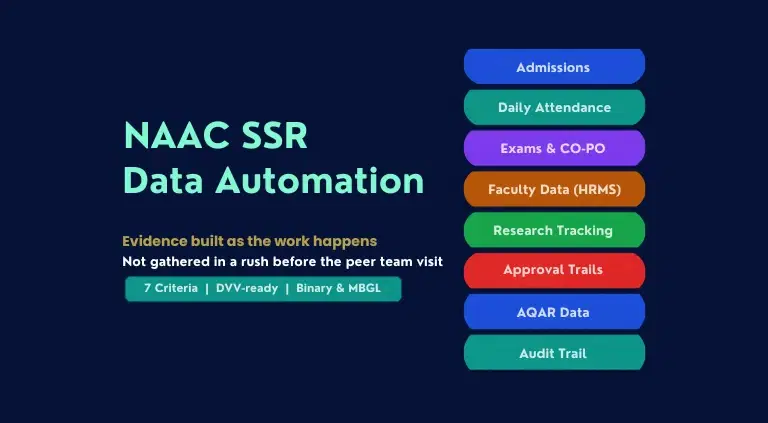
To see how evidence can be built day by day inside each college, explore our article on NAAC SSR data automation.
How edumergeOS Gives Group Leadership a Clear View of NAAC Readiness
When a group of colleges prepares for NAAC, trustees and directors usually ask the same questions. Which college needs attention? Which criteria are falling behind? Is the group ready for the next cycle?
In most groups, finding these answers means making calls and checking spreadsheets from each college. edumergeOS makes the answers easy to find, because every college in the group works on the same platform.
- "Which college needs our attention right now?" With every institution on the same system, leadership can compare colleges side by side through real-time dashboards, instead of waiting for monthly reports.
- "Which criteria are we weak on?" The accreditation management module gives each college gap analysis across NAAC's criteria, while leaders can see completion percentages and gaps through department-wise dashboards.
- "Who is responsible for fixing it?" Every criterion has a named owner within each college, and evidence is stored against the criterion it supports. Follow-ups go straight to the right person.
- "Are we doing better than last cycle?" Cycle comparison shows how each college's readiness has changed over time, so recurring weak spots are easy to identify.
- "How do we guide colleges without micromanaging them?" Centralised governance lets the group set shared standards, while each college continues to run its own NAAC preparation.
To understand how edumergeOS connects academics, HR and finance for every institution in your group on a single platform, read what is edumergeOS: the operating system for India's groups of educational institutions.
From Last-Minute Fixes to Group-Wide Readiness
For a college group, NAAC success depends on more than one strong IQAC. It depends on seeing every college's progress clearly, so weak criteria are found and fixed long before the peer team visits.
A group-level view also helps colleges learn from each other. When leadership can compare progress across the group, good practices spread faster and support reaches the colleges that need it most. This holds true whatever changes NAAC's binary accreditation brings.
edumergeOS gives groups of colleges that clarity. With every college on one platform, accreditation management in each institution and real-time dashboards for leadership, accreditation becomes a steady, visible process rather than a last-minute rush.
Frequently Asked Questions (FAQs)
1. What is NAAC preparation for multiple colleges?
It is the process of tracking SSR and AQAR readiness for every college in a group from one place. Group leadership can see each college's progress across NAAC's 7 criteria, spot weak areas early and support the colleges that need help, well before assessment.
2. How can a group of colleges track NAAC readiness?
Start by mapping each college's accreditation cycle and AQAR status. Then track progress on each criterion every month, assign owners to any gaps and hold a quarterly review with group leadership. A shared platform makes this far easier than collecting updates by email.
3. How often should group leadership review NAAC progress?
IQAC teams in each college should review criterion-wise progress every month. Group leadership can then hold a shorter review every quarter, focusing on colleges or criteria that are falling behind. Reviews should become more frequent as a college's next SSR approaches.
4. Why do colleges in the same group have different NAAC timelines?
Each college is accredited separately, so each has its own accreditation cycle and grade validity. Every accredited college also submits its own AQAR for the previous academic year by 31 December, which means a group manages several timelines at once.
5. What is the role of the IQAC in a college group?
Each college's IQAC coordinates its own NAAC data, evidence and AQAR. At group level, leadership sets shared standards, reviews progress across colleges and helps IQACs learn from each other, so good practices spread across the whole group. Clear shared timelines also help every IQAC plan its work with confidence.
6. Does NAAC's binary accreditation change group-level preparation?
NAAC's move to binary accreditation may change parts of the SSR and AQAR process. So colleges should check naac.gov.in for their own cycle. Whatever the final rules, tracking readiness across the group and fixing gaps early will remain valuable for every college.