It's December, the AQAR deadline is weeks away, and the IQAC is still chasing departments for data. Sounds familiar? Knowing how to prepare AQAR the right way can turn that scramble into a routine.
An Annual Quality Assurance Report (AQAR) is the yearly self-review that NAAC-accredited institutions submit to NAAC through their Internal Quality Assurance Cell (IQAC), covering one academic year.
The AQAR deadline doesn't move. NAAC requires the report for the previous completed academic year to be submitted online on or before 31 December, whatever the college's date of accreditation. After submission, NAAC verifies the AQAR and may ask for clarification, which the college must answer within 15 days.
The AQAR also shapes a college's next accreditation. Since 16 September 2016, NAAC has made regular AQAR submission mandatory for the second and later cycles. Under the current framework, a functional IQAC and timely AQARs are minimum requirements for applying for the next cycle.
In this blog, you'll learn how to prepare AQAR step by step, and how each year's report can leave your next SSR largely assembled before it's due.
TL;DR
AQAR preparation is easiest when the report is compiled from records kept throughout the year. Rebuilding data in December leads to missing evidence and figures that do not match.
In a five-year cycle, a college submits 4 AQARs. Together, they form most of the data behind the next SSR, so every well-kept year makes the SSR easier.
edumerge College ERP turns the AQAR into a by-product of daily records. Each year's report is ready to compile, and the SSR is largely assembled before it is due.
What is AQAR and Why Does It Matter for NAAC?
An AQAR is NAAC's annual quality assurance report, submitted each year by accredited institutions through their IQAC. When compiled from records kept throughout the year, it's accurate & quick to submit. But when rebuilt from scratch just before the deadline, it becomes a rushed and error-prone exercise.
Each AQAR covers one academic year. It is filled in online on the NAAC portal and brings together basic institutional details with criterion-wise information across NAAC's criteria.
In simple terms, it's a yearly record of what the college has done to maintain and improve quality since its last accreditation. The AQAR matters for 3 key reasons:
- It shows how quality is sustained between cycles. Accreditation is awarded once in a cycle, but the AQAR shows NAAC that quality work continues every year in between. It also gives college leadership a clear yearly view of progress across each criterion.
- It is a requirement for the next accreditation. For colleges in their second or later cycle, regular AQARs are a minimum requirement for applying again. A missing or late AQAR can therefore affect a college's eligibility for its next cycle.
- It builds trust with stakeholders. Colleges upload each AQAR on their own website, so students, parents and other stakeholders can see the college's progress for themselves. A well-prepared AQAR reflects an institution that takes quality seriously.
When they are together, these reasons make the AQAR far more than a yearly formality. It is the foundation the next SSR is built on, which is why the way it is prepared matters so much.
Keeping the AQAR accurate year after year depends on how well everyday college operations are run. To see what that involves, explore our guide on how to manage affiliated college operations.
Why AQAR Preparation Becomes a Year-End Scramble?
The AQAR is no surprise to any IQAC team as it comes around the same time, every year. Even so, the work still tends to pile up in the last few weeks before the deadline.
There is usually a reason behind this. In most colleges, the delay can be traced back to 6 common patterns:
- Data is collected only when the deadline nears. Requests go out to departments in October or November, long after the activities took place.
- Evidence is missing dates, signatures or reference numbers. Certificates and reports gathered months later are often incomplete, which makes them hard to verify.
- Figures do not match the previous year's AQAR. Student and faculty numbers shift between reports, which invites questions during verification.
- The same data is rebuilt every year. Without a single source, the IQAC collects details that were already reported in earlier years.
- Departments send data in different formats. As a result, the IQAC spends time cleaning and merging files before the real work begins.
- IQAC members juggle the AQAR with teaching. Most IQAC responsibilities sit alongside full teaching loads, so year-end pressure falls on a few people.
Faculty records are often the slowest part of the AQAR to compile. To keep them current throughout the year, explore our guide on faculty data for NAAC: HRMS for Criteria 2 and 6.
How to Prepare AQAR: A Step-by-Step Guide for IQAC Teams
The AQAR does not have to be a last-minute race against the deadline every time. With a clear IQAC AQAR process, it can become a steady routine that runs throughout the year.
The 6 steps below explain how to prepare AQAR in a way that keeps the report accurate and the deadline well within reach.
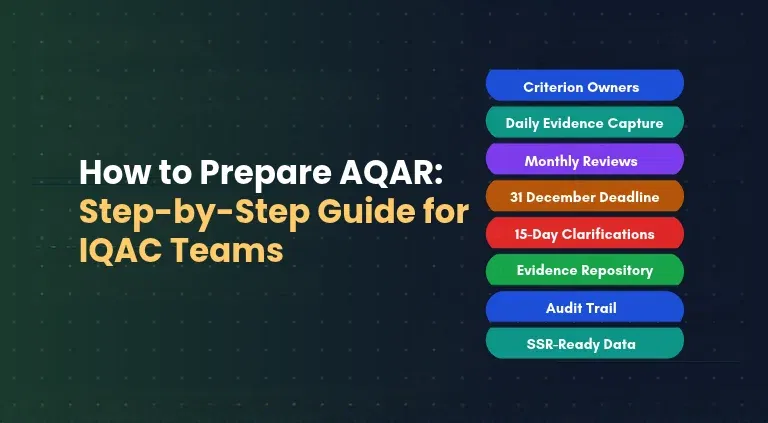
- Assign an owner for each criterion. Name one person or team responsible for each criterion, so criterion-wise data collection has clear ownership.
- Record data and evidence as activities happen. Log events, results, publications & approvals with dates and supporting documents at the time they occur, not months later.
- Review criterion-wise progress every month. A short monthly review helps the IQAC spot missing data and evidence while there is still time to collect it.
- Check figures against the previous year's AQAR. Compare key numbers, such as student strength and faculty count, so any change can be explained before submission.
- Compile, approve and submit before 31 December. Fill in the AQAR format on the NAAC portal. Get it reviewed by college leadership & complete the AQAR submission well before the deadline. Then upload the final report on the institution's website.
- Respond to any NAAC clarification within 15 days. With good NAAC evidence management, dated records and supporting documents are already stored, so replies can be prepared quickly.
Followed every year, these steps make the report a routine task rather than a rush.
Assigning the right owner to each criterion is still the first step to a smooth AQAR. Our guide on NAAC criteria data collection: Who owns each metric shows which department typically owns which metric.
How Your AQARs Build Your Next SSR
Many colleges see the AQAR as just a report they submit once a year. In reality, each AQAR also becomes part of the college's next SSR.
In a five-year accreditation cycle, a college submits 4 AQARs. These reports supply most of the information the SSR will need when the college applies for NAAC reaccreditation.
For the fifth year, the college collects the data directly for the SSR. The table below shows what each year adds to the SSR.
| Year of the cycle | What that year's records capture | What it contributes to the SSR | Risk if the data is weak |
|---|---|---|---|
| Year 1 (AQAR 1) | Baseline data across all criteria in the first year after accreditation | The starting point for every year-on-year comparison | A weak baseline makes later progress hard to show |
| Year 2 (AQAR 2) | Ongoing records of teaching, research, student support and governance | The first trend line across criteria | Gaps in one year break the multi-year trend |
| Year 3 (AQAR 3) | Mid-cycle progress and quality initiatives with dated evidence | Proof that quality is sustained, not one-off | Missing evidence leads to clarification requests |
| Year 4 (AQAR 4) | The last AQAR submitted before the SSR | The most recent reported figures in the cycle | Figures that do not match the SSR raise questions |
| Year 5 (no AQAR) | Final year's data, collected directly for the SSR | Completes the look-back period for the SSR | A rushed final year if records are not kept daily |
When every year's records are complete, dated and consistent, the SSR becomes a matter of compiling data rather than searching for it.
To see how evidence can be built day by day, so each AQAR and the final SSR come together with ease, read NAAC SSR data automation: Evidence built daily.
One point to keep in mind: As NAAC moves to binary accreditation, annual reporting requirements may change. IQAC teams should check the NAAC portal or naac.gov.in for the current requirement in their cycle. Either way, records kept carefully each year will remain valuable.
How edumerge College ERP Turns Daily Records Into AQAR-Ready Data
Most AQAR problems are not caused by a lack of effort. They happen because data sits in different places, recorded in different ways, and only comes together when the deadline is close.
Solving that requires more than just a checklist. It requires one system where every department records its work as it happens.
edumerge College ERP provides exactly that, turning everyday college activity into AQAR-ready data.
- Data is captured in daily work. Admissions, attendance, examinations, research and placement records are entered as part of routine college operations. AQAR data is then drawn from these same records, rather than being collected again.
- Every criterion has a clear owner. Each criterion and sub-criterion is assigned to a responsible team or person. Owners see their own data entry and evidence tasks, while the IQAC tracks progress across all criteria.
- Evidence is stored as it is created. Documents are uploaded against the relevant criterion and indicator, so certificates and reports are ready when the AQAR is compiled.
- Every change is traceable. A NAAC audit trail records who entered or updated each piece of data and when, which helps when NAAC asks for clarification.
- Gaps show up early. Criterion-wise gap analysis highlights missing data or evidence well before the 31 December deadline.
- The SSR draws on the same records. Because each year's data stays in one place, the SSR at the end of the cycle is largely assembled before work on it begins.
For a complete look at how the platform supports affiliated & autonomous colleges beyond the AQAR, explore what is edumerge College ERP: complete guide for colleges.
From Year-End Scramble to Year-Round Readiness
The AQAR deadline arrives every December, but the work behind a strong report happens throughout the year. When data and evidence are recorded as activities take place, preparing the AQAR becomes a matter of review rather than reconstruction.
The benefits also build over time. Four well-kept AQARs, followed by a carefully recorded fifth year, give a college most of what it needs for NAAC reaccreditation. Whatever changes the binary framework brings, records kept carefully each year will remain the strongest foundation.
edumerge College ERP helps colleges make that shift. As a college ERP for NAAC, it turns daily records into AQAR-ready data, so the SSR at the end of the cycle is already assembled rather than rebuilt in a rush.
Frequently Asked Questions (FAQs)
1. What is the last date for AQAR submission?
NAAC requires accredited institutions to submit the AQAR for the previous completed academic year on or before 31 December each year, whatever their date of accreditation. For example, an AQAR for the academic year that ended in mid-2026 is due by 31 December 2026, through the NAAC portal.
2. How many AQARs are required for NAAC reaccreditation?
In a five-year accreditation cycle, a college submits 4 AQARs. Data for the fifth year is collected directly for the SSR. Under the current framework, submitting AQARs regularly is a minimum requirement for colleges applying for their second or later cycle of accreditation.
3. What happens after an AQAR is submitted?
NAAC verifies the submitted AQAR and may ask for clarification on the data or information provided. Institutions must respond within 15 days of the request. Colleges should also upload each AQAR on their own website, so that students, parents and other stakeholders can access it.
4. Is AQAR mandatory under NAAC's new binary framework?
Submitting AQARs regularly has been mandatory for second and later cycles since 2016. NAAC's move to binary accreditation may change annual reporting, so IQAC teams should check the NAAC portal for their current requirement. Keeping AQAR-ready records each year protects the college whatever the final rules turn out to be.
5. Who prepares the AQAR in a college?
The IQAC coordinates AQAR preparation. Criterion owners collect data and evidence for their part of the report. While the IQAC coordinator checks completeness and consistency with the previous year. College leadership then reviews the report before the IQAC submits it online through the NAAC portal.
6. What is the AQAR format?
The AQAR is filled in online, in the format provided on the NAAC portal. It covers basic institutional details along with criterion-wise information across NAAC's criteria for one academic year. Colleges should follow the current format on the portal rather than older templates shared offline.