Ask an IQAC coordinator which NAAC data takes the longest to compile, and faculty records are almost always one of the first answers.
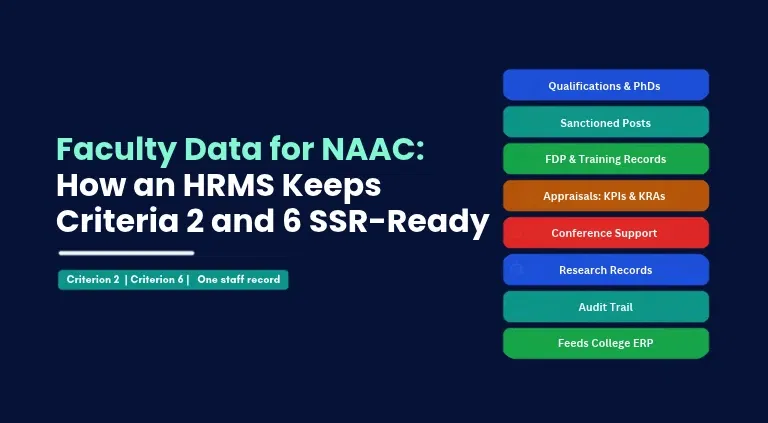
Faculty data for NAAC is everything a college reports about its teachers in the Self-Study Report (SSR). How many teachers it has, what qualifications they hold and how the college helps them grow. Most faculty data for NAAC sits under Criterion 2, in teacher profile and quality.
Within this, colleges report full-time teachers against sanctioned posts over the last 5 years, along with how many teachers hold a PhD. For affiliated colleges, the count goes a step further, with teachers who have cleared NET, SET or SLET also included.
Similarly, Criterion 6 covers the rest of the faculty data, under faculty empowerment strategies. Colleges describe their appraisal system and report teachers who attended FDPs or received at least Rs. 5,000 a year for conferences and professional bodies.
The good news is that HR already holds nearly all of this data. This blog explains what faculty data NAAC needs, why it falls out of date and how an HRMS keeps it SSR-ready all year.
TL;DR
Faculty data for NAAC changes all year, as teachers earn degrees, attend programmes and receive support. Yet most colleges collect it only when the SSR is due.
Updating records in a rush leads to mismatched teacher counts and missing certificates, often just when DVV asks for proof.
edumerge HRMS keeps every teacher's qualifications, training, appraisals and support records in one profile. So NAAC Criteria 2 and 6 draw on records HR already keeps current.
What Faculty Data Does NAAC Need for the SSR?
NAAC asks colleges for 5 years of faculty data on sanctioned posts, qualifications, PhDs, appraisals, financial support and FDPs. Each of these figures must also be supported by documentary evidence.
The simplest way to manage all of this is to keep one complete HRMS record for each teacher. That way, the data isn't split across HR files, department lists and teachers' own folders.
The table below breaks this down. For each type of faculty data, it shows which criterion it belongs to, what proof NAAC expects and where the data should be kept.
Some requirements differ for affiliated and autonomous colleges, and these are marked in the table.
| Faculty data point | Criterion | Supporting documents | Where it should live |
|---|---|---|---|
| Full-time teachers against sanctioned posts | Criterion 2 | Sanction letters from the competent authority, including management-sanctioned posts; year-wise teacher lists | Staff records in the HRMS, with sanctioned posts held centrally |
| Teachers with a PhD, D.Sc., D.Litt. or LL.D. (plus NET, SET or SLET for affiliated colleges) | Criterion 2 | Degree-awarding university, subject and year of award; copies of degrees | Qualification fields and uploaded documents in each staff profile |
| Average teaching experience and full-time teachers working in the institution (autonomous colleges only) | Criterion 2 | Joining dates and service records | Appointment and service history in the HRMS |
| Publications, books and research grants | Criterion 3 | Paper and chapter details, sanction letters for grants | Research records linked to each faculty profile |
| Performance appraisal system and welfare measures | Criterion 6 | Appraisal policy and records of welfare and career progression | Appraisal cycles with KPIs and KRAs in the HRMS |
| Financial support of at least Rs. 5,000 a year for conferences and professional bodies | Criterion 6 | Support policy, assistance letters, year-wise lists and audited statements | Support records against each teacher, matched with accounts |
| Participation in FDPs, MDPs and training programmes | Criterion 6 | Year-wise lists, certificates and annual reports | Training records with dated certificates in each staff profile |
Why Do Faculty Records Fall Out of Date Before Every SSR?
For most colleges, collecting faculty data is not the real challenge. The challenge is keeping it up to date. When records are only updated just before the SSR, the same 6 problems tend to appear.
- Qualifications and PhD completions are not updated after joining. A teacher who finished a PhD 2 years ago may still appear without one in HR's records.
- FDP certificates are collected just before deadlines. Teachers are asked to find certificates from years ago, and some are never found.
- HR and department faculty lists do not match. Each keeps its own list, so the number of full-time teachers changes depending on who is asked.
- Guest, visiting and newly joined teachers are counted differently. Without one rule for who counts as full-time, year-wise figures shift between reports.
- Financial support records are split between HR and accounts. Approvals sit with HR, payments sit with accounts, and matching them takes time.
- Sanction letters and degree copies go missing. When DVV asks for proof, the documents are often in old files or with a teacher who has since left.
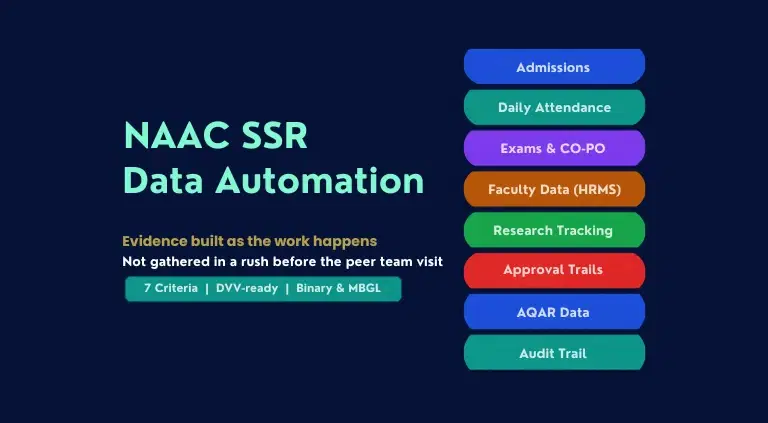
To understand how colleges can avoid these gaps by building evidence as the work happens, explore our article on NAAC SSR data automation: evidence built daily.
Spreadsheets vs HRMS: Managing Faculty Data for NAAC
In most colleges, faculty records are maintained in spreadsheets and paper files. For routine HR work, this approach is usually sufficient.
However, once NAAC preparation begins, every figure must be current, consistent & supported by evidence, and the limitations of manual records quickly become clear.
The comparison below shows how the two approaches differ.
| What NAAC needs | Spreadsheets and files | HRMS |
|---|---|---|
| Qualification tracking | Recorded once at joining, rarely updated | Updated in the staff profile as teachers add qualifications |
| PhD updates | Found out only when someone asks before the SSR | Recorded with university, subject and year as soon as awarded |
| FDP records | Certificates chased from teachers before deadlines | Logged with dated certificates as each programme ends |
| Financial support records | Split between HR files and accounts registers | Linked to each teacher and matched with accounts |
| Sanctioned post data | Kept in letters and separate sheets | Held centrally alongside staff records |
| Audit trail | No record of who changed what, or when | Every change logged with user and date |
| SSR readiness | Weeks of compiling and checking | Year-wise faculty reports available any time |
The verdict is clear. Spreadsheets can store faculty data, but they cannot keep it current, traceable or consistent across offices.
To see how much time manual records quietly cost an institution, read our article on the hidden cost of spreadsheet administration.
What to Look for in an HRMS for NAAC Faculty Data
Not every HRMS is designed with accreditation in mind. Even though many systems handle payroll, leave and attendance well, they often fall short when it comes to the records NAAC actually asks for, such as PhD details, FDP certificates and appraisal records.
So before choosing a system, use these 5 points to check whether it can keep your faculty data complete, current and ready to support NAAC Criteria 2 and 6.
| Checklist point | What good looks like |
|---|---|
| Qualification and PhD tracking in every staff profile | Each profile holds degrees, NET, SET or SLET, and PhD details with university, subject, year and document copies. |
| FDP, training and appraisal records with dated certificates | Training and appraisal entries carry dates and certificates, so year-wise counts for Criterion 6 are ready on demand. |
| Research & publication records linked to faculty profiles | Papers, books and grants sit against the teacher who earned them, which also supports Criterion 3. |
| Integration with the College ERP and its accreditation module | Faculty data flows into accreditation reports without being re-typed or exported between systems. |
| Role-based access with a complete audit trail | HR, HoDs and the IQAC see what they need, and every change to staff data is logged. |
Appraisals deserve a closer look, since NAAC asks colleges to describe their appraisal system in detail. Our guide to faculty appraisal systems for educational institutions explains what a strong system includes.
How edumerge HRMS Keeps Faculty Data NAAC-Ready All Year
Faculty data should not need a rescue mission every time the SSR comes around. It should be accurate on any given day, ready the moment the IQAC asks for it.
edumerge HRMS makes that possible by turning HR's everyday records into NAAC-ready evidence. Here is what changes for each team once faculty data lives in one system.
- The IQAC stops chasing certificates. Qualifications, PhD details and training certificates are already in each teacher's profile when Criterion 2 and 6 reports are due.
- Teacher counts match everywhere. HR and departments work from the same staff records, so full-time teacher figures stay consistent across every report.
- The appraisal system is ready to describe. Structured KPI and KRA cycles give colleges a documented process to present under Criterion 6.
- Nothing is typed twice. Because edumerge HRMS is integrated with College ERP, staff records feed the faculty metrics used in NAAC and NBA evidence directly.
- DVV queries get quick answers. Role-based access and a full audit trail show exactly who updated each record and when.
To explore how an HRMS manages the full staff lifecycle, from recruitment to appraisals, read what is edumerge HRMS - complete talent lifecycle management for educational institutions.
Make HR the Source of Truth for NAAC
Every figure NAAC asks about teachers starts as an HR record: an appointment, a degree, a training certificate or an appraisal. The question is whether those records are kept current as part of daily work, or rebuilt in a hurry every few years.
When HR becomes the single source of faculty data for NAAC, the IQAC stops chasing and starts reviewing. HR and departments stop debating numbers, and every figure in Criteria 2 and 6 has a document behind it.
edumerge HRMS makes that shift practical for colleges of every size.
Frequently Asked Questions (FAQs)
1. What faculty data does NAAC need for the SSR?
NAAC needs year-wise data on full-time teachers against sanctioned posts, teachers with a PhD or equivalent, appraisal systems, financial support for conferences and participation in FDPs. Each figure must be backed by documents such as sanction letters, degree copies and training certificates, covering the last five years.
2. Which NAAC criteria use faculty data?
Faculty data mainly feeds Criterion 2, under teacher profile & quality, and Criterion 6, under faculty empowerment strategies. Research records such as publications, books and grants also support Criterion 3. Keeping all of them in one faculty profile means each criterion draws on the same, consistent records.
3. Does NET or SET count for NAAC?
For affiliated colleges, yes. The affiliated college manual counts full-time teachers with NET, SET, SLET, PhD, D.Sc., D.Litt. or LL.D., using only the highest degree. The autonomous college manual counts only PhD, D.Sc., D.Litt. and LL.D., so autonomous colleges should not include NET or SET.
4. Is teaching experience required in the NAAC SSR?
It depends on the college type. The autonomous college manual asks for the average teaching experience of full-time teachers and the share who stayed in the institution. The affiliated college manual does not include these metrics, so affiliated colleges focus on sanctioned posts and qualifications under teacher profile.
5. What FDP records does NAAC accept?
NAAC asks for year-wise lists of staff who attended FDPs & training programmes, copies of certificates and annual reports of the programmes. Affiliated colleges count both teaching & non-teaching staff, while autonomous colleges count teachers only. Dated certificates stored in each staff profile make this easy.
6. How does an HRMS help with faculty data for NAAC?
An HRMS keeps each teacher's qualifications, PhD details, training, appraisals and support records in one profile that HR updates as things change. When linked to the College ERP, this data feeds NAAC reports directly, so the IQAC no longer collects certificates from teachers before every SSR.