For most IQAC teams, submitting the SSR feels like the end of the hardest stage. After months of collecting data, checking figures and uploading documents, it's natural to feel that the most important work has been completed.
Then a message arrives from NAAC, asking the college to prove one of the figures it reported. Soon, another follows, and then another. These are called NAAC DVV queries.
They are raised when a figure in the SSR does not match the evidence uploaded for it, or when that evidence is not clear enough to confirm it. They mainly carry real weight, because quantitative metrics make up about 70% of NAAC's assessment, and every one of them is verified.
Also time is what makes DVV so demanding as colleges are only given 15 days to complete the DVV process. So when evidence is scattered across old files, emails and different departments, those 15 days pass very quickly.
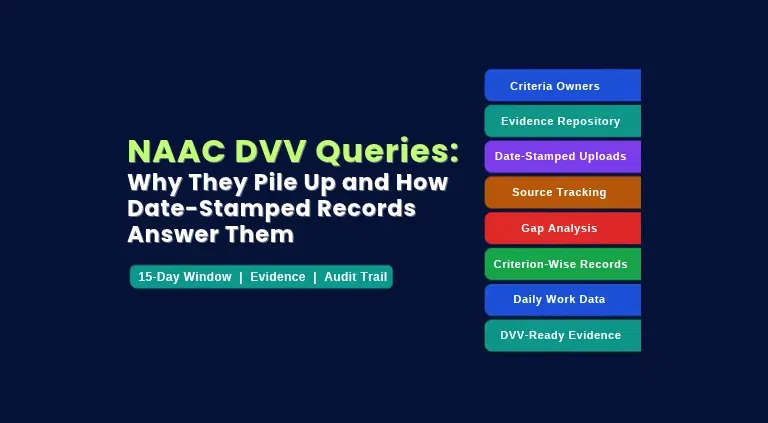
This blog explains why DVV queries pile up, what evidence each type of query needs and how date-stamped records help your IQAC respond calmly and with confidence.
TL;DR
DVV clarifications are raised when a figure in the SSR does not match, or is not supported by its uploaded evidence.
Most queries come from the same few causes: totals that don't match lists, undated documents and figures reported differently across criteria.
edumerge College ERP keeps every SSR figure linked to dated, traceable evidence, so colleges can answer queries quickly and within NAAC's window.
What are NAAC DVV Queries?
NAAC DVV queries are the clarifications NAAC raises during data validation & verification. When a figure in the SSR does not match, or is not supported by, the evidence the college has uploaded.
The college must then explain the difference or provide corrected data and documents, so that NAAC can confirm the figure before finalising its assessment.
In the accreditation process, DVV takes place between SSR submission and the peer team visit. Once the SSR is submitted, NAAC verifies the reported figures and generates a DVV deviation report.
The college can then move on to the peer team visit, but only after it clears the pre-qualifier. During that visit, the peer team focuses on the qualitative metrics.
For groups managing DVV across several colleges at once, our guide on NAAC preparation for multiple colleges explains how leadership can track readiness for every institution from one place.
Why NAAC DVV Queries Pile Up for Colleges
Getting a DVV query does not mean your college did something wrong. Usually, the work was done well, but the problem is that NAAC cannot find a clear record to prove it.
This points to a clear solution. To avoid DVV queries, a college does not need to take on additional work. It only needs to maintain proper records of the work it already carries out.
Furthermore, most of the queries happen for the same few reasons, and each of them can be fixed before the SSR is submitted. Below are 6 most common reasons, along with why each one leads to a DVV query.
- Figures do not match their supporting lists. A total in the SSR says one thing, while the uploaded list adds up to something different.
- Documents lack dates, signatures or reference numbers. Without these details, a document cannot prove when an activity happened or who approved it.
- The same number is reported differently across criteria. Student or teacher strength may appear with one figure in one metric and another figure elsewhere.
- Evidence falls outside the assessment years. Records from before or after the period a metric covers cannot be counted.
- Data is gathered in a rush before submission. When evidence is collected at the last minute, gaps and errors are easy to miss.
- Records sit with people who have left. When the staff member who held the data moves on, the evidence often goes with them.
Many of these issues begin with unclear ownership of NAAC data. Our guide on NAAC criteria data collection explains which department typically owns which metric.
The Most Common Types of DVV Queries, and the Evidence Each One Needs
Most DVV clarifications follow a few familiar patterns. While the details may change from one college to another, the underlying issue is usually the same: a figure that the evidence does not fully support.
So knowing these patterns in advance helps IQAC teams check their evidence before the SSR is submitted, rather than after a query arrives. It also makes responding faster, since the team already knows what kind of proof NAAC expects.
The table below lists each type of query, what usually causes it and the evidence that can answer it. Metric numbers are not included, as they vary between college types and NAAC manual versions.
| Type of query | What usually triggers it | Evidence that answers it |
|---|---|---|
| Count does not match the list | The number in the SSR differs from the names or items in the uploaded list | A complete list whose total matches the figure exactly |
| Document is missing or unclear | The uploaded file is unreadable, incomplete or does not relate to the metric | A clear, complete copy of the original document |
| Document has no date, signature or seal | Certificates, letters or reports lack details that prove when and by whom they were issued | A dated, signed copy from the issuing authority |
| Evidence falls outside the assessment years | Activities or records are dated before or after the years the metric covers | Records that fall within the assessment period only |
| Same figure differs across metrics | A number such as student or teacher strength appears differently in two places | One reconciled figure, used consistently across the SSR |
| Financial claim is not supported | Expenditure is reported without matching statements | Audited statements showing the relevant amounts |
| Link or publication cannot be verified | Web links are broken or publication details are incomplete | Working links, with full publication details and a copy of the first page |
Faculty figures are among the most frequently questioned SSR supporting documents. Our guide to faculty data for NAAC explains which records to keep for each faculty metric.
How Date-Stamped Records Help Colleges Answer DVV Queries Quickly
At its core, every DVV query asks the same underlying question, which is whether the college can prove the figure it has reported. Date-stamped records answer that question before it is even asked.
In fact, when each record carries a date, an owner & a source, responding to DVV simply becomes a matter of looking up the right record, rather than searching through old files. The comparison below shows this difference clearly.
| Step in the response | Without date-stamped records | With date-stamped records |
|---|---|---|
| Finding the evidence | Searching through files, emails and cupboards | Opening the record stored against the criterion |
| Proving when it happened | Asking staff to recall dates or find old letters | The date is already attached to the record |
| Knowing who to ask | Tracing which department or teacher held the data | Each record shows its owner |
| Matching figures to lists | Recounting names to make totals agree | The list and the total come from the same record |
| Responding within NAAC's window | Much of the 15 days spent gathering documents | Most of the time spent checking and submitting |
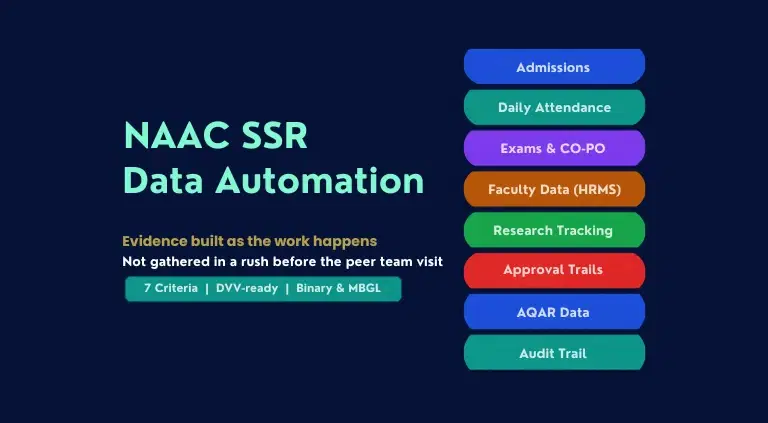
As a result, responses become much faster and far easier to complete within NAAC's 15-day window. To see how this evidence can be built day by day across the whole SSR, read our article on NAAC SSR data automation.
How edumerge College ERP Keeps DVV-Ready Evidence for Every Criterion
The best time to prepare for DVV is before the SSR is submitted, not after a query arrives. edumerge College ERP helps colleges do this by making sure every figure they report already has proof behind it.
When NAAC raises a DVV query, it usually wants to know one of five things. Here's how edumerge College ERP helps answer each one:
- Who is responsible for this figure? In the accreditation management module, every criterion and sub-criterion has a named team or person in charge. So when a query comes in, the IQAC knows straight away who to ask.
- Where is the proof? All documents are stored in one evidence repository, filed under the criterion and indicator they support. Nobody has to search through old files, emails or different departments.
- When did this happen, and where did the information come from? Every document uploaded is recorded with its criterion, date and source. This creates a clear NAAC audit trail that shows when each piece of evidence was added and where it came from.
- Is anything missing? Gap analysis shows which evidence is incomplete well before the SSR is submitted. This gives the college time to fix gaps before NAAC finds them.
- Why is this number different somewhere else? Accreditation data comes from the same records the college uses every day. This keeps figures like student or teacher strength the same across every part of the SSR.
To explore everything edumerge College ERP offers beyond accreditation, from admissions & examinations to fees & faculty management, read what is edumerge College ERP for affiliated & autonomous colleges.
From Stressful Searches to Quick Checks
DVV is one of the most demanding stages of NAAC accreditation, but it doesn't have to be the most stressful. Most queries come down to one question: can the college prove what it has reported?
Colleges that record evidence with a date, an owner and a source can answer that question with confidence.
This also makes every later stage easier, from the annual AQAR to NAAC reaccreditation.
edumerge College ERP helps colleges make this shift. As a college ERP for NAAC, it keeps every SSR figure backed by dated, traceable evidence, so DVV queries become a quick check rather than a stressful search.
Frequently Asked Questions (FAQs)
1. What are NAAC DVV queries?
DVV queries are clarifications raised during Data Validation and Verification, when a figure in a college's SSR does not match, or is not supported by, the evidence uploaded for it. The college must explain the difference or provide corrected data and documents within NAAC's stipulated time.
2. How many days do colleges get to respond to DVV queries?
Under NAAC's manual, institutions are given 15 days to complete the DVV process and must respond to clarifications within the stipulated time. NAAC itself completes the DVV process in not more than 30 days, and any Re-DVV follows the same timelines.
3. What happens if a college does not clear the DVV pre-qualifier?
After DVV, a college must score at least 25% in Quantitative Metrics, based on its final score, to proceed to the peer team visit. A college that does not clear this pre-qualifier cannot move to the visit and should check NAAC's current guidelines on next steps.
4. What is a DVV deviation report?
A DVV deviation report is generated after NAAC verifies the data in the SSR. The report shows where the data submitted by the college differs from what the supporting evidence confirms. And it feeds into the college's final score on those metrics before any peer team visit.
5. What documents help answer DVV clarifications?
The right documents depend on the query, but they usually include complete lists that match reported totals, dated & signed certificates, audited financial statements and working links for publications. Every document should fall within the assessment years and clearly relate to the metric it supports.
6. How can colleges reduce DVV queries?
Colleges can reduce DVV queries by recording data and evidence as activities happen, with a date, an owner and a source attached. Checking that every figure matches its supporting list, and that the same figure is used consistently across criteria, also prevents many common clarifications.