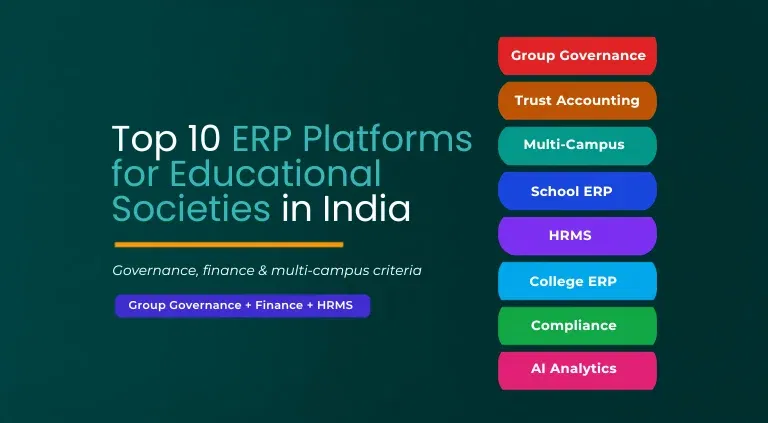
Educational societies & trusts in India rarely run just one school or one college. Most manage a cluster: a few schools, a couple of colleges, sometimes a diploma institute, all under one registered trust or society.
Choosing among the top 10 ERP platforms for educational societies in India looks simple from the outside. But the requirements of a multi-entity trust are structurally different from those of a single campus.
A society running 5 institutions cannot operate on 5 disconnected systems. They still expect the trustee board to see one true picture of enrollment, fee recovery, and academic outcomes. Every additional spreadsheet, folder, or standalone tool adds a reconciliation step that someone in the trust office has to do by hand.
This guide sets out why ERP selection for educational societies needs a different lens than a single-campus purchase, the governance problems that appear without a unified system.
TL;DR
Educational societies running multiple schools & colleges under one trust cannot rely on disconnected systems for each campus. Without a unified ERP, the trust office ends up manually assembling enrollment, fee & finance data every month. Delaying board decisions & creating audit-time scrambles.
The top platforms for this segment differ sharply. Most, including Academia ERP, Mastersoft, Camu & Entab, are built for single campuses or single-stream institutions. Leaving group-level consolidation, trust accounting, and trustee dashboards as custom add-ons rather than core features.
edumergeOS stands apart by treating the society as the primary unit. Unifying School ERP, College ERP, HRMS, and Finance & Control on one data layer. New campuses onboard using templates instead of fresh procurement cycles.
Common Governance Challenges Societies and Trusts Face Without a Unified System
These are the patterns that show up most often in societies and trusts that have not yet moved to a unified platform. Each challenge compounds as the group adds institutions.
1. Every Campus Runs Its Own System
Effect for educational societies: Different schools and colleges in the same group end up on different software, spreadsheets, or paper registers. There is no single source of truth the trust office can rely on when a decision needs to be made quickly.
2. Zero Consolidated Visibility
Effect for educational societies: Trustees & directors cannot see real-time enrollment, fee recovery, or academic performance across campuses without requesting manual, unit-wise reports first, which delays every board-level decision by days or weeks.
3. Inter-Entity Finance Becomes a Black Box
Effect for educational societies: Trust accounting, inter-campus fund transfers, and consolidated balance sheets are maintained on separate books with no reconciliation. So the finance head cannot produce a group-wide financial position without a manual, error-prone exercise.
4. Inconsistent Processes and Standards
Effect for educational societies: Admission workflows, fee structures, and HR policies differ from campus to campus. And standardising even one process across the group requires months of coordination between institutions that were never built to work the same way.
5. Growth Stalls Without Scalable Infrastructure
Effect for educational societies: Adding a new campus means a new vendor, new training, and a fresh data migration each time. This makes expansion slower and costlier the bigger the group gets, working against the very growth the society is trying to achieve.
Discover how educational groups of institutions can save operational costs with edumerge for a closer look at where that spend typically hides.
Top 10 ERP Platforms for Educational Societies in India
1. edumerge OS
An operating system built specifically for Groups of Institutions (GOIs), unifying School ERP, College ERP, HRMS, and Finance & Control in one suite (edumergeOS). Designed to give trust and society leadership a single source of truth across every campus, without stitching together separate vendors for academics, people, and finance.
Key strengths:
- Four integrated platforms under one roof, removing the need to stitch together separate vendors for academics, people, and finance.
- Finance & Control Suite built around group-critical workflows: S2S fund flow, structured approval chains, Budget vs Actual tracking, and a Trustee dashboard, giving management-level visibility without a full accounting system replacement.
- Scalable architecture to accommodate institution-level growth, served with the best-in industry customer support
- GOI Command Center gives trustees & group leadership a consolidated, cross-campus view rather than requiring custom reporting work on top of a generic ERP.
- Organized around a "Suite = POD" model, so each functional area (admissions, examinations, HR, finance) is owned and evolved as a dedicated product line rather than a bolted-on module.
2. Academia ERP (Serosoft)
Full-scale campus management platform used by colleges, universities, and large institutions across India for complex, high-volume data operations.
Key strengths:
- Broad module coverage across admissions, examinations, and student records in a single suite.
- Provides migration support for institutions moving off legacy or spreadsheet-based systems.
What to note:
- Group-level features such as consolidated multi-campus trustee reporting typically need custom configuration rather than coming standard.
- Implementation timelines can extend for larger groups given the breadth of modules being configured together.
Explore more challenges of running multiple institutions under a trust.
3. Mastersoft ERP
Higher-education focused ERP with a long-standing presence among Indian colleges and universities for admissions, exams, and administration.
Key strengths:
- Long operating history with a large installed base among Indian higher-ed institutions.
- Covers admissions, examination management, and academic administration in one system.
- Offers biometric and hostel management add-ons alongside core academic modules.
What to note:
- Interface and workflow design can feel dated compared to newer, mobile-first ERPs.
- Multi-campus group governance features often require add-on customization.
See how edumerge compares with MasterSoft for educational ERP capabilities and institutional requirements.
4. Camu
AI-powered campus ERP for schools and higher education, positioned for NAAC, NEP, and NIRF compliance readiness.
Key strengths:
- Claims adoption across institutions indicating scale in higher education deployments.
- Covers the full student lifecycle from admissions to alumni in one module structure.
- Includes operational modules such as inventory, hostel, mess, and library management alongside academics.
What to note:
- Depth of compliance-specific features (NAAC, NEP, NIRF) may need validation against a specific institution's accreditation body.
- Group-level trustee or society-wide financial control is not the platform's primary positioning.
You might also like our comparison between edumerge vs Camu.
5. Digiicampus (Digii)
Digital campus platform aimed at higher-education institutions looking to centralize operations and student information.
Key strengths:
- Centralizes ERP and student information system functions on one platform.
- Built with a mobile-first approach for student and staff access.
- Includes disaster recovery and business continuity features for operational uptime.
What to note:
- Positioning skews toward individual campus digitization rather than multi-campus group orchestration.
- Public information on society-level or trustee-facing features is limited.
6. Contineo
Campus ERP used by colleges and universities for academic and administrative process automation.
Key strengths:
- Covers core academic workflows including admissions, attendance, and examinations.
- Offers role-based dashboards for administrators, faculty, and students.
- Positioned for both autonomous colleges and university-affiliated institutions.
What to note:
- Less public documentation is available on group-wide or society-level consolidation features.
- Suited more to single-campus or affiliated-college deployments than large multi-entity groups.
7. Heraizen (DHI / GUNI-ERP)
Engineering-education focused ERP centered on accreditation readiness and performance analytics.
Key strengths:
- Strong focus on NBA and NIRF accreditation preparedness through automated tracking.
- Descriptive, prescriptive, and predictive dashboards for faculty and student performance.
- Includes an in-built expert system aimed at capability improvement for students and faculty.
What to note:
- Product focus leans toward engineering colleges rather than broad K-12 or multi-stream group operations.
- Financial and HR modules are less emphasized compared to academic and accreditation tracking.
8. Entab
School-focused ERP and campus management system with wide adoption among K-12 institutions in India.
Key strengths:
- Established presence across a large number of K-12 schools nationally.
- Covers admissions, fee management, attendance, and parent communication in one platform.
- Offers a mobile app for parent and student engagement alongside the core ERP.
What to note:
- Primary strength is single-school and school-chain operations rather than large, diversified education groups spanning schools, colleges, and universities.
- Group-level financial governance (trustee dashboards, consolidated Budget vs Actual) is not a core focus area.
Explore how edumerge compares with Entab across core features, scalability, integrations, and administrative workflows.
9. Next Education
K-12 focused education technology company offering ERP alongside curriculum and learning content.
Key strengths:
- Bundles ERP with curriculum, assessment, and learning content, useful for schools wanting an integrated academic and administrative stack.
- Established brand recognition among Indian school chains.
- Offers analytics on student learning outcomes tied to curriculum data.
What to note:
- ERP capabilities are often positioned alongside content and curriculum offerings, so institutions purely seeking administrative ERP may find the scope broader than needed.
- Multi-campus trustee or society-wide financial control is not a primary feature set.
10. MyClassboard
Cloud-based school ERP aimed at K-12 institutions and school groups for day-to-day administrative operations.
Key strengths:
- Covers attendance, fee collection, timetable, and communication modules for schools.
- Offers a parent-facing mobile app for real-time updates.
- Supports multi-branch school chain deployments.
What to note:
- Positioning is centered on K-12 school chains rather than diversified groups running schools, colleges, and universities together.
- Depth of finance-and-control features (approval chains, trustee-level Budget vs Actual) is limited compared to platforms built for group governance.
You might also like this guide on the top 10 multi-campus management software for educational groups in India.
Evaluation Criteria for Choosing an ERP for Educational Societies
Before shortlisting any platform, trustees and ERP decision-makers should test candidates against these criteria. A society-grade ERP should clear all of them, not just two or three.
| Criteria | Why It Matters | What Good Looks Like |
|---|---|---|
| Unified data architecture | Determines whether every module across every campus shares one source of truth | One database across all institutions, not campus-level silos |
| Trust/society accounting | Governs how fund transfers and consolidated books are managed | Multi-entity ledgers, inter-campus transfers, consolidated P&L |
| Governance dashboards | Gives the trust office a real-time, group-wide view | Live KPIs on enrollment, fee recovery, and academic outcomes |
| Campus-level autonomy | Ensures local operations are not slowed down by central control | Group policy enforced centrally, daily operations run locally |
| Onboarding speed | Determines how fast the group can add institutions | New campus configured on the same platform in days, not months |
| Compliance and audit readiness | Reduces the burden at year-end and during regulatory review | FCRA-compliant reporting and audit trails built into daily use |
| Security and access control | Protects sensitive student, staff, and financial data | Role-based access with entity-level data isolation |
| Support model | Affects how quickly issues get resolved across a large group | Dedicated account management aware of every campus in the group |
For a closer look at what a unified system looks like in practice for trusts & societies, see top unified ERP systems for educational trusts in India.
Conclusion
Choosing among the top ERP platforms for educational societies in India ultimately comes down to one question: does the platform treat the group as the primary unit, or does it treat each campus as a separate customer that happens to share a trust name. Societies that get this right stop reconciling spreadsheets and start running one system with real-time visibility across every institution.
For trustees and finance heads evaluating ERP for educational societies in India, the platforms that pass the test are the ones built for consolidated governance, trust accounting, and campus autonomy from day one, not retrofitted for it. edumergeOS is built on exactly that foundation, unifying School ERP, College ERP, HRMS, and Finance & Control on a single data layer.
Frequently Asked Questions (FAQs)
1. How is a society ERP different from a single-campus ERP?
A single-campus ERP manages one institution end to end. A society or group ERP must do that for every institution simultaneously, while also managing the group office layer that a single-campus system was never built for.
2. Does an ERP for educational societies support FCRA-compliant reporting?
Yes. A society-grade ERP should include consolidated trust accounting with FCRA-compliant reporting, so donor and grant-linked funds are tracked with a full audit trail across the group.
3. Can each campus in a society keep its own fee structure on a unified ERP?
Yes. A properly built group ERP lets each campus retain its own fee structures and admission workflows while the group office sets standardised policy and monitors compliance centrally.
4. How long does it take to onboard a new campus onto a group ERP?
Platforms built for groups of institutions, such as edumergeOS, use pre-built templates so a new campus can go live in about a day, compared to months for a fresh single-campus procurement cycle.
5. What is Society-to-School (S2S) fund flow?
S2S fund flow tracks every rupee transferred from a parent trust or society to an individual institution, with a full audit trail and approval history, removing the need for manual fund reconciliation.