Autonomous colleges in India carry a level of academic & administrative freedom that ordinary affiliated colleges do not. That freedom comes with responsibilities like:
- designing your own curriculum,
- running your own examinations, and
- proving outcomes to NAAC and NBA on your own schedule.
India's roughly 1,222 autonomous colleges make up just 2.6% of the country's 47,000 colleges, yet they carry a disproportionate share of governance, accreditation, and reporting complexity.
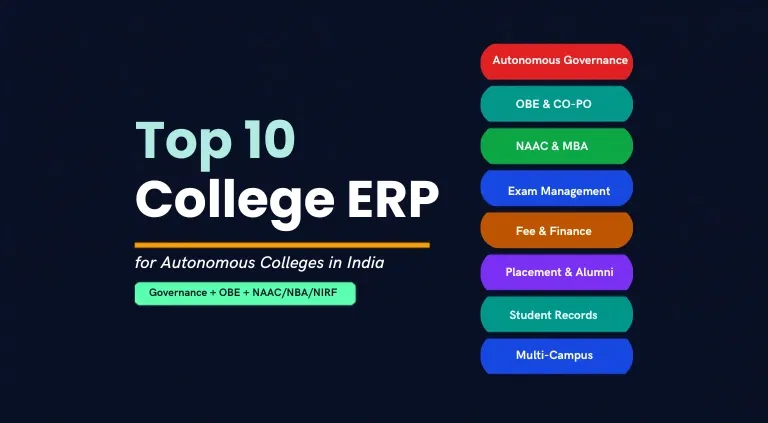
Autonomous colleges need software that flexes around their own governance structures, credit systems and accreditation cycles instead of forcing workarounds onto them. This is why the top 10 college ERP software for autonomous colleges in India look nothing like generic college management tools.
TL;DR
Autonomous colleges set their own curriculum, exams & grading. So generic ERPs built around a university calendar don't fit. They need software that lets departments update syllabi directly, runs independent exam cycles, and continuously captures evidence for NAAC, NBA & NIRF instead of forcing a scramble before each audit.
Without a purpose-built ERP:
- colleges see curriculum changes stuck in IT tickets,
- months-long manual accreditation prep,
- governing bodies working off inconsistent numbers, and
- fragmented trust-level finance.
The fix is 10 core capabilities: multi-body governance reporting, flexible credit design, OBE/CO-PO engine, accreditation management, independent exams, unified SIS, multi-entity finance, placement tracking, role-based dashboards, and secure cloud access.
This guide ranks 10 ERPs for autonomous colleges, positioning edumerge's College ERP Suite first for its unified data layer, native GOI/multi-campus architecture, and built-in Autonomous Governance System.
Why Autonomous Colleges Need ERP Software Built Specifically for Them
Autonomy changes what an ERP has to do. A conventional college management system assumes a college follows a parent university's syllabus, exam calendar and grading scale. Autonomous colleges set their own rules, and the software running their operations has to be built around that reality from day one.
- Curriculum and credit design happen inside the institution, through the Board of Studies, not at a university office. The ERP must let academic departments update syllabi and credit structures without IT intervention.
- Examinations, grading bands and result processing are conducted independently, which means the ERP needs its own exam management workflow rather than one tied to a university's timetable.
- NAAC, NBA and NIRF accreditation rest on continuous evidence: attendance, outcomes, research, placements and governance records that a generic system was never designed to structure for assessors.
- Multiple governing bodies each need their own reports drawn from the same underlying data. The Board of Studies, Academic Council, Finance Committee and Governing Council should not be working off five different spreadsheets.
- Financial autonomy means self-managed trust or society accounts, fee slabs, scholarships and quota seats, which conventional ERPs built for a single fee structure cannot easily support.
For a deeper look at what day-to-day autonomous administration involves, see how to manage autonomous college operations.
Key Challenges Autonomous Colleges Face Without the Right ERP
When the ERP is not built for autonomy, these gaps show up quickly and compound over time. Only around 21% of universities and colleges qualified for an A grade in NAAC's first accreditation cycle through August 2025, a gap manual evidence-gathering widens rather than closes.
1. Every curriculum change becomes an IT ticket.
Effect: Departments wait weeks for a syllabus or credit update to reflect in the system, slowing the very flexibility autonomy was meant to enable.
2. Accreditation turns into a months-long project.
Effect: IQAC coordinators spend months compiling AQAR and SSR data manually from spreadsheets and faculty laptops instead of pulling it from one source.
3. Governing bodies work from inconsistent data.
Effect: The Finance Committee, Academic Council and Governing Body often review different numbers for the same period, weakening board-level decisions.
4. CBCS, open electives and minor or major tracking is done by hand.
Effect: Manual credit mapping across departments creates errors that surface only during audits or accreditation visits.
5. Independent exam cycles clash with rigid software.
Effect: Systems designed for university exam timelines cannot easily handle an autonomous college's own exam patterns, moderation committees and grade cards.
6. Finance stays fragmented.
Effect: Trust fund accounting, program-wise fee structures and scholarship tracking on disconnected tools delay reconciliation and put audit readiness at risk.
The cumulative effect is not just inefficiency. It is a risk to the accreditation score that autonomy depends on, slower decisions at the leadership level, and staff time spent compiling data instead of improving outcomes.
Explore how edumerge College ERP compares to generic college ERPs.
Top 10 College ERP Software for Autonomous Colleges in India
1. edumerge College ERP
The most comprehensive solution on this list, purpose built for autonomous colleges, universities, and large institutions handling complex, high-volume data operations. It is the only platform here built ground-up for the Indian autonomous governance model, not adapted from a generic template.
It scales natively from a single autonomous college to a 50+ campus group of institutions on the same codebase, with a Trustee dashboard for real-time financial visibility. Trusted by 800+ institutions and 500,000+ students since 2012.
edumerge College ERP runs alongside HRMS, and Finance & Control on one shared data layer. So data entered once flows through every downstream report automatically. AI-driven analytics span every module, closing the reconciliation gaps that generic multi-vendor stacks create.
Key strengths:
- Unified suite covering admissions, academics, attendance, examinations, OBE/outcome tracking, HR, finance, library, and hostel on a single data layer. So campuses avoid the reconciliation gaps that come from stitching together 5-10 point solutions.
- Built-in NAAC, NBA, NIRF, and AICTE compliance workflows with audit trails, reducing accreditation prep time significantly compared to manual evidence collection.
- Native multi-campus and Group of Institutions (GOI) architecture. A single autonomous college or a 50+ campus group runs on the same codebase, with group-level consolidated reporting and a Trustee dashboard for real-time financial visibility.
- Society-to-School (S2S) fund flow tracking, Budget vs Actual reporting, and an approval chain designed specifically for Indian trust & society governance structures.
- Handles high-volume, high-concurrency data (large student cohorts, multi-semester academic calendars, multi-entity finance) without the custom development typically required by generic ERPs.
- Trusted by 800+ institutions and 500,000+ students across India since 2012, with AI-driven analytics layered across every module.
- Direct integration between College ERP, HRMS, and Finance & Control means data entered once (admissions, payroll, fee heads) flows through every downstream report automatically.
2. Academia ERP (Serosoft)
Full-scale student information system and ERP used by colleges & universities to manage the entire student lifecycle from enquiry to graduation.
Key strengths:
- Broad module coverage across admissions, examinations, HR, finance, hostel, and library within a single Java-based, scalable platform.
- Strong global and Indian footprint, with institutional implementations across countries and nearly two decades of higher-ed focus.
- Configurable and customisable architecture that institutions report as feature-rich without sacrificing ease of navigation.
What to note:
- Best suited for institutions up to roughly 5,000 students; very large multi-campus groups may need additional scoping.
- On-premise deployment carries typical ERP infrastructure overhead if cloud hosting isn't chosen.
3. MasterSoft College ERP
Long-established e-governance ERP provider serving Indian colleges, universities, and autonomous institutions.
Key strengths:
- Extensive module depth, with 25-plus pro modules and 30-plus inbuilt modules covering admissions, examinations, HR, and compliance reporting.
- Biometric, RFID, and BI-dashboard integration built in, useful for large campuses tracking attendance and access at scale.
- Deep experience with government-funded and autonomous institutions, including NITs and central universities.
What to note:
- Breadth of modules means implementation and configuration can take longer for larger, multi-department colleges.
- Customisation for specific autonomous-college workflows (e.g., unique grading or credit structures) may require dedicated project time.
Explore the comparison between edumerge Education ERP vs MasterSoft Education ERP.
4. Camu
Integrated SIS and LMS platform built around outcome-based education (OBE) and choice-based credit systems.
Key strengths:
- Purpose-built OBE and CBCS modules aligned to Washington Accord guidelines, a specific need for autonomous engineering and technical colleges.
- Combines SIS, LMS, and video conferencing in one interface, useful for institutions running hybrid academic delivery.
What to note:
- Some users report occasional technical glitches in report generation and asset management modules.
- New users may need a learning curve given the depth of the OBE and CBCS configuration options.
You may also find this comparison helpful edumerge vs Camu.
5. Contineo
Academic administration platform focused specifically on outcome-based education for affiliated and autonomous institutions.
Key strengths:
- Workflow-based admissions capturing extensive applicant data fields with instant ID generation and statutory reporting.
- Strong contact-hour and timetable tracking tied directly to the academic calendar, useful for autonomous colleges managing their own exam schedules.
- Configurable assessment engine supporting CO/PO mapping and Bloom's taxonomy tagging for accreditation evidence.
What to note:
- Fee management exists in the platform but is reported as not commonly used, so institutions may need a separate finance system.
- Narrower focus on academic/OBE administration means broader HR or finance needs may require third-party integration.
6. Heraizen DHI ERP
Digital transformation platform focused on engineering education and outcome-based performance tracking.
Key strengths:
- NBA and NIRF-readiness automation with descriptive, prescriptive, and predictive analytics dashboards.
- Faculty and student capability-improvement tools built on an in-built expert system and Bloom's Taxonomy-based tracking.
- Policy-driven, single-source-of-truth architecture with a private cloud deployment for data security.
What to note:
- Primary design focus is engineering colleges, so non-technical autonomous colleges may find some modules less directly relevant.
- Mobile app reviews point to occasional performance and login stability issues that institutions should validate during a pilot.
7. Fedena
Modular, plugin-based college and school management platform used globally by institutions.
Key strengths:
- Providing customisable modules spanning admissions, examinations, finance, and HR at a comparatively affordable price point.
- Open-source community edition available alongside the commercial product, giving institutions with in-house IT teams flexibility.
- Strong third-party integration support, including payment gateways and video conferencing tools.
What to note:
- Multi-entity trust accounting and inter-campus HRMS for institution groups require heavy custom development rather than coming standard.
- Advanced analytics and reporting are more basic than purpose-built higher-ed platforms.
Take a deeper look at how edumerge School & College ERP compares with Fedena.
8. Creatrix Campus
AI-native, modular higher-education platform covering the academic and administrative lifecycle end to end.
Key strengths:
- Combines CRM, admissions, SIS, LMS, OBE, and accreditation automation in one configurable, low-code platform.
- Embedded agentic AI for accreditation automation, student-success insights, and document intelligence.
What to note:
- Some users note slower data-upload performance under heavy data loads.
- As a comparatively newer AI-native platform, large autonomous colleges should validate depth of India-specific compliance reporting (NAAC/NBA) during evaluation.
9. Digiicampus
Campus engagement, management, and analytics platform used by several Institution-of-Eminence-status universities in India.
Key strengths:
- Layered architecture separating campus administration, academic/LMS, and analytics, giving flexibility in what's deployed.
- Strong Campus Help Centre for digitising workflows like no-dues processing and grievance redressal.
- Direct engagement model with senior institutional leadership rather than a heavy sales layer.
What to note:
- Initial setup and customisation can be time-consuming for larger institutions.
- Ongoing subscription costs may be a consideration for institutions with tighter budgets.
10. Ellucian Banner
Global higher-education ERP with limited but notable adoption among premium Indian universities with international exposure.
Key strengths:
- Purpose-built for higher education across student lifecycle, financial aid, HR, and finance in one system of record.
- Used by institutions worldwide with SaaS, private cloud, and on-premise deployment options.
- Deep higher-ed specific configurability built from decades of sector-specific process design.
What to note:
- Designed primarily for global/large university systems; localisation for Indian statutory and affiliation-specific processes (NAAC/AICTE) typically needs partner customisation.
- Reporting is reported as comparatively basic relative to newer analytics-first platforms, and implementation cycles tend to run longer.
You might also like our comparison on edumerge College ERP vs. Ellucian Banner.
How College Leadership Should Choose the Right ERP
Feature checklists matter, but different decision-makers in the same institution are evaluating different things. A shortlist that satisfies the IT Head alone will stall at the board level, and one that satisfies the Trustee alone will fail during rollout.
| Decision-Maker | What They Should Verify Before Signing |
|---|---|
| Trustee/Chairperson | Governing body dashboards, consolidated financials across the trust, audit trail depth, and the vendor's track record with autonomous institutions. |
| Principal/Academic Head | OBE and CO-PO workflows, curriculum flexibility, faculty workload visibility, and how fast academic changes reflect in the system. |
| Registrar | Examination and result processing for independent exam patterns, document and compliance workflows, and admission-to-alumni lifecycle coverage. |
| IT Head | Cloud architecture, data security and role-based access, integration effort, implementation timeline, and support SLAs. |
Beyond features, leadership should ask 3 practical questions before shortlisting any vendor.
- Can this ERP be configured by our own staff without ongoing developer support?
- Does the vendor have existing autonomous college customers who can be contacted directly?
- And how long does the vendor's own implementation typically take, from contract signing to the first live semester?
For a module-by-module walkthrough of admissions, OBE, examinations, finance & governance inside the suite. Read what is edumerge College ERP? A complete feature guide for affiliated & autonomous colleges.
Institutions evaluating options at the group level can also check 6 best ERP for college groups in India.
Conclusion
Autonomous status gives colleges freedom over curriculum, exams & grading. But that freedom only works if the ERP behind it can flex just as much.
Generic systems built for university-affiliated colleges break down exactly where autonomy demands the most control, forcing manual workarounds that slow decisions and put accreditation scores at risk.
The right ERP turns that risk into an advantage. Governing bodies work from one dataset, accreditation evidence builds continuously instead of scrambling before a NAAC visit, and departments manage their own curriculum without waiting on IT.
Thus, giving trustees, principals, registrars, and IT Heads a shared framework to evaluate vendors against. Among them, edumerge stands out for combining it all on one unified architecture rather than a patchwork of point solutions.
For institutions planning to scale from a single autonomous college to a full Group of Institutions, that single data layer is the difference between growing smoothly and rebuilding the system twice.
Frequently Asked Questions (FAQs)
1. What makes an ERP suitable for autonomous colleges specifically?
It must support independent curriculum and credit design, the institution's own exam patterns, and continuous NAAC, NBA and NIRF accreditation evidence, rather than assuming a university-mandated calendar.
2. Do autonomous colleges need a different ERP than affiliated colleges?
They need a platform flexible enough for very different workflows. Autonomous colleges set their own syllabi and grading, so the ERP must let departments manage that directly instead of following university-set data.
3. What is OBE and why does an autonomous college ERP need it?
Outcome-Based Education (OBE) is the UGC and NAAC-mandated framework for measuring course and program outcomes through CO-PO mapping, and it is one of the most commonly requested pieces of accreditation evidence.
4. Can college ERP software reduce the time spent preparing for NAAC or NBA visits?
Yes. When the ERP captures attendance, outcomes, placements and governance data continuously, AQAR and SSR reports become a data export instead of a multi-month manual compilation exercise.
5. How long does it take to implement a college ERP for an autonomous institution?
Core modules such as student records, fees and attendance can go live within a few months, while full rollout including accreditation and governance modules depends on the number of departments and campuses involved.
6. Does college ERP software support CBCS and open electives?
A properly built system tracks credit mapping across departments automatically, supporting choice-based credit systems, open electives and minor or major specialisations without manual reconciliation.
7. Can an autonomous college's ERP handle its own examination pattern?
Yes. Autonomous colleges need independent exam management, including grade moderation committees, hall ticket generation and result processing built around the college's own pattern, not a university timetable.
8. Is cloud-based college ERP software secure for student data?
Look for role-based access controls, data encryption, automated backups and Indian data hosting as baseline security requirements for any cloud college ERP.