Affiliated college management becomes hectic because the software underneath was built for a standalone institution. That kind of institution controls its own academic calendar end to end. An affiliated college does not; it answers to a university it does not control.
Most comparison lists score platforms on admissions, attendance, and fee collection. These are the parts every college ERP handles reasonably well. They rarely test the parts that actually break under affiliation. Exam pattern changes, NAAC data requests, and renewal paperwork with a fixed university deadline are where the real risk sits.
This guide sets the ranking format aside. Instead, it works through what a college ERP for affiliated institutions in India actually needs to do. The approach is department by department, deadline by deadline.
TL;DR
Affiliated colleges fail with generic ERPs because those systems assume full control over the academic calendar. Affiliated colleges answer to an external university on exams, syllabus and results. This mismatch causes calendar clashes, scattered accreditation data and fragmented finance tracking.
The right ERP syncs the university calendar internally, builds OBE & CO-PO mapping into daily workflows, and consolidates department records into one institutional view. It also unifies program-wise fees, quota billing, scholarships and hostel charges into a single ledger. Role-based access and audit trails give registrars real compliance visibility.
edumerge College ERP leads the list of 10 platforms, built specifically around affiliation as the default operating context. It cuts accreditation prep time by up to 70%, speeds fee reconciliation 3x, and enables go-live in as little as 7 hours. Other platforms treat group-level governance and affiliation-specific compliance as add-ons rather than core design.
Why Affiliated College ERP Software Needs to Be Purpose-Built, Not Conventional
Most ERP software sold to Indian higher education institutions is built for the general case: a college that sets its own exam dates, decides its own syllabus, and issues its own results.
Affiliated colleges do not work this way. They run internal operations day to day while staying accountable to an external university on exams, syllabus, and results. That single difference changes what the software needs to do.
A conventional college management system, however feature-rich, tends to treat every date as internally controlled. And every report format as fixed. For an affiliated college, several things need to be true at the same time:
- University calendar dependency: Exam dates, syllabus updates, and revaluation cycles are set externally and can change with little notice.
- Dual reporting: Internal academic records must also convert into the exact submission formats the university expects upstream.
- External accreditation cycles: NAAC, NBA, and NIRF each expect specific, structured data on a fixed timeline that does not move for the college.
- Departmental variance with one institutional view: Every department runs its own attendance and internal marks process, but the Principal still needs one consolidated picture.
- Statutory renewal timelines: Affiliation itself must be renewed on a schedule, with its own documentation requirements.
None of this is optional for an affiliated college. It is the operating context, and ERP software that was not designed around it tends to become one more system the college has to work around rather than through.
Key Challenges Affiliated Colleges Face Without the Right ERP
1. University Calendar Misalignment
The Challenge: University calendar changes are communicated once and expected to cascade down instantly. But most ERPs treat the academic calendar as a static, manually entered field rather than a live sync point with the affiliating university.
How it Affects Affiliated Colleges: University calendar changes reach departments late, causing internal exam schedules to clash with the university's own dates. Students end up confused about which timeline to follow, and faculty lose time re-planning around dates that should have been updated automatically.
2. Accreditation Data Scattered Across Systems
The Challenge: CO-PO mapping, student feedback, and outcome data are generated continuously across the academic year. But generic ERPs do not capture this data at the point of creation, so it never accumulates in one place.
How it Affects Affiliated Colleges: Accreditation becomes a scramble rather than a routine. Data ends up scattered across departmental spreadsheets and individual faculty laptops. NAAC or NBA data requests trigger weeks of manual compilation instead of a quick export.
Explore how edumerge simplifies accreditation management.
3. Departments Operating in Isolation
The Challenge: Attendance and internal assessment are typically owned at the department level. And without a shared data layer connecting departments, there is no single source of truth for the institution as a whole.
How it Affects Affiliated Colleges: Departments operate as islands. Each maintains its own attendance registers and internal mark sheets. No single system consolidates that data institutionally. This leaves registrars reconciling numbers manually before every university submission.
4. Fragmented Fee and Finance Tracking
The Challenge: Program-wise fees, government quota billing, scholarship deductions, and hostel charges each follow different rules. Most ERPs handle them as separate, loosely connected records. Rarely does a system pull them into one consolidated ledger.
How it Affects Affiliated Colleges: Fee structures compound the problem. With everything tracked separately, reconciling bank statements against student ledgers can take days rather than minutes. Trustees, in turn, rarely get a real-time, consolidated view of collections versus dues.
Explore the fee management capabilities of edumerge College ERP.
What the Right ERP for Affiliated Colleges Must Include
Once the challenges are clear, the required capabilities follow directly. The table below maps each affiliation-specific challenge to the ERP capability that actually resolves it, rather than a generic feature that sounds relevant.
| Affiliation-Specific Pain Point | Required ERP Capability |
|---|---|
| University exam and syllabus changes | University-aligned exam scheduling with configurable internal assessment cycles |
| Manual NAAC/NBA data compilation | Built-in OBE framework with CO-PO, PEO and PSO mapping tracked continuously |
| Fragmented department-level records | Institutional student information system with department-level entry and one consolidated view |
| Complex, program-wise fee structures | Program-wise fee configuration with quota, scholarship and hostel billing in one ledger |
| No visibility into compliance status | Role-based access with an audit trail visible to Principals and Registrars |
A system that covers this table end to end is doing the actual job an affiliated college needs. A system that covers only the first two rows, however polished its interface, is still a conventional college ERP wearing an affiliation label.
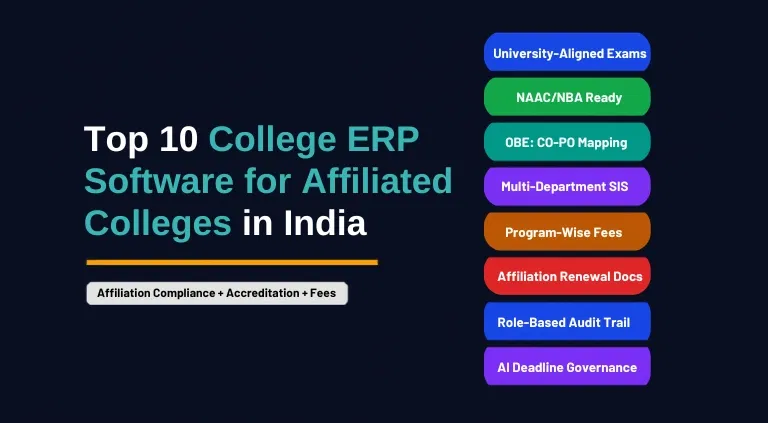
Top 10 College ERP Software for Affiliated Colleges in India
1. edumerge College ERP
Purpose-built ERP for affiliated & autonomous colleges as well as college groups. It's built around university affiliation as the operating context rather than an add-on to a standalone college system. Configuring university guidelines, required reports is a breeze on edumerge.
- Single codebase & database. So a change in one department reflects instantly across the institution, with no sync delays or reconciliation steps between modules.
- University calendar alignment built in. Exam dates, syllabus revisions, and result timelines sync with internal processes. So departments are never planning against an outdated calendar.
- edumerge Govern, using the platform's AI governance layer, you can track university-mandated deadlines against real departmental progress. While it flags what is overdue by department, and confirms before any reminder or submission goes out.
- Native OBE support with CO-PO, PEO and PSO mapping, continuous assessment tracking, and auto-generated attainment reports, cutting accreditation preparation time by up to 70%.
- Group-level governance built in: multi-campus consolidation, trust accounting, and real-time trustee dashboards, not bolted on as add-ons.
- Accreditation data for NAAC, NBA and NIRF stays current continuously. So data requests are answered with an export rather than weeks of manual compilation.
- Automated fee reconciliation across program-wise fees, quota billing, scholarships and hostel charges runs up to 3x faster than manual bank-to-ledger matching.
- Colleges can go live in as little as 7 hours with zero downtime during transition, a meaningful advantage for institutions that cannot pause operations mid-semester.
2. Academia ERP (Serosoft)
Full-scale campus management platform used by colleges, universities, and large institutions across India for complex, high-volume data operations.
- Broad module coverage across admissions, examinations, and student records in a single suite.
- Provides migration support for institutions moving off legacy or spreadsheet-based systems.
What to note:
- Group-level features such as consolidated multi-campus trustee reporting typically need custom configuration rather than coming standard.
- Implementation timelines can extend for larger groups given the breadth of modules being configured together.
3. Creatrix Campus
Academic operations platform positioning itself as an "Academic OS" layer across admissions, curriculum, examinations, and accreditation evidence.
- Strong focus on outcomes and attainment (OBE) tracking with dedicated workflows.
- Dedicated modules for accreditation and evidence management, useful ahead of NAAC or NBA visits.
What to note:
- Marketed more as an academic layer than a finance-and-HR-inclusive ERP, so trust-level finance consolidation may require a separate system.
- Groups with multiple affiliating universities should verify how the platform handles differing curriculum and examination formats across campuses.
4. Mastersoft ERP
Long-standing Indian college ERP with wide adoption across engineering, arts, and science colleges affiliated to state universities.
- Deep experience with Indian university affiliation workflows and examination formats.
- Comprehensive administrative modules including admissions, fees, hostel, and transport.
What to note:
- Interface and mobile experience are often described as dated compared to newer cloud-native platforms.
- Multi-campus group governance and consolidated trustee reporting are not a core design focus and may need workarounds.
You might also find this comparison helpful edumerge Education ERP vs MasterSoft Education ERP.
5. Digiicampus
Cloud-based ERP for colleges and universities covering academics, administration, and student engagement.
- Cloud-first deployment with comparatively quick onboarding for single campuses.
- Reasonable coverage of admissions, attendance, and examination workflows.
- Mobile app for student and faculty access to attendance, results, and notices.
What to note:
- Group-level consolidation across multiple affiliated colleges typically needs additional configuration.
- OBE and NAAC-specific attainment reporting is less mature than in accreditation-first platforms, so gap analysis before purchase is advisable.
6. Contineo
College ERP with academic and administrative modules aimed at standalone and small-group institutions.
- Covers standard academic workflows: admissions, attendance, exams, and fee management.
- Reasonable fit for single-campus colleges with straightforward, linear processes.
What to note:
- Limited depth for group-of-institutions use cases such as inter-campus HR transfers or consolidated finance.
- Accreditation and OBE tooling generally requires manual effort to keep current, adding load on IQAC teams.
7. Camu
Digital campus platform covering student lifecycle management for colleges and universities.
- Reasonably broad feature set across admissions, LMS integration, and examinations.
- Positioned to serve both standalone colleges and small groups of institutions.
- Student-facing app for communication, notices, and academic tracking.
What to note:
- Multi-entity trust accounting and group HRMS are limited compared to platforms built specifically for groups of institutions.
- Accreditation reporting depth varies by module and may need supplementary tools closer to NAAC or NBA cycles.
Explore how edumerge compares with Camu across key management and technology capabilities.
8. Fedena
Plugin-based school and college ERP with an open-source community edition, used globally across institutions.
- Large global install base with an active plugin ecosystem for extending functionality.
- Flexible for institutions with internal IT teams who want to customize or self-host.
What to note:
- Multi-entity trust accounting, group HRMS with inter-campus transfers, and consolidated trustee dashboards require heavy custom development.
- OBE, NAAC, and accreditation management are not core to the platform and need add-ons or manual work to fill gaps.
Discover how edumerge and Fedena compare across essential school management features.
9. Ellucian
Globally trusted higher education ERP with notable but limited adoption among premium Indian universities.
- Strong pedigree in large university and international higher-education deployments.
- Broad enterprise-grade feature set spanning student records, finance, and HR.
- Proven scalability for very large student populations and complex organisational structures.
What to note:
- Built for large universities rather than affiliated college groups, so pricing and implementation scale are geared toward that segment.
- Indian regulatory workflows (NAAC, NBA, state university affiliation formats) are not the platform's original design centre and may need local customisation or partner support.
See how edumerge and Ellucian Banner compare across core college ERP capabilities.
10. Heraizen DHI ERP
Higher education ERP covering academic and administrative operations for colleges and universities.
- Used by a mix of standalone colleges and smaller groups of institutions.
- Administrative modules extend to fee collection and basic compliance reporting.
What to note:
- Group-level trustee and finance consolidation is not a primary design strength.
- Accreditation-specific workflows (NAAC, NBA) often require manual data assembly rather than automated reporting.
Explore how edumerge compares with generic college ERP platforms across the institutional management needs that matter most to affiliated colleges.
How College Leadership Should Choose the Right ERP
Choosing ERP software for an affiliated college is not a single-person decision, and each stakeholder is evaluating the system against a different risk.
| Decision-Maker | What They Should Evaluate |
|---|---|
| Trustee/Chairperson | Governance visibility, cost predictability, and consolidated financial reporting across the trust |
| Principal | Academic outcomes, accreditation readiness, and a single institutional dashboard instead of department-by-department reports |
| Registrar | University compliance reporting, document workflows, and how cleanly internal records convert to submission formats |
| IT Head | Cloud deployment, role-based access, integration effort, and onboarding timeline without heavy on-premise infrastructure |
A useful test during evaluation is to ask each stakeholder the same question from their own seat. "What happens in this system the week before a university deadline, or the week before an accreditation visit." The answers usually reveal more than any feature list.
Conclusion
Affiliation is not a feature to bolt onto a college ERP. It's the operating reality that shapes everything else. edumerge treats university deadlines, accreditation cycles & dual reporting as the default, which is why academics, finance, HR & accreditation sit on one platform instead of several disconnected tools.
Institutions using edumerge report a 70% reduction in accreditation preparation time, 3x faster fee reconciliation, and go-live in as little as 7 hours with no downtime.
The real question isn't how many modules a platform has, but whether it treats a university-mandated deadline differently from an internal one. Explore edumerge's ERP for affiliated colleges to see it in detail.
Frequently Asked Questions
1. What makes ERP software for affiliated colleges different from generic school or college software?
An ERP built for affiliated colleges maps internal academic processes, exam schedules, and result formats to an external university's calendar & rules. Instead of assuming the college controls its own academic year end to end.
2. Is a generic college management system enough for a university-affiliated college?
Generic systems handle admissions, attendance, and fees well. But most were not designed to track university-set exam dates, syllabus revisions, or affiliation renewal timelines, which are the parts that cause the most disruption when missed.
3. How does an ERP help with NAAC and NBA accreditation for affiliated colleges?
A purpose-built ERP captures CO-PO mapping, student attainment, and outcome data as part of routine academic activity. So accreditation data packs are compiled continuously rather than assembled under pressure before a visit.
4. Can college ERP software map exam patterns to different university formats?
Yes, if the ERP is built for affiliation, just like edumerge College ERP. It should let a college configure internal assessment weightage, revaluation cycles, and mark sheet formats to match whichever university the college is currently affiliated to.
5. What documentation does affiliation renewal require, and can ERP help with it?
Affiliation renewal typically requires infrastructure records, faculty qualification data, student ratios, and compliance certificates. An ERP that stores this data centrally throughout the year removes the need for a manual document hunt at renewal time.
6. How long does it take to implement a college ERP at an affiliated college?
Timelines vary by vendor & data readiness. But colleges that keep student, fee & academic records reasonably organised before migration typically see the fastest onboarding. Sometimes within a single day.
7. Does the ERP support multiple departments that follow different academic processes?
A well-built system lets each department manage attendance, internal marks & workload independently. While consolidating everything into one institutional view for the principal and registrar.
8. Is cloud-based ERP suitable for Indian affiliated colleges with limited IT staff?
Yes. Cloud-based ERP removes the need for on-premise servers & dedicated IT infrastructure. This particularly benefits affiliated colleges in smaller cities with lean IT teams.
9. What is OBE compliance, and why does it matter for affiliated colleges?
Outcome-Based Education, or OBE, requires colleges to map course outcomes & program outcomes, and track student attainment against them. NAAC & NBA both expect this data, making OBE tracking a core ERP requirement, not an add-on.