Every school, college & university in India operates under a non-profit legal entity: a public charitable trust, a registered society, or a Section 8 company. The financial obligations of that entity are structurally different from anything a standard accounting tool is built to handle.
When institutions look for trust and society accounting software for educational institutions, they quickly discover that most tools on the market solve only part of the problem.
This guide compares 10 platforms available to Indian education groups in 2026. To help finance heads, trustees & ERP decision-makers identify which platform fits their institution's structure & requirements.
TL;DR
Trust and society accounting software for educational institutions is designed for non-profit legal entities (charitable trusts, registered societies, or Section 8 companies) that own & operate schools, colleges, and multi-campus groups in India.
Unlike generic accounting tools, it handles fund-based bookkeeping, academic-year-aligned fee structures, multi-entity consolidation, FCRA compliance, and real-time dashboards for trustees & management committees.
Connecting the trust's books directly to institutional operations, without manual reconciliation or end-of-year scrambles.
Why Education Trusts and Societies Need Specialised Accounting Software
The challenge is structural, not cosmetic. In India, an educational group may operate as a single charitable trust with 12 campuses under it. Each campus collects fees, runs its own payroll, processes vendor payments, and tracks capital expenditure.
The trust, as the parent entity, is responsible for consolidated income-expenditure statements, FCRA filings (if it receives foreign contributions), and annual audits under the Income Tax Act.
Three gaps that generic accounting tools leave open:
- No multi-entity architecture: Generic accounting tools are designed for a single chart of accounts. Managing trust books & institutional books separately, then consolidating them, requires either two separate software subscriptions or endless manual exports.
- No academic-year alignment: Indian educational institutions run on April to March cycles. Fee structures, budget approvals & audit periods all follow this calendar. Accounting tools built for commercial businesses default to calendar-year structures, creating reconciliation friction every year-end.
- No integration with student records: Fee collection is the primary revenue source for educational institutions. When the fee management system & the accounting system are separate products, every payment requires a manual journal entry or a periodic batch import, introducing errors and delays.
These gaps become most visible at scale. For groups of institutions managing 3 or more campuses without a unified finance platform, books rarely close on time, year-end audit preparation stretches into weeks, and consolidated trustee reporting becomes a manual exercise built on spreadsheets.
You might also like to read about trust accounting for educational institutions in India.
Quick Comparison Table
| Platform | Best Fit |
|---|---|
| 1. edumerge Finance & Control | Groups of institutions requiring consolidated trust accounting, multi-campus fee flow, and real-time trustee visibility |
| 2. RealBooks | Single-campus institutions already using RealFees for fee collection |
| 3. EduXpert School ERP | Institutions already running Tally for accounts and wanting a school management layer on top |
| 4. Vidyalaya School Management Software | K-12 schools in India requiring a single-vendor school management and basic accounts solution |
| 5. Skolaro | Growing schools needing online fee collection, e-payment gateways, and basic financial tracking |
| 6. QuickBooks Online | Small standalone schools or NGO-operated single institutions needing standard bookkeeping |
| 7. Zoho Books | Small to mid-size institutions wanting GST-ready cloud accounting at low cost |
| 8. Aplos Fund Accounting | International or FCRA-registered trusts needing fund-based accounting with donor and grant tracking |
| 9. NetSuite ERP | Large university systems or multi-state education groups requiring enterprise-grade financial management |
| 10. Classe365 | International schools and colleges needing student management combined with basic financial tracking |
10 Best Trust & Society Accounting Software for Educational Institutions in India
1. edumerge Finance & Control (Editor Recommended for Indian GOIs)
Type: Education-native, purpose-built for Indian GOIs
Best for: Groups of institutions requiring consolidated trust accounting, multi-campus fee flow, and real-time trustee visibility
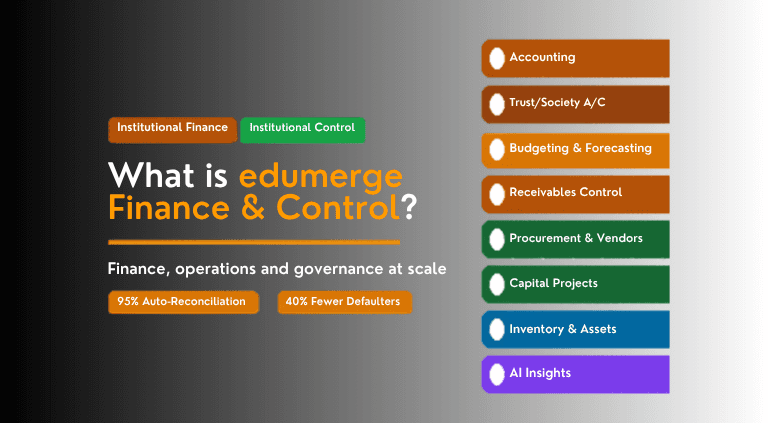
Key capabilities: Society-to-School (S2S) fund flow, multi-entity consolidation, Budget vs Actual reporting, Trustee dashboard, FCRA-ready audit trail, approval chain, direct integration with School ERP and College ERP
What to note: Finance scope focused on GOI governance; full-suite accounting for standalone institutions is roadmap
For groups of institutions in India managing multiple campuses under a single trust or society, edumerge Finance & Control is the only platform in this list that combines Society-to-School fund flow tracking, multi-entity consolidation, and direct integration with School ERP & College ERP in a single, unified data architecture. Finance heads get audit-ready books at all times. Trustees get real-time consolidated visibility without waiting for monthly reports from each campus.
Explore the full Trust/Society Accounting module in depth.
2. RealBooks (RealFees Integration)
Type: Cloud accounting with education add-on
Best for: Single-campus institutions already using RealFees for fee collection
Key capabilities: Multi-location accounting, role-based access, TDS compliance, direct sync with RealFees, audit-ready reports
What to note: Education-specific modules are bolt-on; no native ERP integration for student records or HRMS
3. EduXpert School ERP (Tally Integration)
Type: School ERP with Tally-backed accounting
Best for: Institutions already running Tally for accounts and wanting a school management layer on top
Key capabilities: Invoicing, fee tracking, payment portals, academic management modules
What to note: Relies on a separate accounting stack; two systems means reconciliation overhead at month-end
4. Vidyalaya School Management Software
Type: India-based school ERP with finance module
Best for: K-12 schools in India requiring a single-vendor school management and basic accounts solution
Key capabilities: Fee management, income-expenditure reports, academic scheduling, parent communication
What to note: Multi-campus consolidation and trust-level accounting are limited; suited for standalone schools
You might also like to read the comparison edumerge Finance & Control vs. SAP Business One.
5. Skolaro
Type: School management with online payment integration
Best for: Growing schools needing online fee collection, e-payment gateways, and basic financial tracking
Key capabilities: Online payment portal, fee ledger, student records, collaborative communication platform
What to note: No native trust or society accounting module; limited reporting at group or multi-entity level
6. QuickBooks Online
Type: Generic SME cloud accounting
Best for: Small standalone schools or NGO-operated single institutions needing standard bookkeeping
Key capabilities: Double-entry accounting, invoicing, bank reconciliation, GST-compliant reports, third-party integrations
What to note: Not designed for education; no fee-to-ledger sync, no academic-year structures, no trustee governance module
7. Zoho Books
Type: SME accounting platform, India GST-compliant
Best for: Small to mid-size institutions wanting GST-ready cloud accounting at low cost
Key capabilities: GST filing, multi-currency, automated workflows, client portal, bank feeds
What to note: No education-specific fund accounting; trust structures, FCRA, and multi-campus fee flow require heavy custom configuration
If you’re a finance admin, you might find this guide on managing educational trust accounts in India useful.
8. Aplos Fund Accounting
Type: Non-profit fund accounting platform
Best for: International or FCRA-registered trusts needing fund-based accounting with donor and grant tracking
Key capabilities: Fund-based accounting, grant management, donor reporting, fundraiser tracking, financial statements for non-profits
What to note: Not India-specific; limited integration with Indian education ERPs, compliance modules, or local fee structures
9. NetSuite ERP
Type: Enterprise cloud ERP with education verticals
Best for: Large university systems or multi-state education groups requiring enterprise-grade financial management
Key capabilities: Multi-entity accounting, budget management, grant tracking, advanced analytics, global compliance
What to note: Implementation cost and complexity is prohibitive for most Indian GOIs; not purpose-built for school-college trust structures
10. Classe365
Type: Integrated SIS, CRM, and LMS with finance features
Best for: International schools and colleges needing student management combined with basic financial tracking
Key capabilities: Student information system, CRM, LMS, fee management, payment integration
What to note: Finance module is secondary to academic features; no dedicated trust accounting, Indian compliance, or multi-entity consolidation
Also read about effectively managing a group of schools in India (without losing control/visibility).
8 Criteria to Evaluate Trust Accounting Software for Your Educational Institution
Before choosing a platform, every finance head and trustee should test these eight criteria. Generic accounting tools often clear 3 or 4 of them. Purpose-built education finance platforms are designed to clear all 8.
| Evaluation Criterion | What to Check | Why It Matters for Education Trusts |
|---|---|---|
| Multi-entity architecture | Can the platform maintain separate books for the trust/society AND each institution simultaneously? | Critical for GOIs; single-entity tools force manual consolidation |
| Indian compliance native | Does it handle 12A/80G filings, FCRA reconciliation, and TDS at institution level? | Generic tools require expensive customisation |
| Academic-year alignment | Are fee structures, budgets, and reporting cycles aligned to April-March, not calendar year? | Mismatch creates reconciliation issues every April |
| ERP integration depth | Does the finance module share a live database with student records, HRMS, and admissions? | Disconnected finance tools create data silos |
| Approval chain governance | Can multi-level spend approvals be configured per campus, per cost centre, or per trustee? | Essential for GOI internal controls |
| Budget vs Actual visibility | Can each campus head and the trustee see live variance reports without waiting for month-end? | Real-time BvA is a governance requirement for well-run trusts |
| Trustee/board dashboard | Is there a read-only, mobile-accessible view for trustees who are not daily ERP users? | Non-negotiable for trustee accountability |
| S2S fund flow tracking | Can funds transferred from the society to individual institutions be tracked end-to-end? | Core trust accounting requirement in Indian GOIs |
How edumerge Finance & Control Addresses the Education Trust Accounting Problem
edumerge Finance & Control is built specifically for the financial governance challenges of Indian groups of institutions. The platform operates within the same data architecture as edumerge School ERP & College ERP, which means every fee collected at any campus auto-posts to the group ledger. There are no exports, no manual reconciliation runs, and no separate accounting system to maintain.
The four capabilities at the core of Finance & Control:
- Society-to-School (S2S) fund flow: Tracks every rupee transferred from the parent trust or society to individual institutions, with full audit trail and approval history.
- Multi-level approval chain: Configurable per campus & per cost centre, ensuring no payment leaves the system without the right authorisation at the right level.
- Budget vs Actual reporting: Campus heads & the trust's management committee see live variance reports without waiting for month-end closing. Overspending flags surface in real time.
- Trustee dashboard: A read-only, role-separated view for managing committee members & trustees. Consolidated cash position, fee collection health & budget utilisation across all campuses, accessible from any device.
Because Finance & Control shares a live database with edumerge's School ERP and College ERP, the data that trustees see on their dashboard is the same data the accounts team works with. There is no version mismatch between the institution's operational records and the trust's financial books.
Is your trust's financial architecture built for multi-campus governance?
Most education groups in India discover gaps in their finance stack only at audit time. edumerge Finance & Control gives trustees real-time consolidated visibility and finance teams audit-ready books, without a separate accounting system.
Conclusion
Choosing trust and society accounting software for educational institutions is not a procurement decision for the finance team alone.
It is a governance decision for the managing committee.
The platform you choose either gives your trustees real-time, consolidated visibility across every campus, or it forces another cycle of month-end spreadsheet assembly.
If your group of institutions is ready to move to a purpose-built solution, edumerge Finance & Control is built for exactly this challenge.
Learn more & request a product walkthrough.
Frequently Asked Questions
1. Why can generic accounting software not handle education trust accounting in India?
Generic accounting tools are built for single-entity for-profit businesses. Education trusts in India require fund-based accounting, academic-year-aligned structures, multi-campus consolidation, and compliance with the Indian Trusts Act 1882, Societies Registration Act 1860, and income tax exemption sections 12A & 80G. These are deep-structural differences, not just configuration gaps.
2. What is multi-entity accounting in the context of groups of institutions?
Multi-entity accounting means maintaining separate, ring-fenced books for the trust or society as the parent entity, and for each individual school or college under it, while also generating consolidated financial statements across all entities in real time.
3. What is Society-to-School (S2S) fund flow?
S2S fund flow refers to the movement of funds from the parent society or trust to individual institutions under its umbrella. Education-native finance software tracks these inter-entity transfers automatically, ensuring both the society's books & the institution's books are updated without manual journal entries.
4. What is a Budget vs Actual report for educational institutions?
A Budget vs Actual (BvA) report compares the approved annual budget for each cost centre or campus against actual expenditure in real time. It allows finance heads & trustees to identify overspending early, approve reallocation requests, and maintain fiscal discipline without waiting for month-end closes.
5. What is a Trustee dashboard in education finance software?
A Trustee dashboard is a read-only, mobile-accessible view designed for managing committee members & trustees who need consolidated financial visibility across all campuses without navigating the full ERP. It typically shows live cash position, fee collection status, budget utilisation, and pending approvals.
6. How many campuses can education trust accounting software typically support?
Purpose-built platforms for groups of institutions support unlimited campuses under a single trust entity with individual campus-level books and consolidated group-level reporting. Generic tools often require separate accounts for each entity, making consolidation a manual and error-prone process.
7. What is the difference between school fee management software and trust accounting software?
Fee management software handles the collection, tracking & reconciliation of student fees at the institution level. Trust accounting software manages the financial books of the non-profit legal entity that owns the institution, including fund flow from society to schools, income-expenditure statements, and compliance filings. Education-native platforms integrate both layers.
8. How long does it typically take to implement finance software for a group of institutions?
For a purpose-built education finance platform, like edumerge, implementation usually takes a few days to weeks depending on the number of institutions/campuses and the amount of data to be migrated. Fragmented systems may take more time depending on the complexity.
9. Is cloud-based trust accounting software suitable for Indian educational institutions?
Yes. Cloud-based platforms eliminate the need for on-premise server infrastructure, reduce IT maintenance overhead, and give trustees & finance heads real-time access from any device. They also simplify multi-campus access control through role-based permissions without complex network configurations.
10. What reports does a trust or society need for its annual audit?
An Indian educational trust or society typically requires income & expenditure statements, receipts & payments accounts, balance sheets, fund-wise schedules, fixed assets registers, details of foreign contributions (if FCRA-registered), and TDS deduction certificates. Education-native finance software generates all of these directly from the integrated ledger.