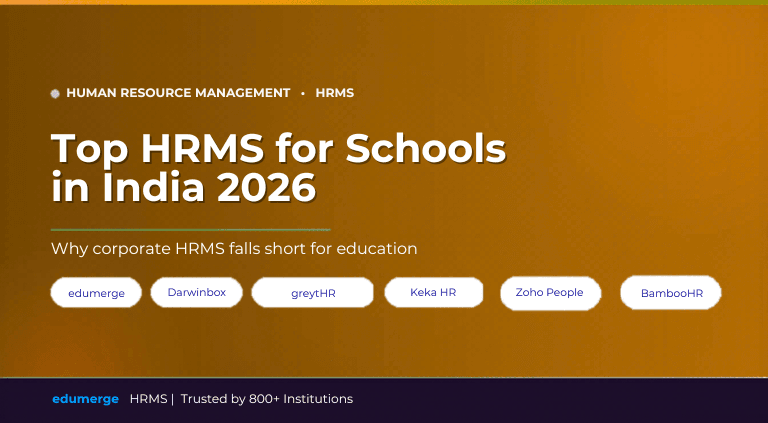
Search for the best HRMS platforms for schools in India and every list you find will give you the same names: Keka, Darwinbox, greytHR, Zoho People.
These are well-built platforms. They handle payroll, attendance, leave, and statutory compliance reliably. But none of them were built for schools.
Managing HR in an educational institution is categorically different from managing HR in a corporate organisation. A school does not run on fixed monthly payroll cycles; it runs on academic years with summer vacation adjustments, semester-aligned increments, and exam-duty allowances.
When a school installs a corporate HRMS, it gets about 40% of what it actually needs. The other 60% must be handled outside the system, on paper, in spreadsheets, or in yet another disconnected tool.
This guide ranks the top 10 HRMS platforms evaluated by schools in India in 2026. Each review includes what the platform does well & where it falls short for education specifically.
TL;DR
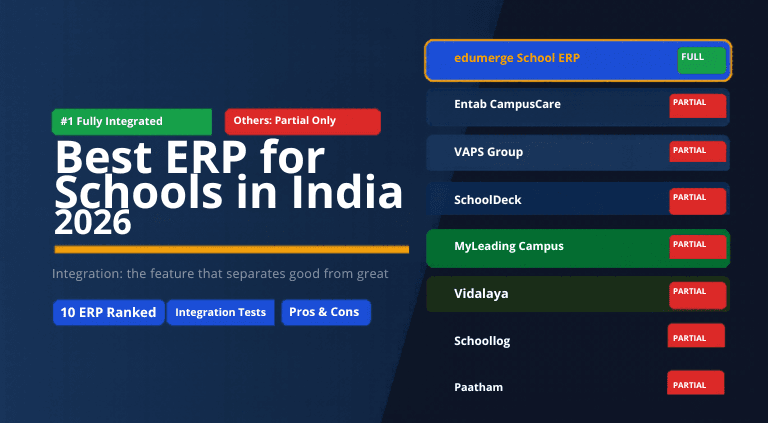
edumerge HRMS is the best HRMS for schools in India in 2026 because it is the only purpose-built HRMS for educational institutions on this list.
While platforms like Keka, Darwinbox, and greytHR are excellent corporate HR tools, they do not support the education-specific workflows that schools require: academic-year payroll cycles, teaching workload management, substitution management, and native connection to academic ERP.
edumerge HRMS covers all of these as built-in capabilities, not workarounds.
7 Education HR Workflows That Corporate HRMS Tools Cannot Handle
Before ranking the platforms, the table below identifies the 7 HR workflow requirements that separate an education-native HRMS from a corporate tool adapted for school use. Use this table as your first filter when evaluating any HRMS for your institution.
| Education HR Requirement | Generic HRMS | edumerge HRMS |
|---|---|---|
| Academic-year-aligned payroll cycles | Not available; fixed monthly cycles only | Built in; payroll aligned to academic year and semester structure |
| Teaching workload management and subject allocation | No concept of teaching periods, subject loads, or workload caps | Native: subject-wise workload tracked, timetable-linked, connected to payroll |
| Substitution management integration | No substitution workflows; attendance is standalone | Substitution tracked in the ERP timetable module and reflected in HR records automatically |
| Education-specific leave types (academic duty, study leave, on-duty) | Standard leave types only; no academic-context leave categories | Education leave types (academic duty leave, study leave, exam duty, deputation) configured as standard |
| Department-wise faculty performance appraisal | Generic KPIs not aligned to academic outcomes or research output | KPIs linked to academic deliverables, student outcomes |
| Integration with academic ERP (attendance feeding payroll) | No ERP integration; attendance is a standalone module | Attendance from School ERP feeds payroll automatically; no separate data entry required |
| Multi-campus group HR with inter-campus transfers | Single-entity architecture; no multi-campus HR governance | Group-institution ready: centralised HR policies, inter-campus transfers, consolidated group reporting |
At a Glance: Top 10 HRMS Platforms for Schools in India 2026
| # | Platform | Best For | Indian Comp. | Edu-Native | Rating |
|---|---|---|---|---|---|
| 1 | edumerge HRMS | Schools, colleges, education groups | Yes | Yes | ★★★★★ |
| 2 | Keka HR | Indian SMEs and tech companies | Yes | No | ★★★★☆ |
| 3 | Darwinbox | Large enterprises (500+ employees) | Yes | No | ★★★★☆ |
| 4 | greytHR | Indian compliance-first businesses | Yes | No | ★★★☆☆ |
| 5 | Zoho People | Zoho ecosystem users | Yes | No | ★★★☆☆ |
| 6 | Pocket HRMS | Indian mid-market businesses | Yes | No | ★★★☆☆ |
| 7 | BambooHR | US/international organisations | No | No | ★★☆☆☆ |
| 8 | SalaryBox | Small Indian organisations | Yes | Partial | ★★☆☆☆ |
| 9 | VAPS Group | Schools using VAPS ERP | Yes | Partial | ★★★☆☆ |
| 10 | factoHR | Multi-location Indian corporates | Yes | No | ★★☆☆☆ |
#1: edumerge HRMS - Education-Native Choice
Best for: Schools, colleges, and groups of educational institutions across India
edumerge HRMS is the only platform on this list built from the ground up for educational institutions. While every other tool on this list is a corporate HRMS adapted for use in schools, edumerge HRMS was designed with the operational reality of education in mind from its first line of architecture: academic-year payroll cycles, teaching workload management, faculty qualification tracking, and native integration with school ERP modules.
Trusted by 800-plus educational institutions across India since 2013, it covers Talent Acquisition, Talent Management, and Payroll & Workforce Management.
Every module is connected: attendance from the academic timetable feeds payroll automatically, appraisals update salary structures directly, and payroll journals post to the Finance & Control module without any manual entry.
Education-Native Capabilities
- Education-specific salary structures for teaching, non-teaching, part-time & contractual staff.
- Faculty qualification tracking, and academic KPIs built into the appraisal module.
- Native integration with edumerge school ERP: academic timetable attendance feeds payroll, substitution management links to HR records, and workload analytics inform academic planning.
- Group institutions manage staff across all campuses with centralised HR policies, inter-campus transfer management, and consolidated group-level workforce reporting in one dashboard.
ERP + HRMS + Finance Integration
- Daily attendance from the timetable module flows to payroll computation automatically. Leave Management connects to Loss of Pay calculations with no manual adjustment.
- Monthly payroll posts salary, PF, ESI, and TDS journal entries to Finance & Control automatically. No re-entry across systems; one ledger for all financial flows.
Education-Native Advantage: edumerge HRMS has no education gap. It was built for education. The 7 workflow requirements that every other platform on this list struggles to meet are standard, built-in capabilities here.
#2: Keka HR
Best for: Indian tech companies and SMEs with 100 to 2,000 employees
Keka HR is one of India's most popular corporate HRMS platforms, consistently ranked at the top of SME HR software lists. It offers a strong, modern interface with solid payroll, attendance, leave, and performance management for Indian businesses. It is particularly popular in the IT, startup, and mid-market corporate segments.
For schools, however, Keka is a corporate tool in an education context. It handles the basics of payroll and attendance well. But the education-specific workflows that define daily HR operations in schools, from teaching workload to faculty profiles to substitution management, are absent from the platform.
What It Does Well vs. Where It Falls Short for Schools
Strengths: Modern, clean interface with high usability scores; widely adopted in Indian corporate SMEs with 6,500-plus customers and strong support infrastructure. Solid Indian statutory compliance covering PF, ESI, PT, and TDS; payroll processing is reliable for standard corporate salary structures. Good employee self-service portal and mobile app for routine HR interactions including leave applications, payslip access, and expense claims.
Weaknesses: No concept of teaching periods, subject workloads, or academic-calendar payroll cycles; payroll runs on fixed monthly intervals with no academic year awareness. No faculty qualification fields, research output tracking, or education-specific KPIs; appraisal module is designed for corporate performance metrics only. No integration with academic ERP modules; attendance is a standalone HR function disconnected from timetable management, substitution workflows, and academic workload data.
Education Gap: Keka is designed for corporate workforces. A school installing Keka gets payroll and attendance automation but loses all education-specific workflows: teaching workloads, NEP compliance, academic duty leaves, and ERP integration have to be handled outside the platform.
Explore more on edumerge HRMS vs Keka HR.
#3: Darwinbox
Best for: Large Indian enterprises with 500-plus employees and dedicated HR technology teams
Darwinbox is an enterprise-grade HRMS platform positioned for large organisations with complex HR requirements. It covers core HR, talent acquisition, performance management, payroll, and analytics in a single system. The platform is used by several large Indian conglomerates and multinationals.
For schools, Darwinbox presents two immediate barriers before the education-workflow gap is even reached: it is designed for enterprise scale and complexity, and its implementation timelines and pricing reflect that. A school or college group evaluating Darwinbox for their teaching staff is using an enterprise aircraft carrier to navigate a campus.
What It Does Well vs. Where It Falls Short for Schools
Strengths: Enterprise-grade feature depth covering core HR, talent acquisition, workforce planning, and analytics; one of India's most technically advanced HRMS platforms. Strong advanced analytics and dashboards with machine learning capabilities; useful for large organisations managing thousands of employees across multiple functions. Robust API ecosystem with integrations to a wide range of enterprise tools; suitable for organisations with complex technology stacks and dedicated IT teams.
Weaknesses: Implementation takes several weeks to months with dedicated project teams; not suited for the 1-to-2-week go-live that educational institutions typically require. No education-specific modules; academic calendar payroll, teaching workload management, substitution tracking, and faculty profiles are not available features. Enterprise pricing is designed for 500-plus employee corporate organisations; the cost structure is inappropriate for most standalone schools and mid-sized college groups.
Education Gap: Darwinbox is enterprise complexity and enterprise pricing applied to an education context that needs simplicity, speed, and education-native workflows. Schools and colleges end up paying for capabilities they will never use while the features they actually need are unavailable.
#4: greytHR
Best for: Indian businesses prioritising statutory payroll compliance (PF, ESI, PT, TDS)
greytHR is one of India's strongest platforms for statutory payroll compliance. Built specifically for the Indian regulatory environment, it handles PF, ESI, Professional Tax, and TDS reliably and has earned a strong reputation in the Indian HR software market for compliance accuracy.
For educational institutions, greytHR's compliance strength is useful but insufficient. The platform's architecture is built entirely around corporate workforce models. Education-specific requirements such as academic calendar alignment, faculty qualification tracking, UGC pay structures, and ERP integration are not part of the platform's design.
What It Does Well vs. Where It Falls Short for Schools
Strengths: India's strongest statutory payroll compliance track record covering PF, ESI, PT, TDS, and the New Labour Code; well-regarded for compliance accuracy and filing reliability. Transparent, affordable pricing starting at Rs. 3,495 per month for 50 employees; accessible pricing for smaller educational institutions watching costs. Solid leave and attendance automation with good self-service features; reliable for organisations where compliance is the primary HR technology concern.
Weaknesses: Entirely generic HR architecture with no education-specific workflows; no academic calendar payroll, no teaching workload management, no pay scale support. No integration with any academic ERP module; HR operations in greytHR are completely disconnected from timetables, attendance registers, and student management systems. No faculty qualification profiles, research tracking, or accreditation-linked performance management; institutions need separate manual systems for NEP.
Education Gap: greytHR does compliance very well for businesses. For schools and colleges, compliance is necessary but not sufficient. The academic-specific workflows, ERP integration, and education-sector reporting requirements that define education HR are entirely absent.
Explore more on edumerge HRMS vs greytHR.
#5: Zoho People
Best for: Organisations already in the Zoho ecosystem seeking flexible, modular HR management
Zoho People is Zoho's HR management platform, offering a flexible, configurable system for managing attendance, leave, performance, and core HR processes. As part of the broader Zoho suite, it benefits from native integration with Zoho Books, CRM, and other Zoho products used by small and medium businesses.
For schools, Zoho People offers good configurability but no education-native architecture. Flexibility is not the same as education-specificity: configuring Zoho People to approximate educational HR workflows requires significant time and customisation effort, and the academic ERP integration that education institutions need is not available within the Zoho ecosystem.
What It Does Well vs. Where It Falls Short for Schools
Strengths: Highly flexible and configurable with no-code workflow customisation; institutions can adapt many HR processes to their requirements without development work. Part of the Zoho product ecosystem; integrates well with Zoho Books, Zoho CRM, and Zoho Payroll for organisations already committed to the Zoho suite. Good value for money with pricing from Rs. 48 per employee per month; accessible cost point for schools evaluating their first HR software.
Weaknesses: No education-native modules; configuring Zoho People for academic calendar payroll, faculty workload, or teacher qualification tracking requires significant custom development. No integration with academic ERP or school management systems; Zoho's ecosystem does not include student management, timetabling, or educational operations. Performance management module is built for corporate KPI frameworks; not aligned to education-sector appraisal criteria including research output, academic outcomes, and NEP.
Education Gap: Zoho People's flexibility is its strength and its education limitation simultaneously. Schools can configure some workflows, but they are building an approximation of education HR rather than using a platform that already understands education HR natively.
#6: Pocket HRMS
Best for: Indian mid-market businesses seeking affordable full-suite HR management
Pocket HRMS is an Indian HRMS platform serving the mid-market with a broad module set covering payroll, attendance, leave, recruitment, and analytics. It has positioned itself for the Indian business market with local compliance expertise and an accessible pricing structure.
For schools, Pocket HRMS offers the same compliance capabilities as other Indian corporate HRMS tools but with the same fundamental limitation: it is designed for business workforces, not education workforces. Teaching-specific workflows, academic ERP integration, and education-sector compliance reporting are outside its scope.
What It Does Well vs. Where It Falls Short for Schools
Strengths: Broad module coverage for core HR functions at mid-market price points; a capable generalist HRMS for Indian businesses with reasonable statutory compliance support. Decent onboarding support and data migration assistance from legacy systems; implementation timeline is reasonable for standard HR deployments. Self-service mobile app for employees with leave, payslip, and attendance management; good for organisations seeking to reduce HR query workload.
Weaknesses: No education-specific modules; academic calendar payroll, teaching workload, substitution management, and faculty profiles are not available. No integration with academic ERP or school management systems; HR data in Pocket HRMS remains isolated from academic operations. Reporting and analytics are built for corporate workforce metrics; no education-sector dashboards, or faculty qualification analytics.
Education Gap: Pocket HRMS is a solid mid-market business HRMS that works well for non-education organisations. Schools and colleges evaluating it will find good compliance coverage but a complete absence of the education-specific workflows that define their HR requirements.
You might also like to read about how edumerge automates payroll for schools in India.
#7: BambooHR
Best for: US-based or international organisations with English-language, Western-centric HR workflows
BambooHR is a globally recognised HR software platform popular among small and medium-sized businesses in the United States and internationally. It is known for its clean design and strong HR fundamentals covering onboarding, employee records, and performance management.
For Indian schools, BambooHR presents fundamental limitations beyond the education-specificity gap. The platform is built for US employment law, US payroll frameworks, and international HR workflows. Indian statutory compliance for PF, ESI, Professional Tax, TDS, and the New Labour Code is either not available natively or requires significant custom configuration.
What It Does Well vs. Where It Falls Short for Schools
Strengths: Clean, modern interface with strong user experience; particularly well-regarded for onboarding and employee record management in Western corporate contexts. Strong performance management and analytics features; well-suited for organisations with appraisal-heavy cultures and structured review cycles. Large global customer base and ecosystem of integrations; suitable for multi-national organisations standardising HR tools across geographies.
Weaknesses: Indian statutory compliance (PF, ESI, PT, TDS, New Labour Code) is not natively supported; Indian institutions need significant workarounds or third-party integrations for local payroll compliance. No education-specific modules of any kind; the gap between BambooHR's corporate US-centric design and Indian school HR requirements is the widest on this list. Pricing in USD with international support structures; not designed for the cost expectations, language requirements, or implementation support needs of Indian educational institutions.
Education Gap: BambooHR is designed for US corporate organisations. Indian schools and colleges evaluating it would face a dual gap: no Indian statutory compliance and no education-specific workflows. The platform is the furthest from education HR requirements of any tool on this list.
#8: SalaryBox
Best for: Small Indian organisations seeking affordable payroll and basic attendance automation
SalaryBox is a growing Indian HR and payroll automation platform positioned at the lower end of the market for small businesses, including some educational institutions. It has been increasingly cited in education HRMS lists due to its accessibility and India-specific compliance coverage.
For schools, SalaryBox handles the basics of payroll and attendance but lacks the depth of a purpose-built education HRMS. It is a starting point, not a long-term platform for institutions that need academic-year payroll cycles, faculty qualification tracking, multi-campus governance, and ERP integration.
What It Does Well vs. Where It Falls Short for Schools
Strengths: Affordable and accessible pricing aimed at small institutions and businesses; low barrier to entry for schools taking their first step toward HR digitalisation. Basic Indian statutory compliance for PF, ESI, TDS; useful for very small school operations seeking to move off manual payroll processes. Mobile-first design with simple interface; easy to adopt for institutions with limited IT experience.
Weaknesses: Limited feature depth across talent acquisition, performance management, and talent development; does not cover the full talent lifecycle that a school's HR function requires. No education-specific workflows, academic ERP integration, or faculty qualification management; education-specific gaps are identical to those of corporate HRMS tools but with fewer compensating features. Not designed for group institutions managing multiple campuses; no inter-campus HR governance, consolidated group reporting, or multi-entity architecture.
Education Gap: SalaryBox is a starting point for small schools beginning their HR digitalisation journey. Institutions with more than 50 staff, multiple campuses, or NEP compliance requirements will outgrow it quickly and find themselves migrating to a more capable platform.
Explore all the capabilities of edumerge HRMS in this detailed blog on what is edumerge HRMS.
#9: VAPS Group
Best for: Schools seeking an education ERP with an integrated HR module as a component
VAPS Group is one of India's most established education technology companies, with over 20 years in the market and 6,000-plus institutional implementations. Their primary product is an education ERP for schools and colleges, with an HR module included as a component of the broader ERP platform.
For institutions already using VAPS ERP, the HR module provides basic staff management within the same platform. However, it is an ERP module, not a standalone HRMS, and the depth of talent acquisition, performance management, learning and development, and talent lifecycle management does not match what a purpose-built HRMS delivers.
What It Does Well vs. Where It Falls Short for Schools
Strengths: Part of a well-established education ERP platform with 20-plus years of Indian education sector implementation experience; familiar to a large number of schools. HR module is natively connected to the academic ERP, so basic staff records are integrated with student management operations within the VAPS ecosystem. Strong hardware integration capability including biometrics, RFID, and GPS; suitable for institutions wanting combined software and hardware from one vendor.
Weaknesses: HR functionality is a module within an ERP, not a dedicated HRMS; talent acquisition, 360 feedback, structured onboarding, learning and development, and full-cycle appraisal management are limited compared to a purpose-built HRMS. Platform UI and mobile experience have not kept pace with modern cloud-native HRMS platforms; user adoption can be a challenge with contemporary staff who expect consumer-grade interfaces. VAPS HR module serves the schools well but does not scale to the depth required by multi-level institutions.
Education Gap: VAPS provides good education ERP coverage with a basic HR component. Institutions that have grown beyond basic staff records to require full talent lifecycle management, structured performance frameworks, and modern HRMS features will need either VAPS's supplementary tools or a dedicated HRMS alongside it.
#10: factoHR
Best for: Indian businesses with complex multi-location payroll and strong compliance requirements
factoHR is an Indian HRMS known for its depth in payroll processing and compliance management, particularly for organisations with multi-location operations and complex salary structures. It has built a reputation for handling intricate statutory compliance scenarios in manufacturing, retail, and services.
For schools, factoHR's compliance depth is its most relevant feature. However, the platform's design, terminology, and workflow architecture are entirely built around corporate and industrial workforce models. Education-specific requirements are not part of its product scope.
What It Does Well vs. Where It Falls Short for Schools
Strengths: Strong multi-location payroll capabilities for Indian organisations with complex statutory requirements across multiple states and compliance zones. Good shift and attendance management for organisations with non-standard working hours; useful for non-teaching staff in large residential institutions with varied duty patterns. Solid compliance track record for the New Labour Code, PF, ESI, and PT across multiple state configurations; one of India's more technically comprehensive payroll engines.
Weaknesses: No education-specific modules; academic calendar payroll cycles, faculty workload management, and teacher qualification tracking are entirely absent from the platform. Platform design and terminology are oriented toward manufacturing and industrial workflows; education institutions find the terminology and interface unfamiliar and the customisation effort significant. No integration capability with academic ERP systems; HR data in factoHR remains siloed from academic attendance, timetable, and student management operations.
Education Gap: factoHR is a strong industrial and corporate payroll compliance platform that has no education-specific architecture. Schools would gain compliance depth but lose all education workflow capability, requiring supplementary systems for every education-specific HR requirement.
You may also like to read: How to Manage a Group of Schools in India (Without Losing Control/Visibility).
How to Choose an HRMS for Your School
The question to ask when evaluating any HRMS for an educational institution is not "which is the most popular HRMS in India?" It is: "which platform understands how a school actually works?"
Before requesting a demo from any vendor, ask them to demonstrate 3 specific scenarios live:
- Academic-year payroll: Show how the system handles payroll during summer vacation months where different leave encashment rules apply versus a standard teaching month.
- Teaching workload integration: Show how faculty workload data from the timetable flows into the HR module and influences workload analytics or overtime calculation.
- Inter-campus transfer: For group institutions, show how a faculty member's records, payroll history, and leave balance transfer when they move from one campus to another.
A platform that cannot demonstrate all three scenarios in a live environment without relying on manual workarounds outside the system does not meet the education-native standard.
Choosing the Right HRMS: Education Needs an Education-Native Platform
Every platform on this list works well for the audience it was designed for. Keka works for Indian tech companies. Darwinbox works for large enterprises. greytHR works for compliance-focused Indian businesses.
None of them were designed for schools, and the education workflows they cannot support are not minor edge cases. They are the daily operating reality of education HR.
edumerge HRMS is the only platform on this list that was designed from its architecture upward for educational institutions. If your institution's HR requirements extend beyond payroll and attendance into teaching workloads, NAAC compliance, academic ERP integration, and talent lifecycle management for teaching staff, the evaluation should begin with a platform that speaks the language of education.
Frequently Asked Questions (FAQs)
1. Why is a corporate HRMS not suitable for schools?
Corporate HRMS platforms are designed for business workforces with fixed monthly payroll cycles, generic KPIs, and standard leave types. Schools require academic-year-aligned payroll, teaching period & workload management, faculty qualification tracking, support for NEP, substitution management linked to timetables, and integration with academic ERP systems. None of these are available in corporate HRMS tools.
2. What education-specific features should a school look for in an HRMS?
Schools should evaluate an HRMS against education-specific requirements: academic-year-aligned payroll cycles, teaching workload management, substitution management integration, leave types, department-wise academic appraisals, integration with academic ERP, and multi-campus group HR for education groups.
3. What is different about edumerge HRMS compared to other HRMS platforms?
edumerge HRMS is purpose-built for educational institutions, not adapted from a corporate product. It includes education-native capabilities that no other platform on this list provides.