In a truly integrated school ERP, marking a student absent triggers a parent notification, flags a substitution requirement for the teacher, updates the attendance register, and records an entry in the HR system. All simultaneously, without anyone entering the same information a second time.
In a fragmented school ERP, most of the process post marking a student absent is either singular, or manual, or spread across multiple tools, or reconciled at month-end, or all of them.
That gap, between a platform where modules talk to each other and one where they sit beside each other, separates a school that grows on auto-pilot from a school managing everything, slowly.
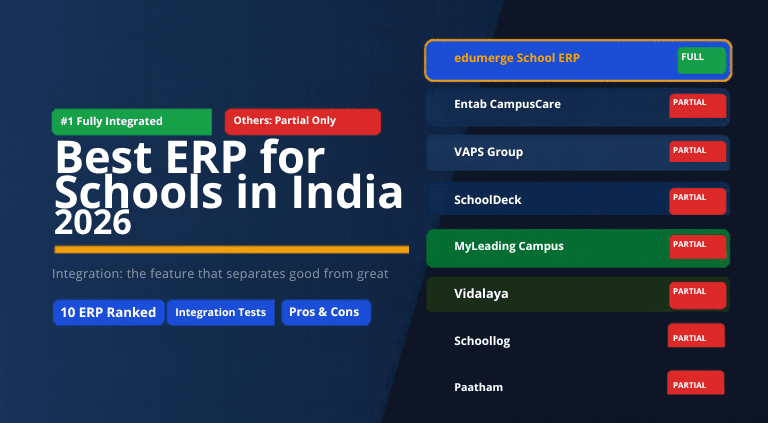
This guide ranks the top 10 school ERPs in India in 2026 on the criterion that matters most: integration. Not which platform has the longest feature list or which has the lowest per-student price.
TL;DR
edumerge School ERP is the best ERP for schools in India in 2026 for schools that prioritise operational integration.
It is the only platform on this list where every module shares a single database by architecture: attendance, fee management, academics, transport, HR, communication, and library all update each other automatically when a relevant action is taken, with no manual steps between modules.
Other capable platforms, including Entab CampusCare, VAPS Group, and SchoolDeck, offer strong individual modules but vary in the depth to which those modules share data natively.
Who Needs This Guide: Is Your School Ready to Evaluate a Full ERP?
Not every school needs the same ERP at the same stage. This guide is written for schools in the following operational situations:
- You manage operations across 5 or more separate apps or tools. And your administrative staff spend time every day moving the same information between systems.
- Parents regularly contact the school to ask about fee status, attendance, or upcoming exams. Because they do not have a reliable single window to check independently.
- Month-end financial reconciliation takes more than 2 working days. Because fee collections, cash receipts, and online payments are tracked in different systems.
- Your school has grown to 800+ students. And the operational workflows that worked at 300 students are now creating bottlenecks, errors, and staff burnout.
- Transport, library & hostel operations are managed on paper or separate tools that do not communicate with the student record or parent notification systems.
- You are evaluating ERP for the first time and want to choose a platform you will not need to replace within 3-5 years as the school grows.
If none of the above apply, a simpler administrative tool may serve your school adequately at this stage. If one or more apply, the integration depth of any ERP you evaluate should be your first question, not your last.
The Real Cost of a Fragmented School ERP: What Schools Lose Every Day
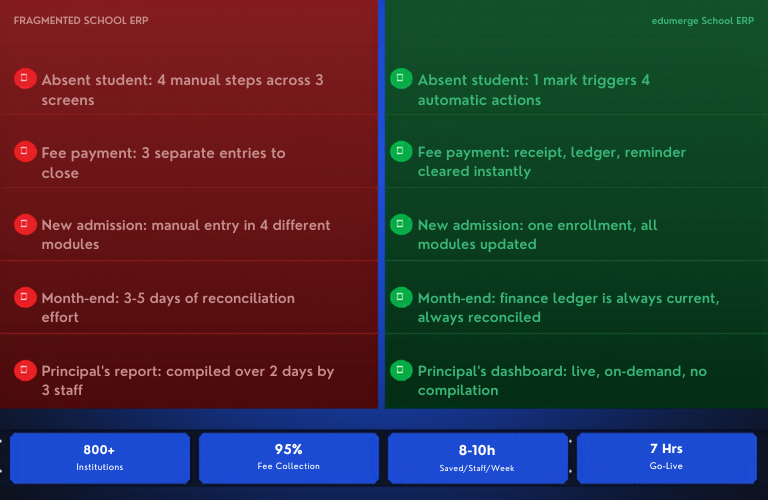
When a school ERP's modules do not share data natively, the gap is not just inconvenient. It is measurable. The infographic above maps the specific operational cost of fragmentation across the 6 core functions of a K-12 school.
| School Operation Area | Without Full Integration |
|---|---|
| Attendance Management | Parent notification sent manually or not at all. Substitution organised over phone or WhatsApp. HR attendance record updated separately at end of day. 3-4 manual steps per absent student per day. |
| Fee Collection and Finance | Payments received across cash, online, and UPI not auto-matched to ledger. The finance team reconciles manually. Defaulter list maintained separately. Month-end close takes 3-5 days of dedicated effort. |
| Admissions to Academics | New students enrolled in the admissions system. Manually transferred to the academic section allocation system. Manually added to the fee schedule. Manually registered in the communication system. 4 separate entries per admission. |
| Transport and Parent Alerts | GPS data and parent notification in a separate app not linked to the student record. Parents receive no alert if the child is absent but their bus seat remains allocated. No operational cross-check between attendance and transport. |
| HR and Payroll | Teacher attendance is tracked separately from the academic timetable. Leave management not connected to substitution. Payroll processed manually against HR records that may not reflect the week's actual attendance. |
| Academic Results and Communication | Exam results processed in the examination module. Report cards generated separately. Parent notification sent manually. No single action that updates the result, generates the card, and notifies the parent simultaneously. |
In most cases, the issue is not the quality of the school's staff. It is that the ERP they are using was built as a collection of features, not as a connected system. The integration gap is a design choice, not a configuration setting.
What Makes a School ERP Truly Integrated: The 3 Architecture Tests
Before reviewing any school ERP, principals & IT heads should understand the three architectural characteristics that determine whether a platform is genuinely integrated or simply feature-rich. These tests can be applied during any ERP demo in under 30 minutes.
Test 1: Single Database or Module Sync
A truly integrated school ERP stores all data in one database. Every module reads from and writes to the same data store. A student record created at admission is the same record accessed by the fee module, the attendance module, the academic module, and the communication module.
A bundled ERP maintains separate databases for different modules & synchronises them periodically. This means actions in one module do not immediately reflect in another. As a result, reconciliation errors accumulate over time, and data inconsistencies surface during audits or reporting.
| ERP Capability | What It Does | Outcome for Your School |
|---|---|---|
| Single shared database | One record per student, accessible to every module with no sync delay | Fee, attendance, and academic data are always consistent. No reconciliation errors between modules. |
| Automatic cross-module updates | An action in one module updates all dependent modules simultaneously | Marking absence updates parent alert, HR record, and substitution flag. One action, three outcomes. |
| No data duplication | No re-entry of student or staff data across any module transition | Zero manual data transfer between admissions, academics, fee, and communication. |
Outcome: Schools on a single-database ERP eliminate the class of errors that comes from modules operating on different versions of the same information.
Test 2: Automatic Workflow Propagation
Integration means that a single action in one module triggers its downstream consequences across the platform automatically. A fee payment should trigger the receipt, clear the defaulter list, and post to the finance ledger without three separate staff actions. A teacher marking absent should trigger parent notification, substitution management, and HR record update without three separate staff actions.
Ask the vendor to demonstrate a complete workflow from end to end during the demo. If the demo requires switching between multiple screens or requires the evaluator to assume that a downstream step 'happens in the background,' treat that as a signal to probe further.
| ERP Capability | What It Does | Outcome for Your School |
|---|---|---|
| Workflow trigger architecture | One action propagates through connected modules in real time | Staff time per workflow step reduced from 3-5 actions to 1. Eliminates errors in downstream steps. |
| Configurable automation rules | Platform administrators define propagation rules without IT help | Schools control what triggers what. No vendor dependency for basic workflow changes. |
| Audit trail across modules | Every automated action is logged with user, timestamp, and source | Complete, cross-module audit trail for fee disputes, attendance queries, and regulatory reviews. |
Outcome: Schools with automatic workflow propagation reduce their administrative overhead by 8-10 hours per staff member per week compared to schools using modules that require manual handoffs.
Test 3: Unified Reporting Without Manual Compilation
The third test of integration is whether leadership reports can be generated on demand, drawing from a single live data source. Without anyone compiling data from multiple systems first.
A principal who needs to know the fee collection status for the current week, the attendance rate for a specific section, and the academic performance trend for a year group, should be able to see all three on one dashboard. In real time, without asking three different departments to pull three different reports.
| ERP Capability | What It Does | Outcome for Your School |
|---|---|---|
| Live operational dashboard | Attendance, fee, academic, and transport data visible in real time | Principals make operational decisions on current data, not yesterday's compiled report. |
| Cross-module report builder | Custom reports draw from any combination of modules simultaneously | No manual cross-system data compilation. Any report, any combination, on demand. |
| AI-driven performance insights | Platform surfaces anomalies and trends proactively without queries | Fee recovery risk, attendance trend alerts, and academic performance flags delivered automatically. |
Outcome: Schools with unified reporting eliminate the cycle of monthly report compilation and replace it with continuous operational visibility for school leadership.
Key Insight: A school ERP with 30 modules but fragmented data flows does not give a school more capability. It gives the school more places to enter the same information manually. The number of modules matters far less than whether those modules share data by design.
Explore in-depth on what is edumerge School ERP.
At a Glance: Top 10 School ERP Platforms in India 2026
| # | Platform | Best For | All-Ops Integrated | CBSE/ICSE/IB | Rating |
|---|---|---|---|---|---|
| 1 | edumerge School ERP | K-12, all sizes, all ops integrated | Yes | Yes | ★★★★★ |
| 2 | Entab CampusCare | Premium schools, top school chains | Partial | Yes | ★★★★☆ |
| 3 | VAPS Group (i-Vidyalaya) | Hardware + software, all boards | Partial | Yes | ★★★★☆ |
| 4 | SchoolDeck | WhatsApp-first, CBSE/State Board | Partial | Yes | ★★★☆☆ |
| 5 | MyLeading Campus | Affordable, Tier 2/3 India | Partial | Yes | ★★★☆☆ |
| 6 | Vidyalaya | Finance-first, cloud-based | Partial | Yes | ★★★☆☆ |
| 7 | Schoollog | NEP-aligned, modern UI | Partial | Yes | ★★★☆☆ |
| 8 | Paatham | Admin + e-learning combo | Partial | Yes | ★★★☆☆ |
| 9 | Edsys | Entry-level, basic digitisation | No | Yes | ★★☆☆☆ |
| 10 | ORATARO | Communication-first, parent engagement | No | Partial | ★★☆☆☆ |
#1: edumerge School ERP : Editors' Choice - Fully Integrated
Best for: K-12 schools of all sizes seeking one fully integrated platform across every school operation
edumerge School ERP is the only platform on this list where the word 'integrated' means every module shares the same database and no action in the platform requires manually updating a second system. Marking a student absent triggers a parent notification and records an entry in the attendance register simultaneously. Collecting a fee posts to the finance ledger, generates a receipt, and clears the defaulter reminder, all from one action.
Trusted by 800-plus schools across India since 2013, edumerge covers the complete K-12 school lifecycle: admissions through alumni, academics through examinations, transport through GPS alerts, and staff management through payroll. Every module is purpose-built for K-12 schools and connected by architecture, not by API stitching.
Fully Integrated Capabilities
- Admissions, academics, fee collection, attendance, transport, parent communication, library, hostel, and staff management all on one data layer. An action in one module automatically updates every connected module with no manual entry.
- Attendance → Parent notification + substitution management + HR attendance record. One mark. Three outcomes. No data entry in any secondary system.
- AI-powered timetable generation resolves conflicts across all sections simultaneously. Substitution management is triggered automatically when a teacher marks leave, and parents are notified of class changes in real time.
- Fee payment → Finance ledger posting + receipt generation + defaulter list update. Zero manual reconciliation. All three happen in the same platform at the moment of payment.
- 95% on-time fee collection rate driven by automated multi-channel reminders (WhatsApp, SMS, email, app). Fee collection integrates directly with the finance ledger; there is no separate reconciliation step.
- Academic result → Report card generation + parent notification + performance dashboard update. All auto-generated from the same mark entry.
Integration Advantage: edumerge School ERP has no integration gap. The platform was built with a unified data architecture from day one. Every module that matters for a K-12 school is present and connected.
#2: Entab CampusCare
Best for: Premium private schools and top school chains with enterprise-grade module needs
Entab's CampusCare is one of India's most recognised school ERP solutions, with a long presence in the premium school segment and adoption by several well-known school chains across the country. The platform covers a broad set of administrative and academic modules, has strong NEP 2020 alignment, and is backed by cloud-based access with role-based security.
For school leaders evaluating integration depth, CampusCare is a capable platform with wide module coverage. The question for each school is whether the modules share data natively or whether transitions between functions, such as from attendance to fee deductions or from admissions to academic section allocation, require manual steps or separate configurations.
What It Does Well vs. Where Integration Falls Short
Strengths: Long-standing presence in India's premium school segment with enterprise-grade security, NEP-aligned reporting, and a proven implementation track record with top school chains. Broad module coverage spanning admissions, student information, attendance, transport with GPS, fee management, examinations, and communication. Cloud-based with browser access for management, teachers, parents, and students. Mobile apps available across stakeholder groups with GPS-based bus tracking and online fee payment.
Weaknesses: Integration depth between modules varies. Data flow from attendance to HR records and from admissions to academic allocation may require manual configuration steps rather than automatic cross-module updates. Advanced analytics and real-time consolidated dashboards are not the platform's strongest feature. Principals and trustees looking for live school-health dashboards may find reporting less proactive. Implementation timelines for larger customisations tend to be longer, and the premium positioning means pricing may be above the range of mid-sized and growing schools.
Integration Gap: CampusCare is a strong feature-rich platform. Where schools should probe during evaluation: ask the vendor to demonstrate, live, what happens when a student is marked absent. Does the parent receive an alert, does the substitution get triggered, and does the HR attendance record update, all from that single action, without any manual step in any secondary screen?
#3: VAPS Group (i-Vidyalaya)
Best for: Schools seeking a combined software and hardware solution with two decades of India market experience
VAPS Group is one of India's most established education technology companies, with 20-plus years in the sector and more than 6,000 implementations covering millions of students. Their i-Vidyalaya ERP platform covers K-12 through postgraduate institutions across CBSE, ICSE, state board, and international affiliations, with a particular strength in hardware integration: biometrics, RFID, GPS, and CCTV from a single vendor.
For schools that want a combined software and hardware supply relationship, VAPS is a natural shortlist candidate. For schools whose primary evaluation criterion is deep software integration across academic, financial, and operational modules, the platform's multi-decade architecture deserves closer examination during the demo phase.
What It Does Well vs. Where Integration Falls Short
Strengths: 20-plus years of Indian education ERP experience with 6,000-plus implementations; one of the largest domestic education technology footprints and a proven track record of long-term institutional relationships. Full hardware integration capability including biometrics, RFID smart cards, GPS transport tracking, and CCTV; suitable for schools wanting a single vendor for both digital operations and physical campus infrastructure. Broad module coverage across K-12 through postgraduate, all major Indian boards; NEP-aligned academic tools with strong familiarity among school administrators who have used the platform for years.
Weaknesses: Platform architecture reflects its multi-decade development history. Data flows between academic, financial, and operational modules are not always native; some transitions between functions require separate data entry or configuration steps. User interface and mobile experience have evolved but reflect a legacy-forward design approach. Schools with staff expecting modern, consumer-grade interfaces may face adoption resistance. Reporting and analytics layer is functional but not proactive. Real-time, AI-driven insights for fee recovery risk, attendance trend analysis, and performance forecasting are limited compared to newer platforms.
Integration Gap: VAPS delivers breadth. The integration question to ask during evaluation: does the system have a single data layer, or is it a collection of modules that communicate through database synchronisation? For schools where cross-module workflows, such as fee defaulter flagging from attendance records, are daily operational requirements, verify this live before committing.
You might also find helpful a comparison of edumerge vs generic school ERPs.
#4: SchoolDeck
Best for: CBSE and State Board schools seeking a modern, WhatsApp-first communication-led ERP
SchoolDeck is a modern cloud-based school ERP built specifically for Indian schools, with a strong focus on parent communication through WhatsApp integration, online fee collection via UPI payment links, and digital administration for CBSE and State Board institutions. It has been adopted by over 500 schools and is known for its ease of use and fast onboarding.
SchoolDeck's strength is in the communication and fee collection layer, where its WhatsApp-native approach reduces parent friction significantly. Schools evaluating it as a complete operational ERP, including HR, library, transport, and academic management, should assess whether the integration between these functional areas meets their requirements.
What It Does Well vs. Where Integration Falls Short
Strengths: Modern, intuitive interface with WhatsApp-native parent communication; UPI payment links sent directly on WhatsApp reduce fee payment friction and improve collection rates significantly. Fast onboarding and ease of use makes adoption across administrative staff straightforward; short learning curve reduces implementation risk for schools moving from paper-based processes. Board-specific report card templates for CBSE, ICSE, and State Board schools; strong exam and result management workflows tailored to Indian academic board requirements.
Weaknesses: Stronger on communication and fee collection than on full academic management depth; timetable generation, lesson planning, substitution management, and workload analytics are less developed. HR, payroll, and staff management are limited compared to purpose-built HRMS platforms; schools with 100-plus staff may find staff management capabilities insufficient for their requirements. Integration depth between operational modules (HR attendance feeding fee deductions, admissions triggering academic allocation) is not the platform's primary design focus.
Integration Gap: SchoolDeck is excellent at what it prioritises: digital communication and fee collection. Schools that need those functions specifically, and are willing to manage academic, HR, and operational functions separately or with supplementary tools, will find it effective. Schools seeking full operational integration in one platform should evaluate further.
#5: MyLeading Campus
Best for: Affordable, India-specific school and college ERP for budget-conscious institutions
MyLeading Campus is a Government of India recognised EdTech startup with broad module coverage for both schools and colleges across India. It is known for affordable per-student pricing, multilingual support, and compliance with Indian regulatory frameworks, making it accessible to schools in Tier 2 and Tier 3 cities that are beginning their digital transformation journey.
For schools evaluating MyLeading Campus as a full-operations ERP, the platform's breadth should be assessed against integration depth. Module coverage is broad, but the question is whether fee data, attendance, academic records, and parent communication update each other automatically or whether each function operates as a relatively independent workflow.
What It Does Well vs. Where Integration Falls Short
Strengths: Government of India recognised platform with affordable per-student pricing and a strong presence in Tier 2 and Tier 3 Indian cities; accessible to schools with constrained technology budgets. Broad module set covering admissions, attendance, fees, examinations, communication, HR, and library; good coverage for schools seeking to consolidate from multiple disconnected tools. Multilingual support and multi-board compatibility across CBSE, ICSE, state universities, and international curricula; relevant for diverse school environments across India.
Weaknesses: Integration depth between modules varies; data flows from one operational area to another may require manual steps or separate configurations rather than automatic cross-module updates. Advanced reporting, AI-driven insights, and predictive analytics are not the platform's primary strength; leadership dashboards for principals and trustees tend toward standard MIS reports rather than live operational intelligence. Customer support responsiveness at scale has been noted as variable in the institution community; schools should verify SLA commitments and post-go-live support quality during evaluation.
Integration Gap: MyLeading Campus offers strong affordability and breadth. For schools whose primary need is cost-effective digitisation of core administrative processes, it is a credible option. For schools requiring deep cross-module integration, such as attendance automatically triggering leave deductions from staff salary and parent alerts simultaneously, deeper evaluation of specific data flows is warranted.
Related comparison: edumerge vs generic college ERPs.
#6: Vidyalaya School Software
Best for: Schools seeking affordable cloud-based ERP with a strong finance and accounting focus
Vidyalaya is a cloud-based school ERP with over two decades in the Indian market, known particularly for its accounting and finance management capabilities. The platform covers student fee management, ledger management, and financial reporting in depth, alongside standard academic and administrative workflows for CBSE, ICSE, and State Board schools.
Vidyalaya's accounting depth is its strongest differentiator. Schools where the finance team's daily operations are the primary driver for ERP adoption will find Vidyalaya's ledger management, receipt generation, and financial reporting comprehensive. Schools seeking deep integration between finance and academic or operational data should evaluate those specific workflows in a demo.
What It Does Well vs. Where Integration Falls Short
Strengths: Depth in school accounting and financial management; ledger management, voucher entry, trial balance, and bank reconciliation are handled comprehensively for school finance teams. Long market presence of 20-plus years with a stable product and established customer base; institutional continuity is a strong consideration for schools that prioritise vendor stability. Affordable pricing structure accessible to mid-sized and growing schools; solid coverage of core administrative workflows including attendance, examinations, and student information.
Weaknesses: Modern UI and mobile experience have not kept pace with newer cloud-native school ERPs; user adoption among younger administrative staff and parents may require change management effort. Communication module and parent engagement tools are less developed than platforms that have prioritised WhatsApp integration, AI chatbots, and app-based parent portals as primary features. Integration between the financial module and operational modules such as attendance, transport, and HR is functional but may not provide the automatic, real-time cross-module data flows that a fully unified platform delivers.
Integration Gap: Vidyalaya does school finance well. For schools where the primary pain point is fee management, ledger reconciliation, and financial reporting, it addresses those needs reliably. Where Vidyalaya should be evaluated carefully: whether marking a student absent automatically flows through to fee adjustments, parent notification, and staff substitution without any manual step in a secondary screen.
#7: Schoollog
Best for: Schools seeking a modern, NEP-aligned ERP with a strong academic-first focus
Schoollog is a cloud-based school ERP that has gained recognition in recent India ERP rankings for its comprehensive module set, modern interface, and NEP 2020 alignment. The platform covers admissions, attendance, fee management, examinations, and parent communication with a focus on ease of use and fast customer support.
Schoollog's design prioritises academic management and administrative digitisation for Indian schools of all boards. Schools evaluating it for full operations integration should assess how deeply the academic, financial, and operational modules are connected at the data layer versus configured to work alongside each other.
What It Does Well vs. Where Integration Falls Short
Strengths: Strong NEP 2020 alignment with holistic progress cards, skill-based grading, and extracurricular activity tracking built into the academic module; relevant for schools aligning to national education policy. Modern, clean interface with positive user adoption feedback; fast customer support rated highly in user reviews for responsiveness to school-specific queries during onboarding and operation. Comprehensive module coverage across admissions, attendance, exams, fee management, and communication; well-suited for schools seeking to move from paper-based administration to a single digital platform.
Weaknesses: Transport management with GPS, hostel management, and HR and payroll depth are less developed compared to platforms where these functions are core rather than supplementary modules. Real-time predictive analytics and AI-driven insights for fee recovery, attendance forecasting, and academic performance trending are not prominently available in the current product build. Data integration depth between modules, specifically whether operational actions in one module automatically update connected modules without manual steps, should be verified in a live demo before commitment.
Integration Gap: Schoollog is a strong, modern school ERP for institutions prioritising academic management and NEP compliance. For schools that need full operational integration, including transport data informing the operations dashboard, fee data flowing to the finance ledger in real time, and HR attendance linking to payroll, asking these integration-specific questions during evaluation is essential.
You might also like to read about the silent chaos in schools & student management systems.
#8: Paatham
Best for: Schools seeking a combined school administration and digital learning platform
Paatham positions itself as a one-stop solution for schools that want both administrative ERP and digital learning capabilities in the same platform. It covers attendance, fee management, transport, hostel, library, HR, and payroll for the administrative side, alongside online assessments, study material distribution, and personalised learning content for the academic side.
Paatham's combination of administrative management and e-learning tools is its primary differentiator. Schools that want to avoid maintaining a separate LMS alongside their ERP will find the combined approach appealing. The depth of each function relative to dedicated platforms is the key evaluation question.
What It Does Well vs. Where Integration Falls Short
Strengths: Combined school ERP and e-learning in one platform; schools avoid the overhead of maintaining a separate learning management system alongside their administrative ERP. Good operational breadth covering attendance, fee, transport, hostel, library, HR, and payroll in a single administrative system with academic tools alongside. Online assessment and study material distribution built in; relevant for schools that want to extend digital capabilities into the classroom without adding a separate technology stack.
Weaknesses: Administrative ERP depth in areas like transport GPS integration, AI timetable generation, and advanced finance management may be less developed than platforms where these functions are the primary design focus. Integration depth between the administrative and learning modules, and between individual administrative modules themselves, should be evaluated specifically during a demo to confirm automatic data flows. Support infrastructure and post-go-live availability are not as well-documented or widely verified as longer-established platforms in the Indian school ERP market.
Integration Gap: Paatham's combined approach is genuinely useful for schools that need both administration and learning tools. The integration question here is twofold: how well the administrative modules talk to each other, and how well the learning data connects back to the student academic record and parent communication layer.
#9: Edsys
Best for: Schools seeking an affordable entry-level school ERP for basic administrative digitisation
Edsys is a school management ERP with a presence across India, particularly in Tier 2 and Tier 3 markets. It covers the core administrative functions that schools need to move off paper: admissions, attendance, fee collection, examination management, and basic parent communication with a low barrier to entry.
For schools at an early stage of digital transformation, Edsys provides the foundational capabilities to begin. For schools that have already digitised core functions and are now evaluating an ERP specifically for cross-module integration depth, Edsys's more limited feature set and integration architecture may not meet advanced requirements.
What It Does Well vs. Where Integration Falls Short
Strengths: Affordable, accessible entry-level school ERP with a low cost of ownership; suitable for schools beginning their digital transformation journey from paper-based administration. Core administrative module coverage for attendance, fee collection, examination management, and basic communication; addresses the foundational daily operations of a school. Simple, straightforward interface that minimises training overhead for school administrative staff with limited technology exposure.
Weaknesses: Limited depth in advanced modules such as AI timetable generation, GPS transport management, competitive exam intelligence, and predictive performance analytics. Cross-module integration is limited; functions such as attendance feeding parent communication and fee management updating the finance ledger in real time may not operate natively without manual steps. Not designed for groups of institutions, multi-campus management, or schools with 1,000-plus students where operational complexity requires deeper ERP capabilities and cross-system data flows.
Integration Gap: Edsys is a starting point, not a destination. Schools in early digitalisation will find it functional. Schools that have grown beyond basic digitisation and need modules that talk to each other automatically, from attendance to finance to communication to HR, will need a more capable platform before long.
If you’re a school principal, this guide on digitizing school operations can be your north star.
#10: ORATARO
Best for: Schools seeking a communication-first digital platform for parent and student engagement
ORATARO is described as a smart education and communication platform that brings students, parents, and teachers onto a unified digital interface. It emphasises communication, engagement, and real-time updates as its core value proposition, with administrative functions built around the communication layer.
For schools whose primary pain point is parent engagement and teacher-parent communication, ORATARO addresses those needs specifically. Schools evaluating ORATARO as a complete school ERP covering admissions, finance, HR, transport, and academic management should assess the depth and integration of those functions relative to platforms where they are the primary design focus.
What It Does Well vs. Where Integration Falls Short
Strengths: Communication-first platform with strong real-time parent-teacher interaction, notification systems, and digital engagement tools that address a core pain point for modern schools. Clean, mobile-first interface that reduces friction for parents and teachers engaging with the platform; relevant for schools where parent digital adoption is a primary concern. Student and parent engagement features designed for daily interaction rather than just administrative record-keeping; positions the ERP as an active communication platform.
Weaknesses: Administrative ERP depth, specifically in fee management, finance reconciliation, HR and payroll, library, transport, and examination management, is not the platform's primary design focus. Cross-module integration for operational workflows, such as attendance triggering HR records and fee defaults updating the finance ledger, is limited compared to platforms built around a unified operational data model. Schools seeking to manage all operations, from admissions through alumni, within one integrated platform will find ORATARO better suited as a communication complement to an ERP rather than as a standalone operational system.
Integration Gap: ORATARO excels at the communication layer. For schools where the gap between school and parent is the primary problem to solve, it is relevant. For schools that need full operational integration from admissions to alumni on a single data layer, ORATARO works best as a communication layer alongside a more operationally complete ERP rather than as a standalone solution.
How edumerge School ERP Works: Step-by-Step Across Every School Operation
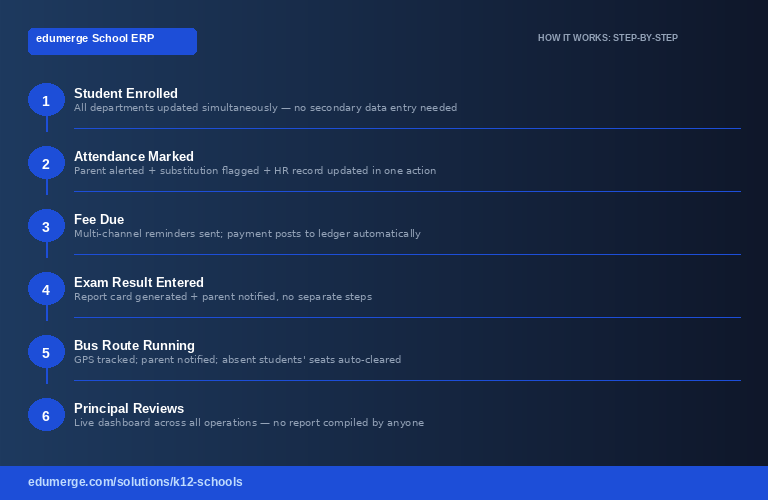
The step-by-step below shows how a single data layer connects every operation in the school. Each step shows what triggers automatically and what administrative staff do not need to do manually.
Step 1: Student Enrolled, Every Department Updated Instantly
A prospective student completes enquiry through the admissions portal. Counsellors manage document collection, eligibility checks, and seat allocation within the ERP. At the moment of enrollment confirmation, the student record is created simultaneously in the student information system, the fee module (with applicable fee structure), the academic section allocation, and the communication module with parent contact registered. There are no secondary data entries, no manual transfers across screens, and no separate registration in any module.
Step 2: Attendance Marked, Four Actions Triggered Automatically
A teacher marks section attendance via the mobile app, the biometric reader, or the RFID scanner. For every student marked absent: the parent receives an SMS, WhatsApp, and in-app alert within 60 seconds; the timetable module checks whether a substitution is required; the HR module logs the teacher's period; the AI engine flags chronic absenteeism if this is a pattern. Four actions. One mark. No additional staff involvement.
Step 3: Fee Due, Multi-Channel Reminder System Activated
As a fee due date approaches, the fee module triggers automated reminders via WhatsApp, SMS, and email at configured intervals. When a parent pays online through the integrated payment gateway, the receipt is generated, the ledger entry is posted to the finance module, the defaulter list is cleared, and the parent receives a payment confirmation, all simultaneously. The finance team performs no manual reconciliation for online payments.
Step 4: Exam Results Published, Report Cards Generated Automatically
Teachers enter marks in the examination module. Result processing applies the configured grading scale and generates report cards in the board-prescribed format automatically. Report cards are made available to parents through the parent portal and app. Communication module sends a notification to each parent when their child's report is ready. No separate report card printing, no manual distribution, no secondary notification step.
Step 5: Transport Route Runs, Parent Notified Automatically
The GPS transport module tracks each school bus in real time. Parents receive automatic notifications when the bus is approaching their stop and when their child boards or alights. If a child who is allocated a bus seat was marked absent that morning, the parent does not receive a pickup notification because the attendance and transport modules share the same student record. The operations head has a live fleet dashboard across all routes simultaneously.
Step 6: Leadership Reviews the Whole School, Live, Without Asking Anyone
The principal opens their dashboard and sees fee collection status for the day, section-wise attendance rates, transport route status, and the week's academic submission completion rate, all from a single screen drawing from a single live data source. No report has been compiled. No department has been asked to pull figures. The data is current because every operational action from Step 1 through Step 5 feeds the same database that the leadership dashboard reads from.
How to Test Integration Before You Sign: A 30-Minute Demo Checklist
Use these 6 tests during any school ERP demo. Ask the vendor's sales team to demonstrate each one live, in the demo environment, without switching to a slide or a recorded video.
| Test | What to Ask the Vendor to Show |
|---|---|
| Absent student to parent alert | Mark a student absent in the attendance module. The parent portal should update and the notification should send within 60 seconds, without any additional action in any other screen. |
| Fee payment to ledger posting | Process a fee payment in the fee module. The finance ledger should show the entry immediately, without navigating to a finance screen and importing or syncing. |
| Admission to fee structure | Enroll a new student in the admissions module. Switch to the fee module. The student should already have a fee schedule assigned. No manual step should be required. |
| Teacher absence to substitution | Mark a teacher absent in the HR/attendance module. The timetable module should flag the periods that need substitution and show available teachers. The trigger should be automatic. |
| Result entry to report card | Enter exam marks for a student in the examination module. Generate the report card. It should be ready without navigating to a separate report card generation tool. |
| Live dashboard without compiling | Ask the principal's dashboard to show today's fee collection, today's attendance rate, and this week's academic submission rate simultaneously. No staff member should compile this data first. |
A platform that requires a separate action, a separate screen, or a separate staff instruction to complete any of the above six scenarios is not fully integrated. That does not necessarily mean it is not the right platform for your school. It does mean the integration gap should be understood, quantified, and factored into the operational cost of using the platform before the contract is signed.
Choosing the Right School ERP: The Only Question That Matters
Every platform on this list has modules. Every platform claims to be comprehensive. The question that separates an ERP that will transform how your school operates from one that will add digital complexity to existing manual processes is not how many modules it has. It is whether those modules share data by design, propagate actions automatically, and give school leadership a live view of operations without anyone compiling a report.
edumerge School ERP ranks first because it is the only platform on this list where the answer to all three integration tests is unambiguously yes, by architecture, not by configuration. The 8-10 hours saved per staff member per week and the 95% on-time fee collection rate that edumerge schools achieve are not marketing claims. They are the direct outcome of not having manual steps between modules.
Book your live demonstration and assess if you have found your platform.
Frequently Asked Questions (FAQs)
1. What makes a school ERP fully integrated?
A fully integrated school ERP stores all data in one shared database. Propagates actions automatically across connected modules without manual steps & provides unified leadership dashboards that draw from live data without compilation.
2. What is the difference between an integrated school ERP and a bundled ERP?
An integrated school ERP shares one database across all modules. An action in attendance updates the parent communication, HR & substitution modules simultaneously. A bundled ERP maintains separate module databases & syncs them periodically. Bundled ERPs create reconciliation delays, data inconsistencies & manual work at every module boundary.
3. What school ERP is used in CBSE schools in India?
CBSE schools in India use a range of school ERPs including edumerge, Entab CampusCare, VAPS Group, SchoolDeck, Schoollog, and MyLeading Campus. Each platform offers CBSE-specific report card formats & board-aligned examination workflows. edumerge shines a class apart by supporting NEP.
4. What is the cost of school ERP in India?
School ERP pricing in India varies from Rs. 25-100 per student per month, to flat annual fees for smaller deployments. Pricing depends on the number of modules, number of students, implementation support included, and whether hardware integration is required. Always request a full cost breakdown including implementation, data migration, training, and annual renewal, not just the per-student rate.
5. Can a school ERP manage groups of schools with multiple campuses?
Yes, but only platforms built with multi-campus architecture can do this natively. edumerge School ERP is part of the edumergeOS platform. Which manages groups of institutions with centralised governance and campus-level autonomy. Other platforms on this list are primarily designed for single-campus operations.