Finding the best ERP for college groups is harder than it looks. Most platforms available in India cover individual college operations reasonably well. Fewer are genuinely built for groups of institutions, where the demands are structurally different.
These include multi-campus consolidation, outcome-based education at scale, continuous accreditation data management across campuses, and governance visibility for directors & trustees who cannot wait for month-end reports.
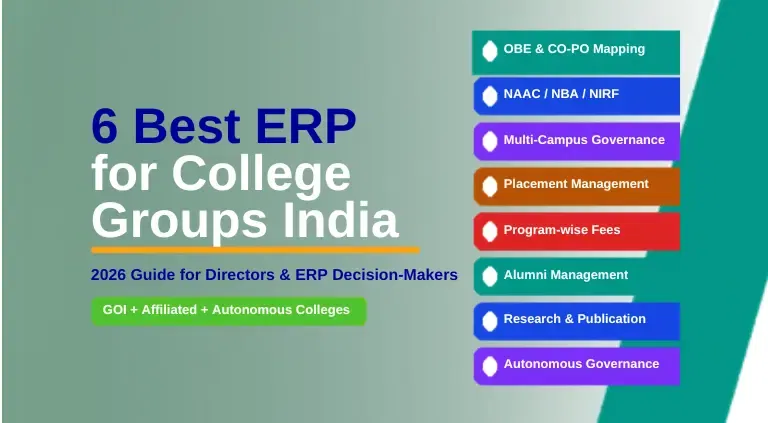
This guide compares 6 ERP platforms evaluated for college groups in India in 2026. Each assessed on OBE capability, NAAC & NBA accreditation support, multi-campus architecture, fee management depth, and group-level governance.
TL;DR
The best ERP for college groups in India is one that handles the full student lifecycle across multiple campuses. While supporting OBE & CO-PO mapping natively, and keeping accreditation data (NAAC, NBA, NIRF) current without manual effort.
And that's not it. It should be able to manage complex fee structures across programs, and give directors & trustees a real-time group-level view. All without stitching together separate tools.
edumerge College ERP is purpose-built for exactly this. A single unified platform for affiliated & autonomous college groups that need governance, accreditation, and operations managed from one codebase.
Why College Groups Need a Different Kind of ERP
A standalone college and a group of colleges have different operational needs. And most ERP platforms are built for the former. The specific challenges that emerge at group scale are not solved by running multiple single-campus ERPs side by side:
- Consolidated accreditation pressure. Each campus in a group faces NAAC, NBA, or NIRF independently. Directors need a group-level view of accreditation readiness across all institutions. Not separate reports from each campus coordinator.
- OBE at multi-department, multi-campus scale. Outcome-based education requires CO-PO mapping, attainment tracking, and evidence collection at the course & program level. For a group managing 10 colleges with 5 programs each, manual OBE management is operationally impossible without a purpose-built system.
- Complex fee structures multiplied across campuses. Program-wise fees, quota billing, scholarship slabs, hostel charges, and installment plans vary by program & campus. A fee engine that works for one campus rarely handles the full matrix of a multi-campus group without breaking.
- Governance visibility without a unified platform. Trustees & directors running a college group cannot wait for campus-level coordinators to compile and send reports. They need live dashboards, not PDF collations.
- Shared HRMS across institutions. Teaching & non-teaching staff often move between campuses within a group. Payroll, leave, and appraisal management must operate across the group, not per campus.
These are structural requirements. They are not solved by adding modules to a school ERP or deploying separate college management tools per campus. The platforms evaluated in this guide are assessed specifically on how well they address these group-level demands.
You might also like to read about the other challenges faced by college administration in India (and how ERP fixes each one).
Quick Comparison Table
| Platform | Best Fit |
|---|---|
| 1. edumerge College ERP | Groups of institutions with 2 to 50+ campuses needing unified OBE, accreditation, fee management, and governance from one platform |
| 2. MasterSoft ERP | Autonomous colleges in India with heavy accreditation requirements and exam-centric workflows |
| 3. Fedena (Higher Education) | Colleges with internal IT teams comfortable with self-hosted or customised deployments, or institutions on a constrained budget |
| 4. CollPoll | Urban colleges prioritising student-facing digital experience: apps, notifications, and engagement tools |
| 5. iCloudEMS | Mid-size colleges seeking cloud-based automation across all departments under one vendor |
| 6. Ellucian Banner Student | Premium autonomous universities or deemed universities with international accreditation ambitions and large IT teams |
6 Best ERP for College Groups in India
1. edumerge College ERP (Top Pick for Indian College Groups)
Type: Purpose-built Indian college ERP for affiliated and autonomous college groups
Best for: Groups of institutions with 2 to 50+ campuses needing unified OBE, accreditation, fee management, and governance from one platform
Key strengths:
- One codebase, one database: all modules share a single data layer, so changes in one department reflect instantly across the institution
- Built-in OBE with CO-PO, PEO & PSO mapping, continuous assessment tracking, and auto-generated attainment reports
- NAAC, NBA, and NIRF accreditation data structures baked into the core, with live SSR data packs and AQAR dashboards
- Multi-campus architecture from day one: campus-level operations with group-level consolidation for directors and trustees
- Program-wise fee structures, government quota billing, scholarship deductions, hostel charges, and instant payment reconciliation
- Placement and alumni management: recruiter portal, interview scheduling, placement analytics, and alumni network
- Research and publication tracking for faculty and departments
- Role-based governance dashboards for principals, registrars, deans, and trustees
- Competitive exam intelligence module for student performance tracking beyond internal assessments
- Named support managers with same-day onboarding and SLA-backed response times
edumerge College ERP is the only platform in this list that combines a unified single-database architecture with native OBE, NAAC/NBA/NIRF accreditation management. Along with multi-campus group governance, placement & alumni management, and optional HRMS & Finance integration under one roof. Groups of institutions that have outgrown standalone college management tools will find every structural requirement addressed without custom development or stitching together separate products.
2. MasterSoft ERP
Type: India-based college ERP with focus on exam, result, and compliance management
Best for: Autonomous colleges in India with heavy accreditation requirements and exam-centric workflows
Key strengths:
- Strong examination and result management modules
- Accreditation and compliance reporting for NAAC and NBA
- Admissions, fee collection, and hostel management
- Multi-campus data sharing for affiliated groups
What to note: OBE and CO-PO mapping are less integrated than purpose-built platforms; limited group-level governance dashboards for multi-campus trusts; placement and alumni modules are add-ons rather than core.
3. Fedena (Higher Education)
Type: Plugin-based ERP with open-source community edition
Best for: Colleges with internal IT teams comfortable with self-hosted or customised deployments, or institutions on a constrained budget
Key strengths:
- 50+ modules covering admissions, attendance, exams, fees, transport, hostel, and library
- Plugin architecture allows adding only the modules needed
- Multi-school management dashboard for basic multi-campus oversight
- Open-source community edition available for cost-sensitive institutions
What to note: OBE and accreditation are not core to the architecture; significant customisation required for NAAC/NBA data structures; UI is dated; initial setup demands substantial IT involvement; multi-campus governance reporting is limited compared to purpose-built group ERPs.
Explore edumerge for affiliated colleges.
4. CollPoll
Type: Modern mobile-first college management platform
Best for: Urban colleges prioritising student-facing digital experience: apps, notifications, and engagement tools
Key strengths:
- Strong mobile experience for students and faculty
- Academic management, exam workflows, and fee collection
- Hostel and document management modules
- Student engagement features: events, activities, and campus life tools
What to note: Group-level multi-campus governance is limited; OBE and accreditation readiness are not core strengths; no integrated placement management at the depth group colleges need; HRMS and institutional finance require separate tools.
Explore edumerge for autonomous colleges.
5. iCloudEMS
Type: Cloud-based college ERP with broad module coverage
Best for: Mid-size colleges seeking cloud-based automation across all departments under one vendor
Key strengths:
- Cloud-based platform with academic, administrative, HR, and LMS modules
- Finance and fee management with payment gateway integration
- Covers the full department automation spectrum
- Suitable for both affiliated and autonomous institutions
What to note: Multi-campus group governance and consolidated trustee reporting are not primary strengths; OBE depth and NAAC data-pack generation require configuration effort; support and onboarding timelines vary by institution size.
6. Ellucian Banner Student
Type: Enterprise higher education ERP used by universities globally
Best for: Premium autonomous universities or deemed universities with international accreditation ambitions and large IT teams
Key strengths:
- Deep financial aid and student finance management
- Strong student lifecycle coverage from recruitment to alumni
- Recognised globally for large university deployments
- Configurable modules for complex academic structures
What to note: Not designed for the Indian affiliated college context; NAAC, NBA, and Indian regulatory compliance require heavy custom development; implementation costs and timelines are prohibitive for most Indian college groups; not suited for sub-50-campus GOIs.
Explore edumerge for universities.
How to Evaluate ERP for College Groups: 8 Criteria
These eight criteria reflect the structural requirements of college groups in India. Run every platform you evaluate through this checklist:
| Criterion | What to Check | Why It Matters |
|---|---|---|
| Unified database architecture | Do all modules share one database or are they separate apps stitched together? | Shared DB eliminates re-entry errors and keeps all reports current in real time |
| OBE and CO-PO mapping | Is OBE built into the core or an add-on? Can it generate CO-PO attainment automatically? | NAAC & NBA mandate outcome-based evidence; manual mapping is unsustainable at scale |
| NAAC / NBA / NIRF readiness | Does the platform maintain accreditation data continuously or require manual compilation before visits? | Accreditation preparation should be a dashboard refresh, not a 6-month project |
| Multi-campus group governance | Can directors and trustees see consolidated data across all campuses in real time? | Group-level visibility is the primary requirement for college groups managing 3 or more institutions |
| Program-wise fee complexity | Can it handle different fee structures per program, quota, scholarship, hostel, and installment combination? | Indian college fee structures are complex; generic fee tools create reconciliation backlogs |
| Placement and alumni management | Does the ERP include a recruiter portal, interview scheduling, and placement analytics as core? | Placement outcomes are a primary NAAC criterion and a trustee-level KPI |
| HRMS integration | Is staff management (payroll, leave, appraisals) part of the same platform or a separate system? | HR silos create approval delays and data inconsistency between academic and admin operations |
| Support model | Named support managers or anonymous ticketing? What is the onboarding SLA? | Education operations cannot afford week-long ticket queues; named managers with context are critical |
Why edumerge College ERP Stands Out for College Groups
edumerge College ERP was designed for one specific challenge: giving affiliated & autonomous colleges in India, especially those operating as groups, a single platform where governance, compliance, and student outcomes are managed together rather than in parallel.
The five structural advantages relevant to college groups:
- One codebase, one database. Every module from admissions to placement shares the same data layer. A fee payment posts to the student ledger instantly. An attendance record feeds the OBE attainment calculation without import. Exam results appear on the director's governance dashboard without a data pull request.
- Accreditation data lives in the platform, not in preparation folders. NAAC criteria data, NBA evidence packets, NIRF parameter dashboards, and AQAR inputs are maintained continuously as the college operates. When an assessment team arrives, the data is already there.
- Multi-campus architecture is not a bolt-on. Groups of 2 or 50 campuses operate on the same platform, with campus-level access for department heads and group-level consolidated visibility for directors, registrars, and trustees.
- Placement and alumni are core, not afterthoughts. The recruiter portal, student placement tracking, offer management, and alumni engagement tools are part of the base product, because placement outcomes are a primary performance indicator for NAAC and a board-level KPI.
- The edumergeOS connection. College groups that also run schools, manage staff across campuses, and need institutional finance management can extend to HRMS and Finance & Control on the same architecture, without integrating separate products.
Explore edumergeOS for group capabilities.
Is your college group running on a platform built for groups, or for standalone campuses?
The gap between a single-campus college management tool and a purpose-built college group ERP is most visible at accreditation time, fee closing, and trustee board meetings.
The best ERP for college groups in India is not the most feature-rich tool in isolation. It is the one whose architecture matches the structural demands of a multi-campus group. Be it unified data, built-in accreditation management, multi-level governance visibility, or a support model that treats institutions as partners.
edumerge College ERP is built for exactly that. For groups from day one.
Frequently Asked Questions
1. What is OBE in a college ERP?
OBE (Outcome-Based Education) in a college ERP refers to the system's ability to map courses to course outcomes (COs), program outcomes (POs), program educational objectives (PEOs), and program-specific outcomes (PSOs). While tracking student attainment against these outcomes, and generating reports for NAAC, NBA, and internal quality assurance cells.
2. How does a college ERP help with NAAC accreditation?
A college ERP with built-in NAAC support maintains accreditation data continuously as part of daily operations. Auto-generating SSR data packs & AQAR inputs, tracking CO-PO attainment, and showing a live accreditation readiness score. This replaces the months of frantic manual data compilation that institutions without an integrated ERP go through before every NAAC visit.
3. Can a college ERP manage both affiliated and autonomous colleges?
Yes. Purpose-built college ERPs like edumerge support both affiliated colleges (which must align to university exam schedules, syllabi & result timelines) and autonomous colleges (which design their own CBCS structures, credit patterns & assessment frameworks). Multi-type institution groups can manage all campuses from one dashboard.
4. What is multi-campus college ERP?
A multi-campus college ERP manages multiple institutions under a single trust or society from one platform. It maintains campus-level operations (attendance, exams, fees, HR) independently. While providing consolidated group-level reporting for directors, chancellors & trustees, without manual data aggregation.
5. What is the difference between a college management system and a college ERP?
A college management system typically handles academic & administrative operations at the module level. A college ERP integrates all departments, including HR, payroll, finance, governance, accreditation & analytics, into one platform with a shared database. Eliminating the data silos and manual reconciliation that come with stitched-together tools.
6. Is cloud-based college ERP better than on-premise for Indian college groups?
For most Indian college groups, cloud-based ERP is the practical choice. It eliminates on-premise server costs, and allows multi-campus access without complex VPN configurations. All while providing automatic updates, and making trustee & director dashboards accessible from any device.
7. What is the role of HRMS in a college ERP?
HRMS in a college ERP manages the full staff lifecycle. Right from vacancy management, recruitment, onboarding, attendance, leave management & payroll with PF/ESI compliance, to performance appraisals & exit processing. When HRMS & academic operations share one database, faculty workload data, timetable assignments, and payroll processing stay automatically in sync.